HelloGrowthCRM software
Built for real small-business sales teams
HelloGrowthCRM helps reps qualify faster, follow up on time, and close more deals—with practical automation in one place.
- AI lead scoring and pipeline visibility
- Built-in dialer, WhatsApp, and email automation
- Sales forecasting and RevOps-ready reporting
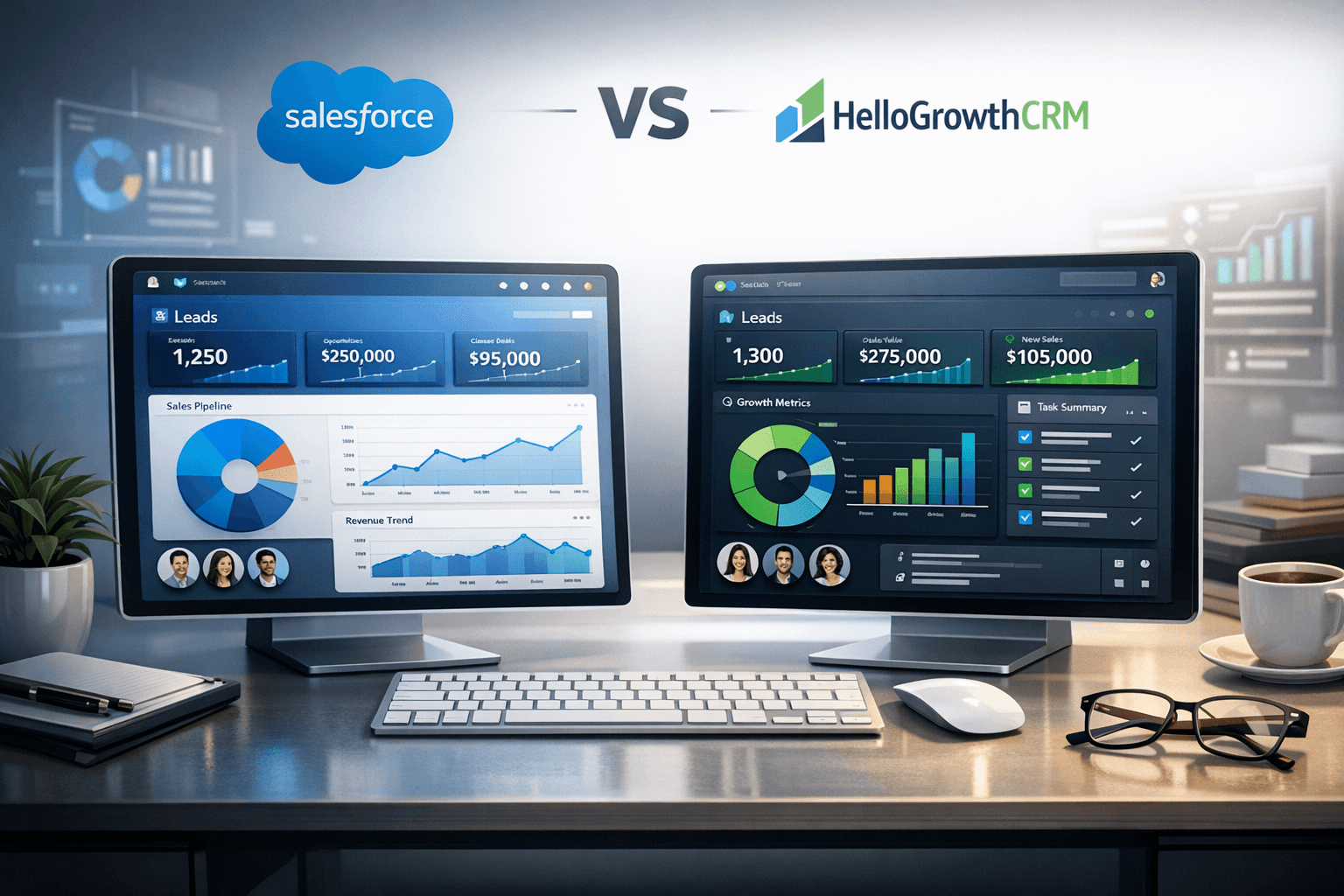
When it comes to managing customer relationships and optimizing revenue operations, a CRM (Customer Relationship Management) platform is essential for businesses of all sizes. In examining your options, you may find yourself weighing two popular choices: Salesforce and HelloGrowthCRM. This article provides a comprehensive comparison of Salesforce vs. HelloGrowthCRM, exploring features, pricing, and unique selling points to help you determine which platform aligns best with your business needs.
Understanding the Basics: What is Salesforce and HelloGrowthCRM?
Salesforce is a cloud-based CRM solution that enables organizations to manage customer interactions, sales, service, and marketing. Its flexibility and extensive integrations make it a popular choice among various industries. With a market presence that spans decades, Salesforce offers a wide range of features and capabilities to help businesses optimize their customer relationship processes.
In contrast, HelloGrowthCRM is designed specifically for small to mid-sized businesses, focusing on efficient revenue operations and their unique challenges. HelloGrowthCRM combines powerful automation tools with user-friendly interfaces to streamline customer management and improve overall sales performance. Specifically, it caters to the need for integrated solutions that drive growth without overwhelming users with complexity.
While both platforms serve the same fundamental purpose—enhancing customer relationships—they take different approaches in terms of usability, pricing, and feature sets.
Key Features Comparison
User Interface and Usability
- Salesforce:
- HelloGrowthCRM:
Automation Capabilities
- Salesforce:
- HelloGrowthCRM:
Sales Forecasting
- Salesforce:
- HelloGrowthCRM:
AI Integration
- Salesforce:
- HelloGrowthCRM:
Customer Support
- Salesforce:
- HelloGrowthCRM:
Pricing Comparison
When comparing Salesforce and HelloGrowthCRM, pricing is an important factor to consider.
- Salesforce:
- HelloGrowthCRM:
Integration Capabilities
A CRM platform is only as good as its ability to integrate with other tools.
- Salesforce:
- HelloGrowthCRM:
Unique Selling Points
While both Salesforce and HelloGrowthCRM offer valuable CRM solutions, they each have unique selling points worth noting.
Salesforce's Selling Points
- Established Credibility: With decades of experience, Salesforce is a trusted brand in the CRM space, used by businesses across various industries.
- Comprehensive Customization: Organizations with sizable teams can create tailored solutions to suit their specific workflows.
HelloGrowthCRM's Selling Points
- Focus on Growth: The platform is centered around helping small to mid-sized businesses streamline processes and achieve sustainable growth.
- Simplified Experience: Features are designed to maximize efficiency and minimize unnecessary complexity, making onboarding quicker and user-friendly.
Which CRM is Right for Your Business?
Choosing between Salesforce and HelloGrowthCRM boils down to your organization's specific requirements, size, and long-term goals. Here are some guiding considerations:
- If you're a larger organization looking for extensive customization options and advanced functionalities, Salesforce may be the solution for you. The robust feature set might justify the investment if your organization can fully utilize its capabilities.
- If you're a small to mid-sized business, HelloGrowthCRM presents a more cost-effective option with a focus on usability and quick implementation. You'll gain access to essential CRM features without the intimidating complexity or high costs associated with Salesforce.
Frequently Asked Questions
1. How do I decide between Salesforce and HelloGrowthCRM?
Start by assessing your business size, complexity, and specific needs. If you require extensive customization and advanced analytics, Salesforce might be suitable. Conversely, for ease of use and rapid onboarding, HelloGrowthCRM is an excellent choice.
2. What is the pricing structure for HelloGrowthCRM?
HelloGrowthCRM offers transparent pricing plans based on features used, along with a Free Trial to help businesses evaluate the platform risk-free.
3. Can I integrate HelloGrowthCRM with other tools?
Yes, HelloGrowthCRM provides seamless Integrations with popular sales and marketing tools, ensuring a fluid workflow between your existing systems.
4. Is HelloGrowthCRM suitable for larger enterprises?
While HelloGrowthCRM is designed primarily for small to mid-sized businesses, it can also scale as your organization grows, making it a versatile option for businesses of various sizes.
5. What support options are available with HelloGrowthCRM?
HelloGrowthCRM focuses on personalized customer support, providing prompt assistance for any queries. Users can rely on a dedicated support team to help them navigate the platform effectively.
Conclusion
In conclusion, when evaluating Salesforce vs. HelloGrowthCRM, understanding the key features, pricing, and unique selling points of each platform is essential. Depending on your organization's needs, either system could enhance your CRM experience. If you're a small to mid-sized business looking for a user-friendly CRM that fosters growth, consider trying HelloGrowthCRM today and see how it can transform your customer relationship management approach.
Implementation Checklist for Salesforce vs. HelloGrowthCRM: Which CRM is Right for Your Business?
Teams researching salesforce vs hellogrowthcrm usually need more than a high-level definition. They need a repeatable process, clear ownership, and a way to connect day-to-day execution back to pipeline quality and revenue outcomes. That is why the most useful version of this topic is practical: it should help a team decide what to standardize, what to automate, and what to measure first.
Start by deciding where salesforce vs hellogrowthcrm fits in the revenue workflow. For some teams it belongs near lead qualification, because better prioritization affects who gets attention first. For others it belongs in pipeline management, because the real problem is inconsistent stage movement, poor follow-up discipline, or weak forecast confidence. The exact placement matters because it determines which records, fields, and manager reviews should change after the process is introduced.
Step-by-step rollout model
- Define the business outcome the team wants from salesforce vs hellogrowthcrm. That could be faster speed-to-lead, better conversion from demo to opportunity, cleaner qualification, or fewer stalled deals.
- Identify which team owns the process day to day. A workflow with no owner usually becomes a dashboard topic instead of an execution habit.
- Decide which fields or signals are required. Keep the list narrow enough that reps can maintain it without turning the CRM into admin overhead.
- Add automations only after the workflow is clear. Good automation reduces repetitive work, but bad automation hides process problems and makes reporting less trustworthy.
- Review performance weekly. Teams improve faster when they inspect real records, not just summary charts.
What strong teams usually standardize
- A clear definition of when a lead, account, or deal qualifies for the next step
- Required fields that support follow-up, segmentation, and reporting
- Ownership rules for handoffs, reminders, and stage progression
- Manager review checkpoints for aging, conversion, and execution quality
- An escalation path for records that are blocked, stale, or missing context
Metrics to watch after rollout
When a team implements salesforce vs hellogrowthcrm well, performance should change in ways that are visible. Look at conversion rate between stages, response time, meeting creation, pipeline age, follow-up completion, and forecast confidence. If those numbers do not move after implementation, the process may be too theoretical, too hard to use, or not connected tightly enough to how reps actually work inside the CRM.
It is also useful to separate activity metrics from quality metrics. A team can appear busy while still failing to improve outcomes. Measuring both helps leadership understand whether salesforce vs hellogrowthcrm is increasing output only, or improving the quality of decisions and follow-through as well.
How HelloGrowthCRM supports this workflow
HelloGrowthCRM is most effective when the team uses it as an operating system rather than a contact database. The platform helps centralize lead records, activity history, communication, automation triggers, reporting, and follow-up actions in one place. That matters for salesforce vs hellogrowthcrm because it reduces the gap between strategy and execution. Reps can see the context, managers can inspect progress, and leaders can connect the process back to revenue performance.
For example, a team may start with a simple scoring or qualification framework, then connect it to follow-up tasks, reporting views, internal alerts, and manager dashboards. Another team may apply the same principle to messaging, meeting scheduling, outbound sequencing, or account prioritization. In each case, the system works best when the workflow is inspectable and the next step is obvious.
Common mistakes that reduce content quality and execution quality
One common mistake is treating salesforce vs hellogrowthcrm as a one-time setup instead of an ongoing operating discipline. Teams launch the framework, create a dashboard, and assume the problem is solved. In reality, the process needs feedback loops. Inputs drift, rep behavior changes, and the market evolves. Without review, even a good workflow loses accuracy.
Another mistake is overcomplicating the first version. Teams sometimes try to capture too many fields, too many exceptions, or too many automations before the basic operating model is stable. That creates resistance and lowers adoption. A better approach is to launch the smallest version that still produces measurable decisions, then add sophistication after the team trusts the workflow.
Practical FAQ extension
How long should a team give this process before judging results?
Most teams need a few weeks of consistent use before they can evaluate whether salesforce vs hellogrowthcrm is improving execution. The exact timing depends on deal cycle length and lead volume, but a workflow should usually be reviewed across multiple reporting intervals before large conclusions are drawn.
Does salesforce vs hellogrowthcrm matter only for large sales teams?
No. Smaller teams often benefit even more because a clear workflow prevents follow-up gaps and makes performance easier to inspect without adding management layers. The key is to keep the process proportional to team size.
What is the best first improvement to make?
Usually the best first improvement is clarity. Define the next step, the owner, and the required information. Once those are stable, automation and reporting become much more valuable.
Final execution notes for Salesforce vs. HelloGrowthCRM: Which CRM is Right for Your Business?
salesforce vs hellogrowthcrm becomes commercially valuable when it helps a team move faster with more confidence, not when it just adds vocabulary. The teams that get the best results usually connect workflow design, data hygiene, automation, and manager inspection into one rhythm. That is the lens readers should use when evaluating any approach connected to HelloGrowthCRM.
Frequently Asked Questions
Ready to put this into practice?
Set up your pipeline, WhatsApp follow-ups, and AI lead scoring in minutes — free, no credit card.
Try HelloGrowthCRM freeGet CRM tips in your inbox
Join thousands of sales professionals who get weekly insights on CRM strategy, AI automation, and pipeline optimization.

The HelloGrowthCRM team publishes guides on CRM strategy, AI sales tools, and revenue operations for small business sales teams.