Most small-business CRM comparisons start with feature checklists. That is the wrong place to start, because at the entry tier almost every serious CRM has pipelines, contacts, tasks, and email sync. The differences that actually cost you money show up later: what happens to the bill when you grow from 5 seats to 25, which capabilities are locked behind a tier you did not budget for, and how many extra subscriptions you need to bolt on before the CRM does what the sales pitch implied. The honest way to choose is to price the platform at the team size you expect to be in eighteen months, with the features you will actually use — calling, messaging, automation, AI scoring — switched on.
Five criteria separate the six platforms below. First, total cost at realistic seat counts — headline entry prices ($14 to $25 per user per month for most of this list) tell you very little, because the tier most teams actually land on is two or three steps up. Second, communication channels: if your buyers live on WhatsApp or you run an outbound calling motion, a CRM without a native dialer and native WhatsApp means adding Twilio-style integrations and separate subscriptions, plus the glue work to keep conversations logged. Third, AI: lead scoring and call summaries are either included, gated to premium tiers, or dependent on months of your own data before they work. Fourth, setup time — anywhere from 15 minutes to 6 months with consultants, and a small team cannot absorb the long end of that range. Fifth, support model: self-serve documentation, partner agencies, or a managed option where specialists run the system for you.
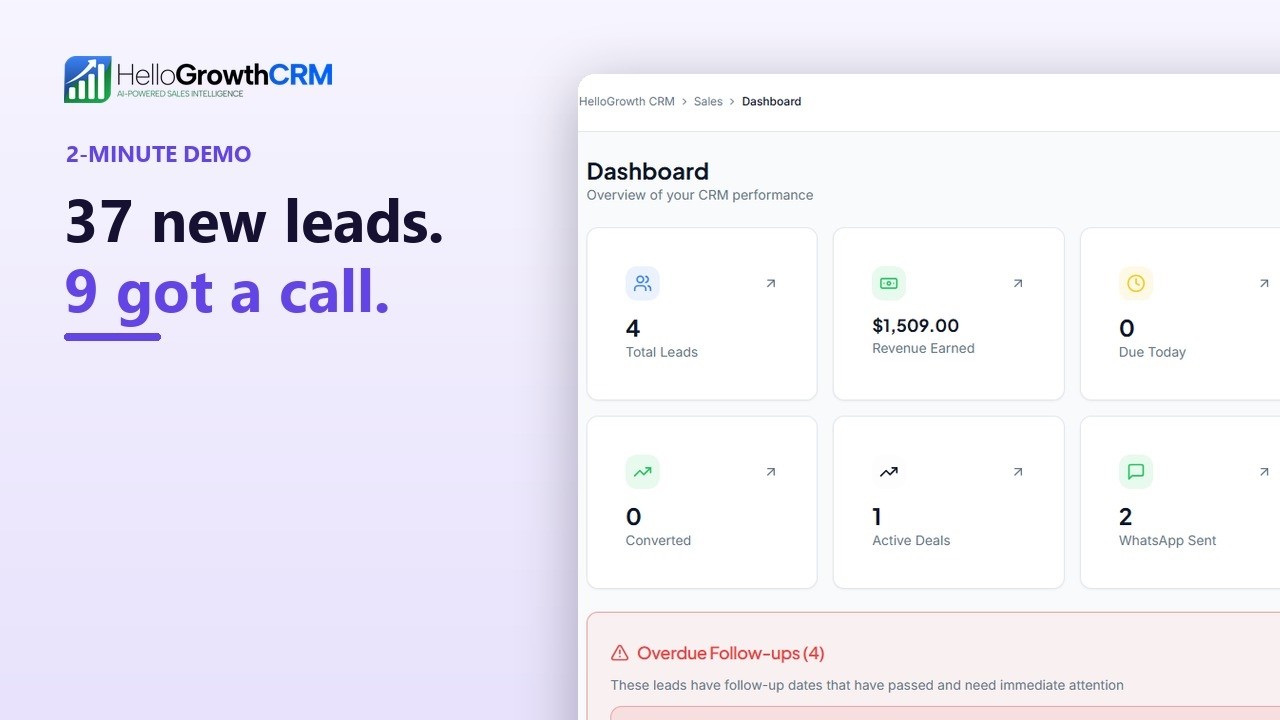
HelloGrowthCRM is the platform this site publishes, so read this paragraph with that in mind — but the packaging argument is straightforward to verify. Professional is $12 per user per month, or $10 on annual billing (₹899 in India), and that single tier includes AI lead scoring, a built-in dialer with call recording and transcription, native WhatsApp and SMS, email sequences, and reporting — the four or five items that competitors sell as add-ons or gate to higher tiers. There is a Free Forever plan to start on, setup takes 15 to 30 minutes rather than weeks, and there are 259+ integrations for the rest of the stack. For teams that want execution help rather than just software, Growth Engine ($1,500 per month flat) and RevOps Partner ($4,000 per month) add specialists who manage the pipeline, run reviews, and enforce follow-up. The honest limitation: it is a sales-first CRM. If you need heavy marketing automation, deep support ticketing, or enterprise-grade metadata customization, one of the platforms below does that part better.
HubSpot has the best free CRM in the category and the strongest marketing-sales integration of the six. Starter is $15 per seat per month as of July 2026, which is a fair on-ramp — the escalation begins when you need sequences, AI scoring, and real reporting, which live in Sales Hub Professional at $90 per user per month, with calling sold as an add-on and Marketing Hub adding $800+ per month for the automation features the Starter pitch implied. A 10-rep team on Sales Hub Professional pays $10,800 per year before Marketing Hub. Choose HubSpot when marketing genuinely drives your revenue: if you run an inbound motion with content, landing pages, nurture flows, and multi-channel attribution, the Marketing-CRM integration is real and no sales-first CRM on this list replicates it. Pay the premium if you will use it; skip it if marketing is a smaller input to your pipeline.
Pipedrive is the cleanest visual pipeline in the market — drag-and-drop stages, simple activity tracking, and an interface reps learn in a day. There is no free plan (14-day trial only), and Lite starts at $14 per user per month on annual billing without a dialer, advanced automation, or forecasting; calling is a paid add-on, WhatsApp and SMS go through integrations like Twilio at $0.03 to $0.10 per message, and stacking add-ons (Caller, LeadBooster, Smart Docs) pushes the real per-seat cost above $50. A 15-person team on Professional at $59 per user per month pays $10,620 per year before integration expenses. Choose Pipedrive when your motion is a straightforward pipeline with email follow-up, you already have (or do not need) calling and messaging tools, and you value a best-in-class lightweight interface over bundled capability. For a simple transactional sales process run by a disciplined team, it is arguably the least cluttered option on this list.
Zoho CRM is the value pick for teams already living in the Zoho ecosystem. The Standard plan is ₹800 per user per month in India, and Zoho One bundles over forty applications — CRM, Books, Desk, Campaigns and more — at $37 per user per month, which is genuinely reasonable if you use the breadth. The catch is that Zia AI and advanced dialer functionality sit in the Enterprise tier at ₹2,400 per user per month, Zia needs months of your historical data before scoring becomes useful, and the modules each carry their own configuration conventions, so setup runs one to two weeks rather than an afternoon. Choose Zoho when you already run Zoho Books or Zoho Desk and want tight single-vendor integration between accounting, support, and sales — that ecosystem link is the one thing a standalone sales CRM cannot offer you, and for many Indian SMBs it is decisive.
Salesforce is the platform everyone measures against, and for good reason: nothing matches its configuration depth or its AppExchange ecosystem of 7,000+ apps. It is also the clearest mismatch for a small business on this list. Starter is $25 per user per month with no free plan and severe limits; the features most teams actually need live in Professional at $165 per user per month or Enterprise at $330, Einstein AI is a separate $50 per user per month, and implementations typically take 3 to 6 months of professional services costing $50,000 to $500,000. A 20-rep team on Professional pays $39,600 per year in licensing alone, before implementation and before the dedicated administrator most instances require. Choose Salesforce when you are genuinely on an enterprise track: complex multi-team processes, regulatory compliance requirements, an in-house admin, or deep AppExchange dependencies. If you expect 500+ users in a few years and can fund the implementation, buying Salesforce early can beat migrating to it later.
Freshsales is the balanced middle option — more capable than a lightweight pipeline tool, far less complex than Salesforce, with a clean interface and fair entry pricing at $19 per user per month for Growth. The tier structure is the friction point: Freddy AI and the full dialer live in Pro at $59 per user per month, Premium runs $99+, and WhatsApp goes through third-party integrations rather than a native Business API connection, which matters in WhatsApp-first markets where unsynced conversations become deal-history gaps. A 10-person team on Pro runs $7,000+ per year. Choose Freshsales when you already use Freshdesk for support — the native ticketing integration is seamless in a way Zapier-glued alternatives are not, and for a business where support and sales share customer context daily, that single-vendor link can outweigh the per-seat premium.