

Skip to content
Agency

Agency CRM That Tracks Every Pitch, Proposal and Retainer

For marketing, creative, digital and branding agencies: one pipeline for new-business pitches, proposal revisions and retainer renewals, with reminders that keep follow-up moving while your team is busy with client work.

Last updated:

Free Forever • No Credit Card Required

Quick answer

What is an agency CRM?

An agency CRM is a customer relationship management system set up around how agencies win and keep clients: several stakeholders per account, proposals that change across revisions, and retainers that renew. HelloGrowthCRM gives marketing, creative and digital agencies one pipeline for all of it, with follow-up reminders, a built-in dialer, WhatsApp and email on the same client record.
  • One pipeline from first enquiry to renewed retainer
  • Proposal versions, call summaries and WhatsApp threads on the same deal
  • Free plan for one user and 150 leads; paid plans $12/user/month, or USD 100/user/year, billed annually

See pricingBook a demo

HelloGrowthCRM

Capture. Follow up. Close.

From Enquiry to Customer in One CRMEvery lead captured, followed up and tracked — so nothing goes cold.The path a lead takes inside HelloGrowthCRM, from first enquiry to a repeat customer.
  1. Step 1

    Capture

    Web forms, WhatsApp, calls and ads land in one inbox

  2. Step 2

    Qualify

    AI lead scoring flags who is ready to talk

  3. Step 3

    Assign

    Routed to the right rep automatically

  4. Step 4

    Follow up

    Reminders, sequences and WhatsApp nudges

  5. Step 5

    Track the deal

    Stages, value and next step in the pipeline

  6. Step 6

    Win & retain

    Renewals and repeat business stay on the radar

Every call, message and email is logged on the contact — the history travels with the lead.

One contact record, one pipeline, one clear next step.

01

What an agency CRM does that a generic sales CRM does not

An agency CRM is a customer relationship management system shaped around how agencies win and keep clients. Agency sales cycles have a structure that most CRMs do not map to well. A typical deal involves several people at the prospect, moves through proposal iterations that can each change its value, and, once won, turns into a retainer that has to be renewed. Tracking this in a CRM designed for one-off transactional deals creates friction, because the stages, fields and reports assume a different kind of sale.

An agency CRM needs to handle five things that a generic sales CRM often treats as edge cases:

  • Several stakeholders per client. A marketing director who briefs you, a procurement contact who negotiates and a finance approver who signs, all on one account.
  • Proposals that change across revisions. The deal value after the third revision is rarely the value in the first draft.
  • Retainers that renew. Closing the deal is the start of the relationship, not the end of the record.
  • Work that arrives through referrals. Many agencies win most of their business through introductions, so the source of each lead matters as much as any ad campaign.
  • Shared client ownership. Account managers and delivery leads both talk to the client, and both need the same history.

HelloGrowthCRM lets agencies set up pipelines that reflect the way they actually sell: discovery, proposal, revision, contract and retainer, each with the fields that matter at that stage. Account records stay active after close, with renewal dates and task ownership visible to both the account manager and the delivery lead, so an at-risk retainer gets a conversation before the client decides not to renew.
02

The agency pipeline, stage by stage: from first enquiry to renewed retainer

Most agency pipelines follow the same seven steps, even when the names differ. Here is what the CRM records at each one, so nothing depends on someone remembering it:

  1. Enquiry or referral. Website form enquiries arrive with their source, campaign and landing page captured automatically. Referrals are logged with who made the introduction, so you can thank them and see which relationships send you work.
  2. Discovery call. Calls go out from the built-in dialer, are logged against the deal, and an AI summary of what was discussed lands on the record once the call ends.
  3. Proposal sent. The proposal is built from your template with the scope and value on the deal, and open tracking tells you when the prospect has read it.
  4. Revision. Each revision updates the deal value, and earlier versions stay on the record, so a scope discussion three weeks later starts from facts.
  5. Signed. The client signs electronically from the deal, and the deal moves to won.
  6. Onboarding and delivery. Tasks and project boards give the delivery team owners and due dates without leaving the client record.
  7. Renewal. Contract and renewal dates on the account feed a renewal pipeline, so the account manager is talking about next year while there is still time to shape it.

Stage names are yours to change. A web development agency might call stage four "scope review", a PR agency might split it into "pitch" and "chemistry meeting". The deals pipeline follows your process, not the other way round.

03

A week in the pipeline: how agencies run HelloGrowthCRM day to day

Monday starts with the pipeline board. The Kanban view shows every open opportunity by stage (discovery, proposal, revision, contract), and deal risk alerts flag the deals that have gone quiet, so the account team knows which prospects need a nudge before the weekly stand-up ends. New enquiries that arrived over the weekend are already ranked by AI lead scoring, which means the first calls of the week go to the prospects most likely to become clients rather than to whoever emailed last.

Through the week, outreach runs on two rails. Follow-up sequences handle the steady nurture: the check-in after a proposal goes out, the nudge two weeks after a discovery call that stalled. They pause as soon as the prospect replies. The built-in dialer handles the conversations that move deals. Calls are logged, and AI call summaries land on the deal record automatically, so a founder reviewing the pipeline on Friday can read what was actually said without chasing the account manager for notes.

For client communication that happens on WhatsApp, which is the default business channel for many agencies in India, the Gulf and Southeast Asia, the native Meta Cloud API integration keeps those threads on the same record as everything else. Friday ends with a two-minute review: which proposals are waiting on the client, which are waiting on us, and which renewals fall inside the next ninety days.

04

Three agency scenarios where the CRM earns its keep

A five-person digital marketing agency that wins most work through referrals uses the pipeline to stop referrals from evaporating. Every introduction is logged with a source, a next step and a follow-up date. When the founder gets pulled into delivery, which is the classic agency trap, the reminders keep new-business conversations alive instead of letting them die in a full inbox.

A branding studio with long proposal cycles tracks each proposal revision as a stage, with the current value on the deal card. When a prospect resurfaces after six weeks of silence, the account lead opens one record and sees every version quoted, every email thread and every call summary, and picks the conversation up in minutes instead of reconstructing it from memory.

A web development agency running retainers keeps a separate renewal pipeline. Each retainer has its end date on the account and a renewal task scheduled ninety days ahead for the account manager. Project boards track delivery alongside, so renewal conversations start from what was shipped, not from a scramble. Pricing stays simple as the team grows: $12 per user per month, or USD $100 per user per year, billed annually, with a free plan for one user and 150 leads to trial the workflow first. See the pricing page, the full feature list, or how HelloGrowthCRM compares with other CRMs agencies evaluate.

05

Agency CRM vs project management tool vs spreadsheet

Most agencies already run a project management tool for delivery and a spreadsheet for new business. The question is not which one to delete, but which job each one should do. Here is how the three compare on the work that happens before and after delivery:

JobSpreadsheetProject management toolHelloGrowthCRM
New-business pipeline with deal valuesManual rows, easy to let driftNot what it is built forCore feature
Reminders on quiet prospectsNoneOnly if someone sets a taskAutomatic reminders and aging alerts
Calls, WhatsApp and email historyNot capturedNot capturedOn the client record automatically
Proposal versions and read trackingSeparate filesAttachments on a taskVersioned, with open tracking
Retainer renewal datesA column someone must checkA task someone must createOn the account, with a renewal pipeline
Delivery tasks and deadlinesPossible but clumsyIts main strengthLightweight task and project boards
Lead source reportingManual taggingNot capturedCaptured automatically on web enquiries

The honest read: if your delivery runs on complex production schedules, keep your project management tool for that and use the CRM for everything before a deal is signed and everything around renewal. If delivery is simpler, HelloGrowthCRM's project boards may be enough on their own, and the handoff from sale to delivery happens inside one system. For a closer look at the spreadsheet question, see CRM vs spreadsheet.

06

How to set up an agency CRM in one afternoon

Basic setup takes 15 to 30 minutes. Getting it to reflect how your agency really sells takes an afternoon. This is the order that works:

  1. Write down your real stages. Start from the seven above and rename them in your own words. If you revise proposals three times per deal, give revision its own stage.
  2. Import your clients and open deals. Bring them in from your existing spreadsheet, with each deal's current stage, value and owner, so the pipeline is useful on day one.
  3. Connect your channels. Link email, sync Google Calendar or Outlook so meetings appear on the deal, and connect WhatsApp if your clients message you there.
  4. Save your proposal as a template. Use the quote builder so every proposal starts from the same structure and pricing.
  5. Set your follow-up rules. Decide how long a proposal can sit unanswered before a reminder fires, and build one email sequence for post-proposal follow-up.
  6. Run one live deal for a week. Have one account manager work a real opportunity entirely inside the CRM before rolling it out. It will tell you more than any feature checklist.
07

Choosing an agency CRM: what to check before you commit

Whichever product you shortlist, test these in a trial rather than a demo:

  • Stages that mirror your process. If you revise proposals three times per deal, the CRM should represent that without workarounds.
  • The all-in cost. Many CRMs price calling, WhatsApp and AI features as add-ons, so a low seat price can double once the tools you actually use are included. HelloGrowthCRM includes the dialer, WhatsApp, email sequences and AI lead scoring on paid plans.
  • Accounts, not just deals. Agencies sell to the same clients again and again, so history has to live on the client, not on a single opportunity.
  • Adoption by non-salespeople. If a delivery lead cannot log a client call in under a minute, it will not get logged.
  • A way out. Check that you can export your data. A CRM you cannot leave is a risk, not a feature.

For the full evaluation framework, including where HelloGrowthCRM is and is not the right fit, read our guide to the best CRM for agencies.

08

Three kinds of agency CRM: standalone, add-on and all-in-one

Agency CRMs come in three shapes, and knowing which one you are shopping for narrows the list quickly:

  • Standalone CRM. A dedicated sales and client-relationship system, used alongside whatever project and finance tools you already run. This is where HelloGrowthCRM sits, with lightweight task boards for handoff.
  • Add-on CRM. A CRM module bolted onto a project management or operations suite. It keeps everything in one login, but the sales side is usually thinner than a dedicated CRM.
  • All-in-one agency platform. Sales, delivery, time tracking and invoicing in a single product. Convenient, but you adopt its way of working for every function at once.

When you compare prices, add up the full cost rather than the seat fee: subscription, any paid add-ons for calling or WhatsApp, the time to set it up and the hours someone spends administering it each month.

09

How to tell whether your agency CRM is paying off

A CRM earns its place when new-business work gets less random. Pick a few numbers before you start, record them for a month in your spreadsheet, then compare once the pipeline has run in the CRM for a quarter:

  • Proposals sent versus proposals signed. The pipeline board shows how many deals reach each stage, so you can see where prospects drop out.
  • Time from enquiry to first reply. Reminders and lead aging alerts exist to shorten this gap.
  • Retainers renewed against retainers due. Renewal dates on the account make this count straightforward.
  • Lead sources that produce signed clients. Source attribution shows which referrals, forms or campaigns bring work that closes, not just enquiries.
10

An agency CRM system for clients with live projects

Searches such as "CRM for agencies with client projects" point at a real gap: a sales CRM stops at the signature, a project tool starts at the kickoff, and the information that matters (what was promised, to whom, for how much) gets retyped in between. These are the records an agency CRM system should keep joined up, and how HelloGrowthCRM handles each:

RecordWhat the agency needs from itIn HelloGrowthCRM
Account (the client company)One home for every stakeholder, past deal and renewal dateAccount record with several contacts and contract and renewal dates
Deal (a pitch or a scope of work)Stage, current value and owner, with earlier proposal versions keptPipeline card with versioned proposals and open tracking
Conversation historyWhat the client said on the call, on WhatsApp and by emailDialer call logs with AI summaries, WhatsApp via Meta's Cloud API and email on the same timeline
Delivery tasksOwners and due dates for the work that follows a signed dealTask and project boards (Kanban, table, calendar) next to the client record
Retainer renewalA reminder well before the end date and a separate list of what is coming upRenewal pipeline fed by dates on the account

The honest boundary: HelloGrowthCRM's boards cover handoff and lightweight delivery tracking. A studio that schedules dozens of people across overlapping production deadlines will still want a dedicated project or resource-planning tool, and the CRM then holds the client, the deal and the renewal. Either way, the client record stays the source of truth for who the client is and what they bought.

11

Web, digital and creative agencies: what changes in the setup

The pipeline shape is the same, and the stage names and the fields on each stage are what you tune. A web agency usually adds a scoping or technical-review stage between discovery and proposal and records the platform, the budget band and the launch date on the deal. A digital marketing agency records the channels in scope and the retainer term. A creative studio records the number of revision rounds included in the quote. Because stage names and fields are configurable, you can start from the seven stages above and rename them after a week of live deals instead of designing the perfect pipeline up front. For discipline-specific starting points see the guides listed at the end of this page, and for a wider look at what to compare, read the best CRM for small business comparison.

12

Agency CRM guides by specialism

The pipeline above fits most agencies, but the details differ by discipline. Marketing agencies juggling retainers and campaign renewals should read the CRM for marketing agencies guide. Studios that build sites can see how teams use a CRM for web design agencies, and search specialists have their own CRM for SEO agencies page. Brand and communications teams can compare notes in CRM for branding agencies and CRM for PR agencies. If most of your client conversations happen in chat, start with WhatsApp CRM for agencies, and if you are a one-person studio, the CRM for freelancers guide covers the free plan in detail.

Challenges we solve

Where agencies lose clients between pitch and renewal, and how HelloGrowthCRM closes each gap

Each card below names one common gap in an agency's sales process and the HelloGrowthCRM capability that closes it.

  • Problem: New-business follow-up stops whenever the team is busy delivering client work, and warm referrals go quiet.

    How HelloGrowthCRM solves it: Every enquiry gets an owner, a next step and a due date. Follow-up reminders and lead aging alerts surface anything overdue, so pitches keep moving through a delivery crunch.

    HelloGrowthCRM capability: Follow-up reminders

  • Problem: Proposal revisions live in email attachments, so nobody can say which version the client saw or what it was worth.

    How HelloGrowthCRM solves it: Proposals are built from templates on the deal record, versioned and tracked for opens, with the current value shown on the pipeline card.

    HelloGrowthCRM capability: Quotes and proposals

  • Problem: Retainer renewals get noticed only after the client's end date has already passed.

    How HelloGrowthCRM solves it: Contract and renewal dates sit on the account, and a separate renewal pipeline gives account managers a clear list of what is coming up next.

    HelloGrowthCRM capability: Contract tracking

  • Problem: Client conversations are split across personal WhatsApp, inboxes and phone calls, so history walks out when an account manager leaves.

    How HelloGrowthCRM solves it: Calls, WhatsApp threads and emails attach to the contact and deal automatically, so the full client history stays with the agency.

    HelloGrowthCRM capability: One client timeline

  • Problem: Founders cannot see which pitches are likely to close this month without asking each account lead in turn.

    How HelloGrowthCRM solves it: The pipeline board shows every open deal by stage and value, and deal risk monitoring flags the proposals that have stalled.

    HelloGrowthCRM capability: Pipeline visibility

What you get

Why teams choose HelloGrowthCRM

AI-powered CRM with the features you need to close more deals.

  • Client pipeline by stage (enquiry, discovery, proposal, revision, signed, retainer) with the deal value and owner visible on every card
  • Account records that hold every stakeholder at a client, so the marketing lead, the procurement contact and the finance approver sit under one company
  • Proposal and quote templates tied to the deal, with open and view tracking so you know when a prospect has actually read what you sent
  • E-signature from the deal record, so a signed proposal moves the deal to won without a chain of PDF attachments
  • Built-in dialer with call logging and AI call summaries, so discovery-call notes land on the deal without anyone typing them up
  • WhatsApp through Meta's official Cloud API, with every client thread attached to the right contact and deal
  • Email sequences that pause automatically when the prospect replies, so nobody chases a client who has already answered
  • Follow-up reminders and lead aging alerts that surface quiet prospects before a pitch goes cold
  • AI lead scoring that ranks new enquiries, so the first calls of the week go to the prospects most likely to become clients
  • Deal risk monitoring that flags stalled stages and long silences on open proposals
  • Task and project boards in Kanban, table and calendar views for lightweight delivery tracking after a deal is won
  • Contract and renewal dates on the account, so retainer conversations start before the end date rather than after it
  • Lead source attribution for referrals, website forms and ad campaigns, so you can see which channels bring clients who sign
  • Optional Managed RevOps, where a specialist runs follow-ups and pipeline hygiene for agencies without a sales operations hire
Watch it work

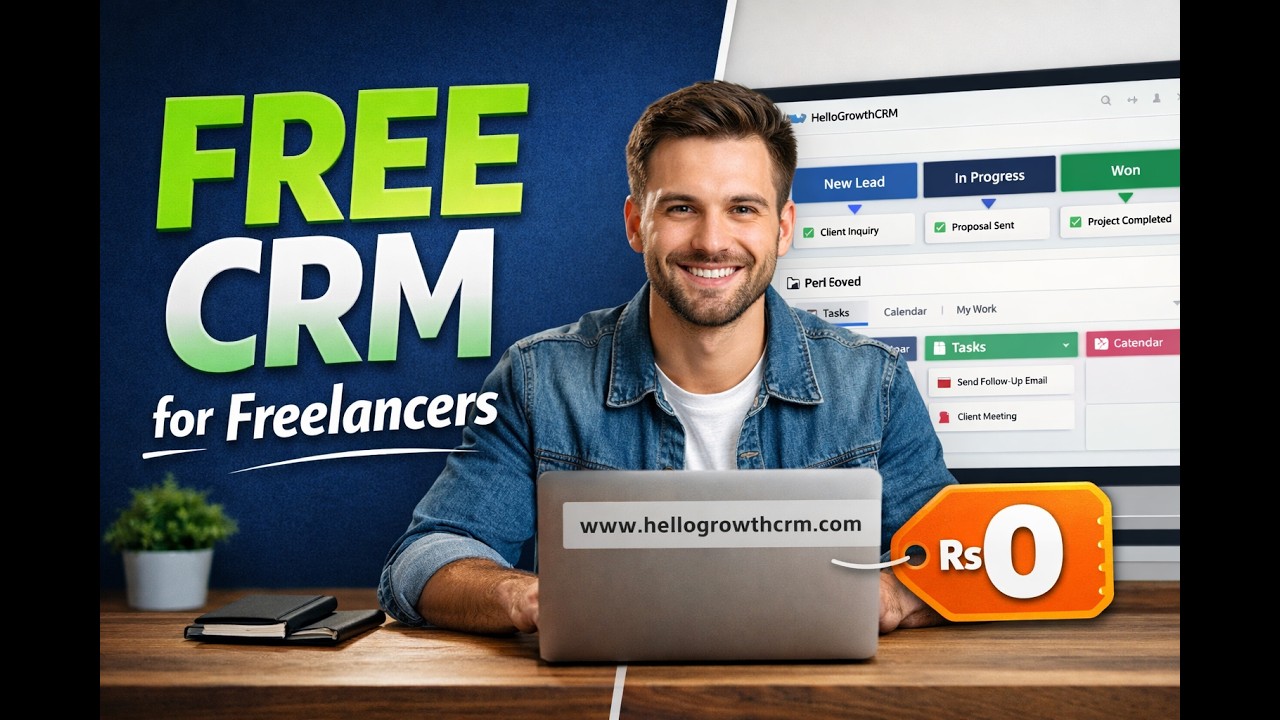
CRM for Freelancers & Solopreneurs — Free Plan Walkthrough | HelloGrowthCRM

CRM for Freelancers & Solopreneurs — Free Plan Walkthrough | HelloGrowthCRM
Client pipeline, tasks and scheduling set up the way a small agency works.

Key takeaways from this video

  • Why spreadsheets break down: scattered client data, missed follow-ups and no view of the pipeline.
  • Setting up pipeline stages, adding clients and moving deals by drag and drop.
  • Task boards with Kanban, calendar and My Work views.
  • Email templates for follow-ups and booking links for scheduling.
  • When it makes sense to move from the free plan to a paid one.

HelloGrowthCRM by the numbers

$12
per user/month list price — USD 100/user/year, billed annually on annual billing, ₹899/user/mo in India
$0
free forever starter plan — no credit card required
14-day
trial included on paid plans
500+
teams worldwide run their pipeline on HelloGrowthCRM

Frequently Asked Questions

Common questions agencies ask before moving their pipeline into HelloGrowthCRM.

An agency CRM is a CRM set up around how agencies win and keep clients: several stakeholders per account, proposals that change value across revisions, referrals as a main source of work, and retainers that renew. A regular sales CRM often assumes one buyer, one quote and a deal that ends at close. HelloGrowthCRM supports the agency shape with configurable pipeline stages, multi-contact account records, proposal versions on the deal and renewal dates on the account.

Agency work is won through conversations that stretch over weeks and several people, and it is easy to lose track of them while the team is busy delivering. A CRM gives every enquiry an owner, a next step and a date, keeps proposal versions and client history in one place, and shows renewal dates before they pass. Without one, that information sits in inboxes, personal phones and spreadsheets that nobody fully trusts.

Agencies typically prioritise multi-stakeholder contact tracking (several contacts per account with different roles), proposal and deal value tracking across revision stages, retainer renewal date visibility, and client communication history across email, WhatsApp and calls. HelloGrowthCRM supports all of these with configurable pipeline stages, multi-contact account records, and native WhatsApp and calling.

Agencies build proposals from templates on the deal record, with line items and the deal value attached. Proposals are versioned, so when one is revised the earlier versions stay on the record, and open tracking shows when the prospect has read it. Supporting files can be attached to the deal, and the email and WhatsApp threads about the proposal are linked to the same record.

Yes. Contract and renewal dates sit on the account, and agencies can run a renewal pipeline separate from their new-business pipeline, with its own stages and owners. Account managers schedule renewal tasks ahead of each end date, so they can see which retainers are coming up and start the conversation before it becomes urgent.

HelloGrowthCRM manages the sales and account side of client relationships: leads, proposals, deals and renewals. Project management tools manage delivery: task assignments, timelines and deliverables. They serve different purposes and many agencies use both. HelloGrowthCRM includes task and project boards for lightweight delivery tracking, so when a deal is won the handoff to delivery can happen inside the same system.

Paid plans are $12 per user per month, or USD 100/user/year, billed annually. In India the price is ₹899 per user per month, before GST. The free plan covers one user and up to 150 leads, which is enough for a solo founder or a small studio to run its new-business pipeline before paying anything. AI lead scoring is included on all paid plans, and setup typically takes 15 to 30 minutes.

Yes. The free plan is built for exactly that stage: one user and up to 150 leads, with a Kanban deal pipeline, contacts, accounts and a task board included, and no time limit. When a second person joins, you move to the Growth plan, which is priced per user with no seat minimum, so the cost grows with headcount, not with the size of your contact list.

Basic setup takes 15 to 30 minutes. Most agencies spend an afternoon on the full move: renaming the pipeline stages, importing clients and open deals from their spreadsheet, connecting email, calendar and WhatsApp, and saving a proposal template. Running one real deal through the CRM for a week before rolling it out to the whole team is the best way to catch anything the setup missed.

Yes. HelloGrowthCRM connects to WhatsApp through Meta's official Cloud API, and every conversation is attached to the right contact and deal, so the account team sees the full thread next to calls and emails. Agencies already using a WhatsApp provider such as Gupshup, Interakt, WATI, AiSensy, DoubleTick or 360dialog can connect through that provider instead.

An agency CRM system is the set of records an agency needs to run client work from first enquiry to renewal: accounts with several contacts, deals with versioned proposals, a timeline of calls, WhatsApp and email, tasks for the work after signing, and renewal dates. HelloGrowthCRM keeps these on one client record. Time tracking and production scheduling are different jobs and usually stay in a dedicated tool.

Look for a CRM where the deal, the delivery tasks and the renewal sit under the same client account, so a signed proposal turns into owned, dated tasks without retyping. HelloGrowthCRM offers Kanban, table and calendar task boards next to the client record for lightweight delivery tracking. If you run complex production schedules, pair a CRM with a project management tool and keep the client record in the CRM.

HelloGrowthCRM is not limited to one discipline, but its configurable pipeline fits how web agencies sell: add a scoping stage between discovery and proposal, record platform, budget and launch date on the deal, and track proposal revisions and the maintenance retainer that follows launch. There is also a dedicated guide on this site for web design agencies.

Yes. Proposals are built from templates on the deal and versioned with open tracking. Once the deal is won, the contract and renewal dates sit on the account and feed a separate renewal pipeline, so new business and retainer renewals are visible in the same system but in different pipelines.

Not for complex delivery. A CRM owns the client relationship, the deal and the renewal; a project management tool owns schedules, dependencies and deliverables. HelloGrowthCRM includes lightweight task and project boards, which can be enough for a small studio with simple delivery, and larger teams commonly run both.

Test candidates on a real deal rather than a demo. Check that pipeline stages match your process, that several contacts can sit under one client account, that renewal dates are visible, and that calling, WhatsApp and email are included in the price instead of sold as add-ons. Confirm you can export your data. The best CRM for agencies guide on this site walks through the full checklist.

More CRM guides to explore

Browse related HelloGrowthCRM guides and see how different teams run their pipelines.

Ready to grow?

Join small businesses that close more deals with HelloGrowthCRM.

Free Forever • No Credit Card Required

Take the next step

Free Forever • No Credit Card Required

Prefer email? Write to sales@hellogrowthcrm.com