

Skip to content
CRM for Kitchenware Retailers

CRM for Kitchenware Retailers That Wins Kitchen Openings and Keeps the Reorders

Run restaurant opening projects against a launch date, plan phased delivery, chase replenishment on rhythm and renew every AMC. From ₹899/user/month, free plan available.

Last updated:

Free Forever • No Credit Card Required

Live preview

Kitchenware Retailers CRM

Live sample workspace for Kitchenware Retailers: HoReCa account records: restaurant, cloud kitchen, hotel, caterer or canteen with.

Open pipeline

42

+12% this month

Follow-ups due

9

5 automated

Response SLA

18m

-34% faster

Automation coverage

76%

HoReCa account records

1

Kitchenware Retailers Account

HoReCa account records: restaurant, cloud kitchen, hotel, caterer or canteen

Rs. 2.4L

Kitchen opening projects

1

Kitchenware Retailers Opportunity

Kitchen opening projects: an opening carries a launch date, an

Rs. 1.1L

Equipment list quotations

1

Kitchenware Retailers Renewal

Equipment list quotations: build the quote line by line from

Rs. 78K

Phased delivery and installation

1

Kitchenware Retailers Follow-up

Phased delivery and installation: heavy equipment before the false ceiling,

Rs. 3.2L

Quick answer

Is HelloGrowthCRM right for CRM for Kitchenware Retailers?

Yes. HelloGrowthCRM gives CRM for Kitchenware Retailers a single system to capture every lead, automate follow-up across phone, WhatsApp, and email, prioritise leads with AI scoring, and forecast revenue — with calling and messaging built in instead of sold as add-ons. It's built for the problems these teams actually hit — like a new restaurant is opening in eight weeks. One quote goes out, the chef revises the equipment list, nobody follows up, and a competitor supplies the whole kitchen — rather than generic sales busywork.
  • HoReCa account records: restaurant, cloud kitchen, hotel, caterer or canteen with cuisine, covers, kitchen size, the purchase contact, the chef who specifies, and agreed payment terms
  • Kitchen opening projects: an opening carries a launch date, an equipment list, a layout drawing and a phased delivery plan, so the deal is run as a project rather than a single quotation
  • Equipment list quotations: build the quote line by line from the kitchen schedule, revise it as the chef changes specification, and keep every version attached to the same project

See pricingBook a demo

HelloGrowthCRM

Capture. Follow up. Close.

From Enquiry to Customer in One CRMEvery lead captured, followed up and tracked — so nothing goes cold.The path a lead takes inside HelloGrowthCRM, from first enquiry to a repeat customer.
  1. Step 1

    Capture

    Web forms, WhatsApp, calls and ads land in one inbox

  2. Step 2

    Qualify

    AI lead scoring flags who is ready to talk

  3. Step 3

    Assign

    Routed to the right rep automatically

  4. Step 4

    Follow up

    Reminders, sequences and WhatsApp nudges

  5. Step 5

    Track the deal

    Stages, value and next step in the pipeline

  6. Step 6

    Win & retain

    Renewals and repeat business stay on the radar

Every call, message and email is logged on the contact — the history travels with the lead.

One contact record, one pipeline, one clear next step.

01

A kitchenware dealer is really running three businesses

The first is commercial supply to hotels, restaurants, cloud kitchens, caterers and institutional canteens. The second is service and spares on the equipment already installed. The third is retail and gifting, which spikes around festivals and weddings. They share a warehouse and almost nothing else. The buyers are different, the cycles are different, and the reason each one is lost is different.

Most dealers manage all three from the same WhatsApp account and the same quotation file. That works until two openings and a gifting season overlap, which in India is most of the last quarter.
02

The opening project is the highest-value pipeline you run

A single restaurant fit-out can be worth more than a month of counter sales, and it is decided over six to twelve weeks by a chef, an owner and often an interior contractor who do not agree with each other. The equipment list changes three times. The launch date rarely moves. Whoever is still in the conversation in week six, with a current quotation and a delivery plan that respects the civil work sequence, usually supplies the kitchen.

Running that as a project rather than a quotation is the whole difference. Version the equipment list, keep the launch date visible, plan delivery in phases, and put a task on every change the chef asks for.

03

Quotation file versus a kitchenware CRM

What the dealer needsQuote file and WhatsAppHelloGrowthCRM
Launch date countdownIn someone's headOn the project
Equipment list revisionsOverwrittenVersioned
Phased delivery planningOne delivery datePhase tasks and dates
Chef gone quietNoticed lateStage ageing alert
Replenishment reordersReactivePrompted on rhythm
AMC and warranty expiryOn an old invoiceRenewal opportunity
Fabricator channel valueUntrackedPartner accounts
04

Reorders are the annuity most dealers ignore

Every kitchen you have supplied is breaking crockery, wearing out pans and losing cutlery at a rate you can predict from its covers. That replacement demand does not come to you automatically. It goes to whoever calls first, and very often that is a local market vendor who happened to be in the area on the right day.

A replenishment rhythm per account, built from its own order history, turns that into a call list. It is unglamorous work that produces the most reliable revenue in the business, and it is almost never done without a system prompting it.

05

The weekly management view

Openings with a launch date inside six weeks and an unconfirmed equipment list. Quotations revised more than twice with no decision. Phase deliveries due this week and whether stock is allocated. Accounts past their replenishment interval. AMC renewals expiring in the next sixty days. And open service tickets past their promised response, because those decide whether the AMC renews at all.

Challenges we solve

Common CRM problems in this industry — and how HelloGrowthCRM solves each one

Every team in this space loses revenue to the same recurring gaps. Each card below states one problem and the specific HelloGrowthCRM capability that closes it.

  • Problem: A new restaurant is opening in eight weeks. One quote goes out, the chef revises the equipment list, nobody follows up, and a competitor supplies the whole kitchen.

    How HelloGrowthCRM solves it: Openings run as projects with a launch date, a versioned equipment list and follow-up tasks tied to the countdown. A revision from the chef becomes a task, not a message that gets lost.

    HelloGrowthCRM capability: Kitchen opening projects

  • Problem: A restaurant you fitted out last year quietly buys replacement crockery from a market vendor, because nobody from your team ever called about replenishment.

    How HelloGrowthCRM solves it: Each account gets a replenishment rhythm based on its own order history and covers. The CRM raises the call before the shortage becomes urgent, which is the only moment you can win it.

    HelloGrowthCRM capability: Replenishment cycle tracking

  • Problem: Annual maintenance contracts on dishwashers and combi ovens lapse silently, and the customer only calls a competitor when something breaks.

    How HelloGrowthCRM solves it: Warranty end dates and AMC expiry sit on the equipment record with renewal opportunities raised in advance. Service revenue becomes a scheduled pipeline instead of an accident.

    HelloGrowthCRM capability: AMC and service contracts

  • Problem: Carpenters and interior contractors specify your accessories, but the arrangement is verbal and nobody tracks which fabricator delivered what business.

    How HelloGrowthCRM solves it: Fabricators become partner accounts with their projects, margin terms and last contact date. The channel becomes something you grow on purpose rather than a set of informal favours.

    HelloGrowthCRM capability: Carpenter and fabricator channel

What you get

Why teams choose HelloGrowthCRM

AI-powered CRM with the features you need to close more deals.

  • HoReCa account records: restaurant, cloud kitchen, hotel, caterer or canteen with cuisine, covers, kitchen size, the purchase contact, the chef who specifies, and agreed payment terms
  • Kitchen opening projects: an opening carries a launch date, an equipment list, a layout drawing and a phased delivery plan, so the deal is run as a project rather than a single quotation
  • Equipment list quotations: build the quote line by line from the kitchen schedule, revise it as the chef changes specification, and keep every version attached to the same project
  • Phased delivery and installation: heavy equipment before the false ceiling, small wares before the trial run, each phase carrying its own task, owner and date instead of one delivery promise
  • Replenishment cycle tracking: crockery breaks and utensils wear on a predictable rhythm, so the CRM raises the reorder call before the restaurant buys from a market vendor instead
  • AMC and service contracts: commercial equipment carries warranty end dates and annual maintenance renewals with reminders, because service is where a kitchenware dealer's steadier margin lives
  • Brand-wise price lists: authorised brands come with their own rate structures and dealer terms, held against the account so quotations leave at the correct price without a phone call
  • Modular kitchen and carpenter channel: fabricators and interior contractors who specify your accessories are held as partner accounts with their own project pipeline and margin terms
  • Corporate and festive gifting pipeline: cookware sets and hampers with headcount, budget per head, branding requirement and a delivery date that cannot move once the festival is fixed
  • WhatsApp inbox on the store number: equipment photographs, specification sheets and order lists sit against the account rather than in a salesperson's private chat history
  • AI lead scoring: launch date proximity, covers, number of quote revisions, chef engagement and past order value, ranked into the visits a rep should genuinely make this week
  • GST invoicing and outstanding: raise tax invoices for commercial supply, track advances taken on equipment orders, and see overdue accounts before the next dispatch is released
Watch it work

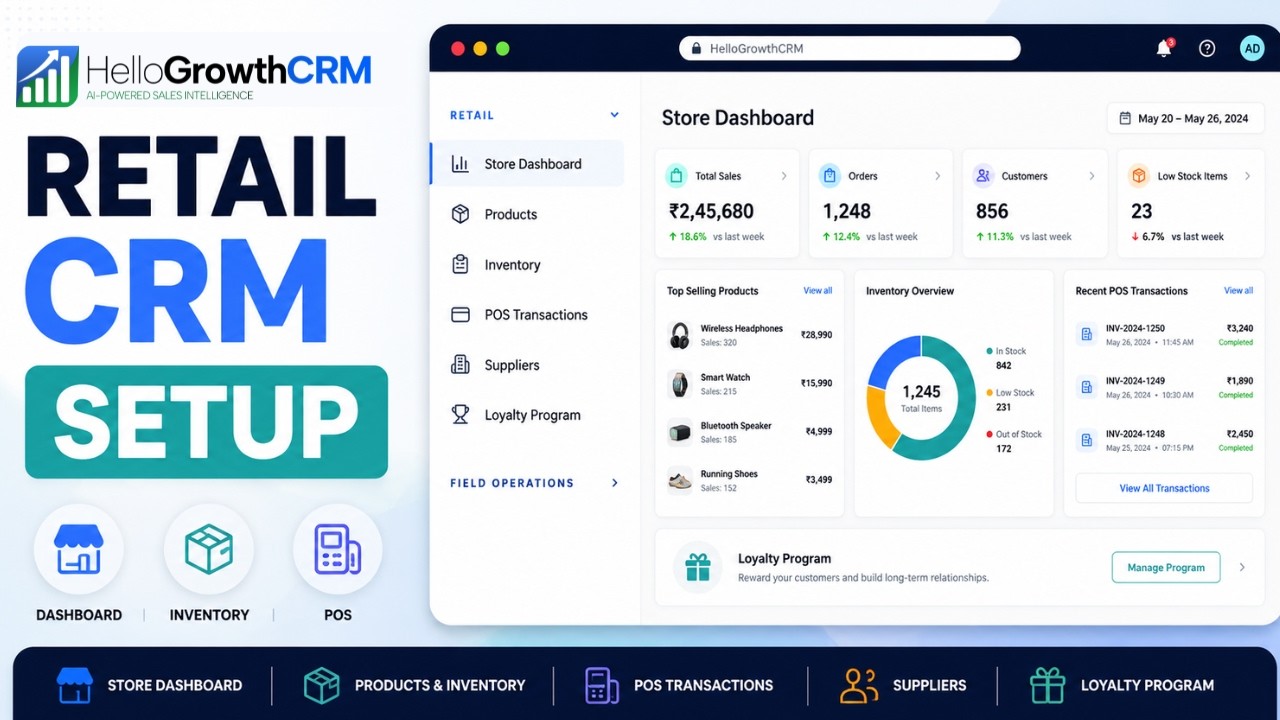
Complete Retail CRM Setup in HelloGrowthCRM | Store Dashboard, Products, Inventory & POS

Complete Retail CRM Setup in HelloGrowthCRM | Store Dashboard, Products, Inventory & POS
A short walkthrough of HelloGrowthCRM for retail.

Key takeaways from this video

  • Where the Retail module sits and how the Store Dashboard gives a daily overview.
  • Managing products and tracking inventory inside the CRM.
  • Handling POS transactions and suppliers.
  • Running a loyalty programme for repeat customers.

HelloGrowthCRM by the numbers

$12
per user/month list price — USD 100/user/year, billed annually on annual billing, ₹899/user/mo in India
$0
free forever starter plan — no credit card required
14-day
trial included on paid plans
500+
teams worldwide run their pipeline on HelloGrowthCRM

Frequently Asked Questions

Common questions about using HelloGrowthCRM in your industry.

HelloGrowthCRM is ₹899 per user per month in India, and a free plan is available so a kitchenware dealer can run the HoReCa pipeline before paying anything. There is no minimum seat count, so a business with two counter staff, one field rep and an owner licenses four users rather than a package built for a larger team. Most dealers begin with the opening projects pipeline and the WhatsApp inbox, then add AMC renewals and the fabricator channel once the core habit is settled.

AI lead scoring ranks live opening projects by how close the launch date is, how many covers the kitchen serves, how many quote revisions have gone back and forth and whether the chef is still engaging, so a rep with twenty projects knows which five to visit this week. AI call summaries turn a long site conversation into a short note with the changed specification and the next action. AI reply drafting handles the routine specification and price questions that fill the WhatsApp inbox during an opening.

Yes. Commercial kitchen selling happens on site, often in a half-built space with a chef, a contractor and an owner all present. The rep opens the project on the app, photographs the layout, records the revised equipment list, logs who committed to what, and creates the follow-up task before leaving. Managers see site visits as they happen instead of on Friday. Recent records are available on the device, which matters in basements and half-finished buildings where mobile signal is poor.

A spreadsheet can hold an equipment list, but it cannot count down to a launch date, chase a chef who has gone quiet, warn you that a phase-one delivery must leave the warehouse on Thursday, or tell you that an account has not reordered crockery in five months. It also cannot hold the WhatsApp thread where a specification changed. The quote is the part a spreadsheet does well and the part that is rarely the reason a kitchen order is lost.

Most kitchenware dealers are live within a working day. HoReCa account lists, contractor contacts and past customers import from Excel or CSV with field mapping. Two pipelines cover the business at the start, which are opening projects and replenishment or repeat orders, and both are configured in an afternoon. AMC records can be imported from your service register. Connecting the business WhatsApp number and installing the mobile app takes an hour. The habit that takes longest is logging site visits, usually a fortnight.

The project starts with the launch date and the covers, then carries the equipment schedule as versioned line items. Quotation revisions are recorded rather than replaced, so a dispute about what was agreed has an answer. Delivery is planned in phases, because heavy equipment must arrive before certain civil work and small wares are needed only near the trial run. Each phase has a date and an owner, and slipped phases raise alerts. After handover, the account moves into the replenishment and AMC pipelines automatically.

Yes. Each piece of installed equipment can be recorded against the account with its serial number, installation date, warranty end and AMC expiry. Renewal opportunities are raised ahead of expiry with the account owner assigned. Service complaints are logged as tickets with a promised response, because a dishwasher failing during dinner service is the single fastest way to lose a HoReCa account, and how quickly you respond decides whether the AMC renews at all.

CRM guides for related industries

See how teams in similar industries run their pipelines in HelloGrowthCRM.

Ready to grow?

Join small businesses that close more deals with HelloGrowthCRM.

Free Forever • No Credit Card Required

Take the next step

Free Forever • No Credit Card Required

Prefer email? Write to sales@hellogrowthcrm.com