

Skip to content
CRM for Watch Retailers

CRM for Watch Retailers: Clienteling, Waitlists and Service in One Place

Hold the client book in the store rather than in associates' phones, allocate scarce references fairly, and keep every service job on its promised date. From ₹899/user/month.

Last updated:

Free Forever • No Credit Card Required

Live preview

Watch Retailers CRM

Live sample workspace for Watch Retailers: Client profiles built for clienteling: brands owned, case size and strap.

Open pipeline

42

+12% this month

Follow-ups due

9

5 automated

Response SLA

18m

-34% faster

Automation coverage

76%

Client profiles built for

1

Watch Retailers Account

Client profiles built for clienteling: brands owned, case size and

Rs. 2.4L

Wishlist and waitlist register

1

Watch Retailers Opportunity

Wishlist and waitlist register: which client asked for which reference,

Rs. 1.1L

Allocation records

1

Watch Retailers Renewal

Allocation records: when a piece arrives, the store sees who

Rs. 78K

Occasion calendar

1

Watch Retailers Follow-up

Occasion calendar: birthdays, anniversaries and wedding dates on the client

Rs. 3.2L

Quick answer

Is HelloGrowthCRM right for CRM for Watch Retailers?

Yes. HelloGrowthCRM gives CRM for Watch Retailers a single system to capture every lead, automate follow-up across phone, WhatsApp, and email, prioritise leads with AI scoring, and forecast revenue — with calling and messaging built in instead of sold as add-ons. It's built for the problems these teams actually hit — like a client has been waiting eight months for a reference. It arrives, and it goes to whoever happened to call that morning. The waiting client hears about it later — rather than generic sales busywork.
  • Client profiles built for clienteling: brands owned, case size and strap preference, budget band, occasions, the gifting contact, and the associate who owns the relationship
  • Wishlist and waitlist register: which client asked for which reference, on what date and whether a token was paid, so allocating a scarce piece is a decision backed by evidence
  • Allocation records: when a piece arrives, the store sees who has waited longest and who has bought most, and the decision is logged with a reason instead of settled by whoever called first

See pricingBook a demo

HelloGrowthCRM

Capture. Follow up. Close.

From Enquiry to Customer in One CRMEvery lead captured, followed up and tracked — so nothing goes cold.The path a lead takes inside HelloGrowthCRM, from first enquiry to a repeat customer.
  1. Step 1

    Capture

    Web forms, WhatsApp, calls and ads land in one inbox

  2. Step 2

    Qualify

    AI lead scoring flags who is ready to talk

  3. Step 3

    Assign

    Routed to the right rep automatically

  4. Step 4

    Follow up

    Reminders, sequences and WhatsApp nudges

  5. Step 5

    Track the deal

    Stages, value and next step in the pipeline

  6. Step 6

    Win & retain

    Renewals and repeat business stay on the radar

Every call, message and email is logged on the contact — the history travels with the lead.

One contact record, one pipeline, one clear next step.

01

Watch retail is measured in relationships, not enquiries

Most retail software assumes a stream of new leads. A watch business does not work that way. A boutique may have four hundred clients who matter, each buying once every eighteen months to three years, coming in for a strap change or a service in between, and referring a friend when they are treated well. The revenue is real and the cycle is long, which means the risk is not a lost lead but a forgotten client.

This is why clienteling, rather than lead capture, is the organising idea here. The question a watch CRM has to answer every morning is not who enquired yesterday. It is which of the clients we already have should hear from us today, and about what.
02

Three revenue lines, one client record

The new sale

Driven by occasion, by wishlist and by allocation of scarce references. It is usually anticipated months in advance if anybody is recording preferences.

Service and repair

Batteries, straps, polishing, water resistance testing and overhauls bring clients back into the store on a predictable rhythm. It is the most reliable footfall a watch retailer has, and the most commonly mishandled through poor communication.

Pre-owned and trade-in

Valuations need to be consistent, documented and photographed, because an inconsistent number quoted by two associates costs credibility that takes years to build.

03

Paper client book versus a watch retail CRM

What the boutique needsRegister and personal phonesHelloGrowthCRM
Client book owned by the storeNoYes
Waitlist with request datesPaper registerRanked and evidenced
Allocation reasoning recordedNoneLogged on the piece
Occasion outreachIf rememberedTask weeks ahead
Service job promised dateOn a slipTracked and escalated
Trade-in valuation consistencyVaries by associateRecorded and approved
Dormant client listNot availableGenerated weekly
04

Allocation is a trust problem before it is a stock problem

When a sought-after reference arrives, somebody is going to be disappointed. That is unavoidable. What is avoidable is the impression that the decision was arbitrary. A client who learns that a piece went to someone who asked last week, while they have waited since spring, does not simply lose one watch. They stop believing the queue exists, and that belief is most of what keeps a waitlist functioning.

Recording request dates, tokens and purchase history turns allocation into a decision you can explain calmly. It also tells the manager which references have genuine unmet demand, which is far more useful at order time than an impression formed on the shop floor.

05

The weekly management view

Outreach completed against target per associate. Occasions falling in the next three weeks and whether contact has been made. Service jobs approaching or past their promised date. Waitlisted references with incoming stock. Clients with two or more purchases and no contact in ninety days. And trade-in valuations quoted but not closed, which age faster than most retailers assume.

Challenges we solve

Common CRM problems in this industry — and how HelloGrowthCRM solves each one

Every team in this space loses revenue to the same recurring gaps. Each card below states one problem and the specific HelloGrowthCRM capability that closes it.

  • Problem: A client has been waiting eight months for a reference. It arrives, and it goes to whoever happened to call that morning. The waiting client hears about it later.

    How HelloGrowthCRM solves it: The waitlist shows request date, token paid and lifetime purchase value for every client wanting that reference. Allocation is a defensible decision, and the reasoning is recorded on the record.

    HelloGrowthCRM capability: Wishlist and waitlist register

  • Problem: A movement overhaul was promised in three weeks. At week five the client is calling the store, and nobody can say where the watch is.

    How HelloGrowthCRM solves it: Every service job carries a promised date, a current stage and the service centre handling it. Status updates go to the client on WhatsApp, so the store calls before the client does.

    HelloGrowthCRM capability: Service and repair jobs

  • Problem: A regular client buys an anniversary gift from another store, because nobody at your boutique knew the date was coming.

    How HelloGrowthCRM solves it: Occasions sit on the client profile and generate outreach tasks weeks ahead. The associate reaches out with two suggestions before the client has started looking anywhere else.

    HelloGrowthCRM capability: Occasion calendar

  • Problem: Client relationships live in associates' personal phones. When an experienced associate leaves, a share of the boutique's best clients quietly leaves too.

    How HelloGrowthCRM solves it: Conversations, preferences, purchase and service history sit on the client record under the store's control. A handover is a briefing rather than a loss, and access ends with employment.

    HelloGrowthCRM capability: Client profiles

What you get

Why teams choose HelloGrowthCRM

AI-powered CRM with the features you need to close more deals.

  • Client profiles built for clienteling: brands owned, case size and strap preference, budget band, occasions, the gifting contact, and the associate who owns the relationship
  • Wishlist and waitlist register: which client asked for which reference, on what date and whether a token was paid, so allocating a scarce piece is a decision backed by evidence
  • Allocation records: when a piece arrives, the store sees who has waited longest and who has bought most, and the decision is logged with a reason instead of settled by whoever called first
  • Occasion calendar: birthdays, anniversaries and wedding dates on the client record raise outreach tasks two to three weeks ahead, which is when a gift is actually being chosen
  • Service and repair jobs: battery, strap, polish, water resistance testing and movement overhaul tracked with a promised date, the technician or brand service centre, and client updates
  • Trade-in and pre-owned records: the piece offered, condition notes, photographs, the value quoted and who approved it, so two associates value the same watch the same way
  • Warranty and documentation history: purchase date, warranty card reference and every service performed, held on the client record for resale, insurance and future claims
  • Dormant client alerts: a client who has bought twice and heard nothing for ninety days is your most likely next sale, and that list is generated rather than remembered
  • WhatsApp inbox on the boutique number: new arrival images, availability confirmations and service updates attach to the client record rather than an associate's personal handset
  • Associate-wise clienteling reporting: outreach completed, appointments booked, conversion and average ticket per associate, so clienteling becomes measurable rather than aspirational
  • AI lead scoring: wishlist activity, occasion proximity, past purchase value, service visits and reply behaviour, ranked into a short daily outreach list for each associate
  • GST invoicing and advances: raise tax invoices against the sale, record tokens taken against a waitlisted reference, and track balances due on pieces booked to order
Watch it work

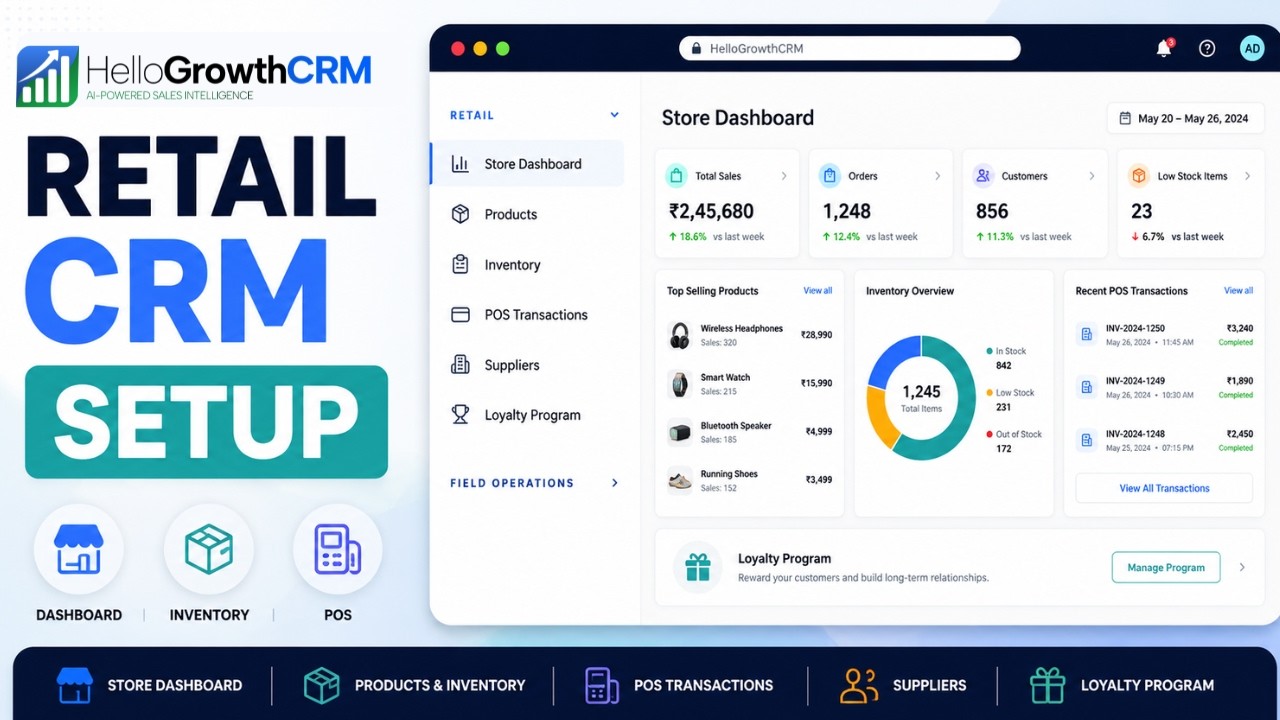
Complete Retail CRM Setup in HelloGrowthCRM | Store Dashboard, Products, Inventory & POS

Complete Retail CRM Setup in HelloGrowthCRM | Store Dashboard, Products, Inventory & POS
A short walkthrough of HelloGrowthCRM for retail.

Key takeaways from this video

  • Where the Retail module sits and how the Store Dashboard gives a daily overview.
  • Managing products and tracking inventory inside the CRM.
  • Handling POS transactions and suppliers.
  • Running a loyalty programme for repeat customers.

HelloGrowthCRM by the numbers

$12
per user/month list price — USD 100/user/year, billed annually on annual billing, ₹899/user/mo in India
$0
free forever starter plan — no credit card required
14-day
trial included on paid plans
500+
teams worldwide run their pipeline on HelloGrowthCRM

Frequently Asked Questions

Common questions about using HelloGrowthCRM in your industry.

It is a clienteling system rather than a lead funnel. Watch retail does not run on enquiries that close this month, it runs on a few hundred relationships that produce a purchase every year or two, plus service visits in between. The stores that need it are multi-brand retailers and brand boutiques where associates hold client relationships personally, where scarce references have waitlists, and where service is a meaningful revenue line. A store selling only entry-price watches over the counter will get much less from it.

Watch clienteling already happens on WhatsApp, which is why so much of it disappears when an associate leaves. Connect the boutique's business number and new arrival images, availability confirmations, service updates and appointment reminders attach to the client record, visible to the store manager. The built-in dialer works the daily outreach list with each call logged. Clients notice no change, because they are still messaging the same way. What changes is that the boutique, not the individual, owns the relationship history.

Each client request is recorded against a specific reference with the date asked, whether a token was paid, and the client's purchase history. When stock arrives, the store sees every waiting client ranked by whatever criteria you choose to weigh, and records who received it and why. This does two things. It removes the appearance of arbitrariness that damages client trust in scarce-allocation retail, and it gives the manager an honest view of demand by reference, which is far more useful than a gut feeling when placing the next order.

Yes, and for most multi-brand retailers this is where the CRM earns its place fastest. A job is created with the client, the piece, the work required, an estimate, a promised date and whether it is being handled in house or by a brand service centre. Stage changes trigger client updates. Jobs approaching or past their promised date are highlighted. Service is the most common reason a client walks back into a watch store, and how a service job is communicated has an outsized effect on whether they buy on that visit.

Instead of scoring cold leads, it ranks existing clients by how ready they are to hear from you. The inputs are wishlist activity, how close an occasion is, lifetime purchase value, how long since the last contact, whether a service visit is due or completed, and how the client responds to messages. The output is a short daily outreach list for each associate, usually five to ten names, which is what makes clienteling achievable on a busy retail floor. A long list gets ignored; a short, well-ordered one gets worked.

Client data in watch retail is unusually sensitive, since it records what people own and what they spend. Role-based access limits associates to their own clients, with managers and owners seeing more. Access is revoked the day employment ends, and export permissions can be restricted, so a client book cannot simply be carried out of the door. GST invoicing is built in: raise the tax invoice against the sale with the correct HSN and rate, record tokens and advances on booked pieces, and track balances due on order.

HelloGrowthCRM is ₹899 per user per month in India, and a free plan is available so a single boutique can build its client book and service register before paying anything. There is no minimum seat count, so a store with three associates and a manager licenses four users. Most watch retailers start with client profiles, the service job register and the occasion calendar, then add waitlist allocation and associate-wise clienteling reporting once the client book is properly populated.

CRM guides for related industries

See how teams in similar industries run their pipelines in HelloGrowthCRM.

Ready to grow?

Join small businesses that close more deals with HelloGrowthCRM.

Free Forever • No Credit Card Required

Take the next step

Free Forever • No Credit Card Required

Prefer email? Write to sales@hellogrowthcrm.com