Automated Follow-Up System for Leads and Clients — Sequences, Reminders and Timely Outreach
Covers follow-up automation CRM, automated follow-up software, sales follow-up automation, lead follow-up CRM, and adjacent CRM buying questions.
Quick answer
What is CRM automated follow up?
CRM automated follow up is the use of sequences, triggers, and rules within a CRM to send emails, SMS, and WhatsApp messages and create task reminders automatically, based on time elapsed, lead behavior, or deal stage changes — without requiring a rep to manually schedule each touchpoint. HelloGrowthCRM's follow-up automation covers all three channels in a single sequence builder with behavior-based branching logic.
Last updated:
Overview
Most deals are lost not because the product wasn't a fit, but because follow-up was inconsistent. A prospect who doesn't hear back in 24 hours finds another vendor. A warm lead who slips through the cracks never converts. HelloGrowthCRM's follow-up automation ensures every contact gets the right outreach at the right time — automatically — so no opportunity dies from neglect.
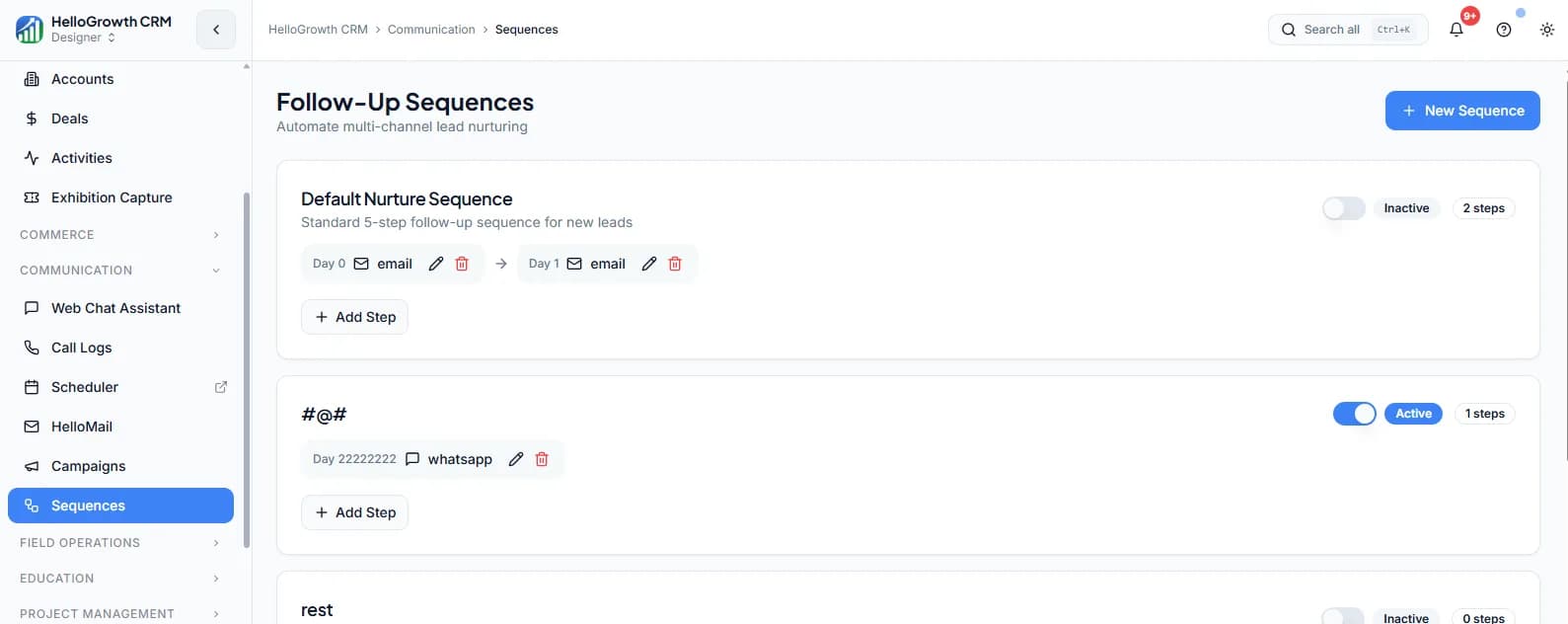
Automated follow-up sequences let teams build multi-touch cadences across email, SMS, and task-based touchpoints. A new inbound lead might receive an immediate acknowledgement email, a call task the same day, a follow-up email on day two, and a LinkedIn connection reminder on day four. The sequence runs automatically based on enrollment triggers — no manual scheduling required.
Smart sequences adapt based on behavior. When a prospect replies to an email, HelloGrowthCRM pauses the automated sequence and creates a task for the rep to respond personally. When a prospect books a meeting, follow-up shifts to pre-meeting prep content. When a deal goes dark, re-engagement sequences kick in after a defined inactivity window. Automation that responds to context is dramatically more effective than rigid drip campaigns.
Task-based reminders keep reps accountable for follow-ups that require personal touches. HelloGrowthCRM creates prioritized daily task lists automatically — calls to make, proposals to follow up on, contracts to check in about — so reps start each day with clear actions rather than deciding where to focus. Managers can see completion rates and identify reps who need coaching on follow-up discipline.
For longer sales cycles, follow-up automation extends to relationship maintenance. Quarterly check-in sequences for existing customers, renewal reminders 90 days before contract end, re-engagement campaigns for closed-lost opportunities six months later — all of these run automatically and keep your brand present without requiring a rep to remember every due date.
The measurement side of follow-up automation is where teams discover what works. HelloGrowthCRM tracks open rates, reply rates, meeting book rates, and deal conversion by sequence, step, channel, and rep. That data drives iteration: cut low-performing steps, promote high-converting messages, and test timing variations. Over time, automated follow-up becomes one of the most measurable revenue-generating systems in the entire sales operation.
Going deeper
Follow-Up Automation That Feels Personal: Templates, Timing, and Behavior Triggers
The tension in sales automation is between efficiency and authenticity. Reps want to automate repetitive outreach, but prospects can tell when they're receiving a mass sequence, and that recognition kills response rates. HelloGrowthCRM resolves this tension by combining template-based automation with dynamic personalization that goes beyond first-name merge tags. Sequences can pull in the prospect's company name, industry, specific product area they asked about, last conversation topic, or recent company news — creating messages that read as custom even when they're running automatically across hundreds of contacts. That contextual relevance is what separates a HelloGrowthCRM sequence from a generic drip campaign.
Timing optimization is an underappreciated driver of follow-up performance. HelloGrowthCRM's send-time intelligence analyzes historical engagement patterns by industry, company size, and geography to recommend optimal send windows for each contact. An IT decision-maker at a mid-size manufacturing company in Pune may respond best to emails sent Tuesday morning, while a founder of an e-commerce startup responds better to late-evening messages. Applying that timing intelligence across a sequence — even if the improvement is only 15% per touch — compounds into measurably better conversion rates over a multi-step cadence.
Re-engagement automation is one of the most overlooked revenue opportunities in a CRM. Most teams put a contact in 'closed lost' or 'not interested' and never systematically revisit them. HelloGrowthCRM's re-engagement sequences automatically enroll contacts after a configurable inactivity window — 30, 60, or 90 days — with outreach calibrated to the original loss reason. Budget-constrained contacts get cost-focused messaging when a new pricing tier ships. Contacts who chose a competitor get re-engaged 6 months later with competitive win stories. That systematic re-engagement strategy consistently recovers 8–15% of closed-lost opportunities that would otherwise be permanently dormant in the database.
A Chennai solar installation company illustrates the before and after. Site-visit requests came in from the website, Facebook ads, and referrals, and each surveyor followed up 'when they got a chance'. Quotes for rooftop systems — decisions homeowners take weeks to make — went silent after one call, and the sales lead assumed silence meant no. After switching on HelloGrowthCRM's follow-up automation, every quote starts a five-touch cadence: a WhatsApp thank-you the same day, a subsidy-explainer email on day three, a call task on day five, a customer-story email on day ten, and a friendly final check-in on day eighteen. Replies pause the sequence and hand the thread to the surveyor. The pipeline of 'quoted but quiet' homeowners now works itself — and the team only steps in when a real conversation starts.
Challenges we solve
The problems holding this industry back — and the fix
The recurring gaps that cost this industry revenue, and how HelloGrowthCRM closes each one.
Warm leads go cold in the gap between touches
Multi-touch cadences across email, WhatsApp, and call tasks run on schedule for every lead, so the follow-up happens whether or not the week got busy.Sequences
Reps forget who they promised to call back
Every commitment becomes a dated task on a prioritized daily list, and overdue follow-ups surface in the manager digest before they become lost deals.Task reminders
Automated messages feel robotic
Personalization tokens pull company, industry, and last-conversation context into each step, and reply detection pauses the sequence the moment a human answers.Smart personalization
Closed-lost leads are abandoned forever
Re-engagement sequences revive dormant contacts after a set window with messaging matched to the original loss reason.Re-engagement
Nobody knows which follow-up actually converts
Open, reply, and meeting-booked rates per step show exactly where the cadence works and where it leaks, so iteration is driven by data.Sequence analytics
Setup guide
How to connect — step by step
Takes about 10–15 minutes. No coding required.
1
Pick your enrollment triggers
Decide what starts a sequence: new inbound lead, quote sent, demo completed, or deal gone quiet. Each trigger gets its own cadence.
2
Build the cadence from a template
Start with the proven 7-touch inbound template and adjust timing to your sales cycle. Mix email, WhatsApp, and call tasks rather than relying on one channel.
3
Set the exit rules
Configure reply detection, meeting-booked exits, and unsubscribe handling so prospects who engage move to a human and nobody gets over-contacted.
4
Add the re-engagement layer
Create a 60-day dormant-lead sequence and a closed-lost revival cadence so no contact is permanently forgotten.
5
Review step performance monthly
Cut steps with no engagement, test new subject lines on the weakest email, and promote the messages that book meetings.
CRM automated follow up is the use of sequences, triggers, and rules within a CRM to send emails, SMS, and WhatsApp messages and create task reminders automatically, based on time elapsed, lead behavior, or deal stage changes — without requiring a rep to manually schedule each touchpoint. HelloGrowthCRM's follow-up automation covers all three channels in a single sequence builder with behavior-based branching logic.
How many follow-up attempts should a sales rep make?
Research consistently shows that most B2B sales require 6–8 touchpoints before a prospect is ready to engage, yet most reps give up after 1–2 attempts. HelloGrowthCRM's recommended inbound lead sequence is 7 touches over 10 days — immediate email + call, day 2 call, day 3 follow-up email, day 5 call, day 7 email, day 10 breakup message. Automation ensures every lead receives the full sequence regardless of rep workload.
Does HelloGrowthCRM support WhatsApp follow-up automation?
Yes. HelloGrowthCRM supports automated WhatsApp messages as part of multi-channel follow-up sequences. WhatsApp follow-ups can be triggered by time elapsed, lead status changes, or CRM field values. Approved WhatsApp Business API message templates run within Meta's compliance rules. For transactional follow-ups in India, WhatsApp consistently outperforms email on open rates and response rates.
How do you write an automated follow-up email sequence?
An effective automated follow-up sequence follows this structure: email 1 — value-focused introduction referencing their specific situation; email 2 (day 2-3) — social proof or case study relevant to their industry; email 3 (day 5) — specific feature or use-case tied to a pain they mentioned; email 4 (day 7-8) — direct ask or meeting request; email 5 (day 10-12) — 'breakup' email that creates scarcity. HelloGrowthCRM includes proven sequence templates for common industries and deal stages.
How does HelloGrowthCRM prevent automated emails from looking like spam?
HelloGrowthCRM prevents spam-like automated emails through four mechanisms: (1) personalization tokens that pull CRM data into every message, making each email specific to the contact, (2) reply detection that pauses sequences when a prospect responds, (3) daily send limits per domain to protect deliverability, and (4) send-time intelligence that spaces emails to mimic natural human timing. Sequences that feel human consistently get higher reply rates and fewer spam complaints than broadcast-style sends.
Want help evaluating the next step?
Book a demo to see HelloGrowthCRM in action, or start a free trial.
Why Leads Go Cold: The Speed-to-Lead Problem
A lead is warmest in the minutes after they enquire. They are at their desk, the problem is on their mind, and yours is the tab they just closed. Every hour that passes after that, two things happen: their attention moves on, and a competitor who replied faster starts the conversation you were supposed to have. Most small businesses do not lose leads to better rivals — they lose them to faster ones.
The second leak is quieter. A rep makes one or two attempts, gets no reply, and moves on to fresher names. Nobody decides to abandon the lead; it just stops appearing in anyone's day. Multiply that across every enquiry for a year and the abandoned pile is usually bigger than the worked pile.
An automated follow-up system attacks both leaks the same way: the first response goes out immediately regardless of what the team is doing, and the later touches go out on schedule regardless of what the team remembers. Reps stop being the bottleneck for persistence and start being the reward for it — the human enters when the lead responds.
Designing the Sequence: Day 0, 1, 3, 7
A working B2B follow-up sequence is shorter and plainer than most people expect. Day 0: an immediate WhatsApp or email acknowledging the enquiry and asking one concrete question — what are you looking to solve, when do you need it? This is the speed-to-lead touch, and it does most of the work.
Day 1: a follow-up with something useful attached — a price range, a relevant example, a one-line case description — plus a call task for the rep, because a conversation converts better than any message. Day 3: a short nudge on a different channel than day 1; if the first touches were WhatsApp, try email or SMS. Channel variety is not a trick — it simply respects that people live in different inboxes.
Day 7:a polite last scheduled touch that makes it easy to say no — “should I close this enquiry, or is the timing just off?” This message gets replies precisely because it offers an exit. After day 7, the lead moves to a long-cycle nurture list rather than being deleted; timing changes, and a “not now” in March is often a buyer in August.
The Day 0, 1, 3, 7 sequence stops as soon as the lead replies.
Stopping Conditions and Human Handover
The most important rule in the whole system: when the lead replies, the sequence stops.Nothing burns trust faster than a scheduled “just checking in” landing the day after a real conversation. In HelloGrowthCRM, a reply — on WhatsApp, email, or SMS — halts the remaining automated steps and hands the thread to a person.
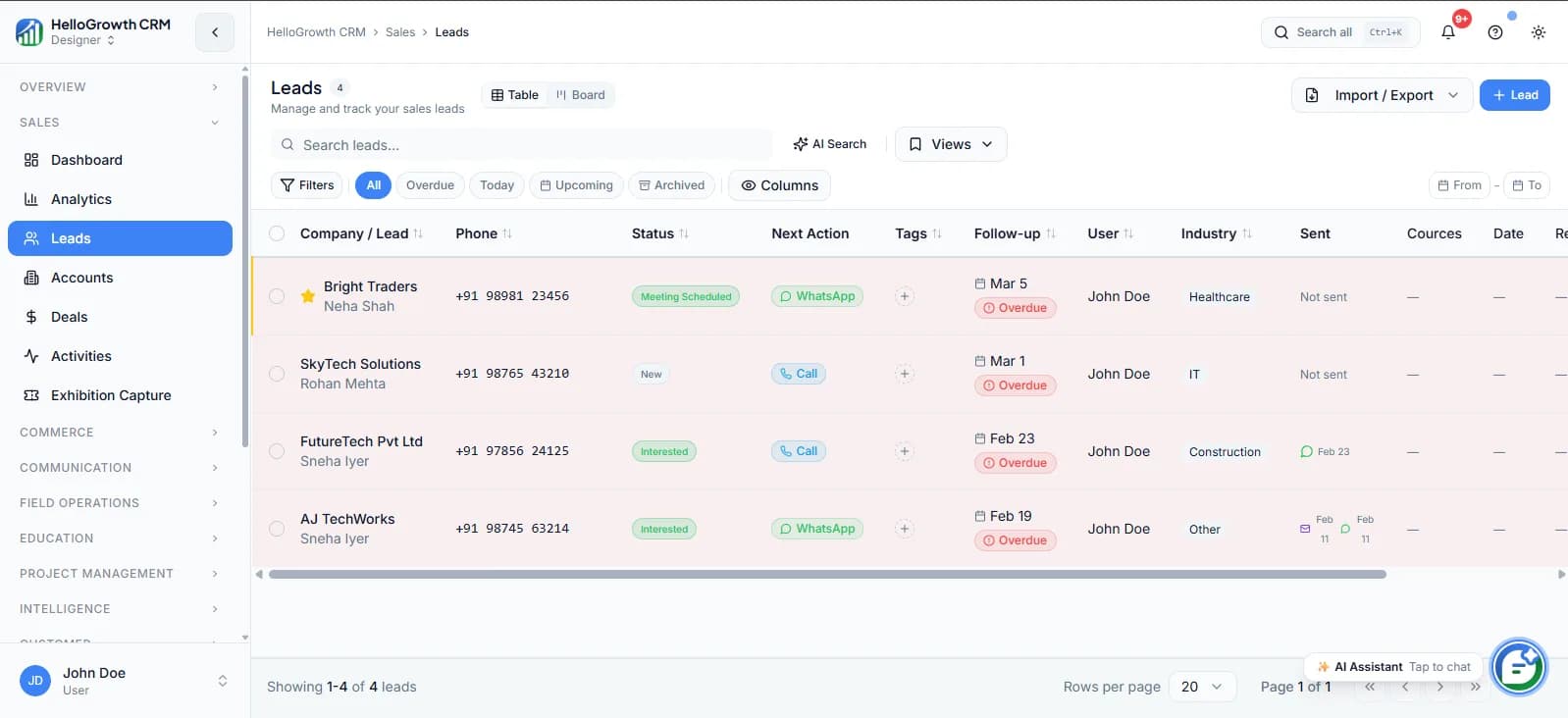
The handover is a task, not a hope. The assigned rep gets a follow-up task with the full conversation on the lead timeline — what was sent, when, and what the lead said. Escalation works the same way for silence: if a lead goes cold beyond the configured window, inactivity alerts nudge the rep, and managers see a digest of leads going quiet across the team.
This division of labour is the actual design principle. Automation handles the touches that require discipline; humans handle the touches that require judgement. A sequence that tries to automate the sales conversation itself fails — one that automates persistence so the conversation can happen is the one that pays.
Key Capabilities
Multi-channel sequences: WhatsApp, email, and SMS steps in one sequence, so follow-up meets the lead where they actually read messages.
Instant first response: Day-0 touches fire the moment a lead arrives — from a website form, IndiaMART, or JustDial — while the enquiry is still warm.
WhatsApp Business API templates: Pre-approved templates send immediately and legitimately, from your business number, into the CRM timeline.
Reply-based stopping conditions: A response on any channel halts the remaining automated steps and routes the thread to a rep.
Call tasks inside sequences: Sequences schedule human calls between messages, because the goal of every message is a conversation.
Missed-call fallback: An unanswered outbound call can trigger a WhatsApp or SMS within minutes, turning a dead dial into an open thread.
Inactivity alerts: Reps are nudged when an assigned lead goes quiet beyond a set window; managers see cold leads across the team.
Sequence enrolment rules: Leads enter sequences by source, stage, or score, so a portal enquiry and a referral get different treatment automatically.
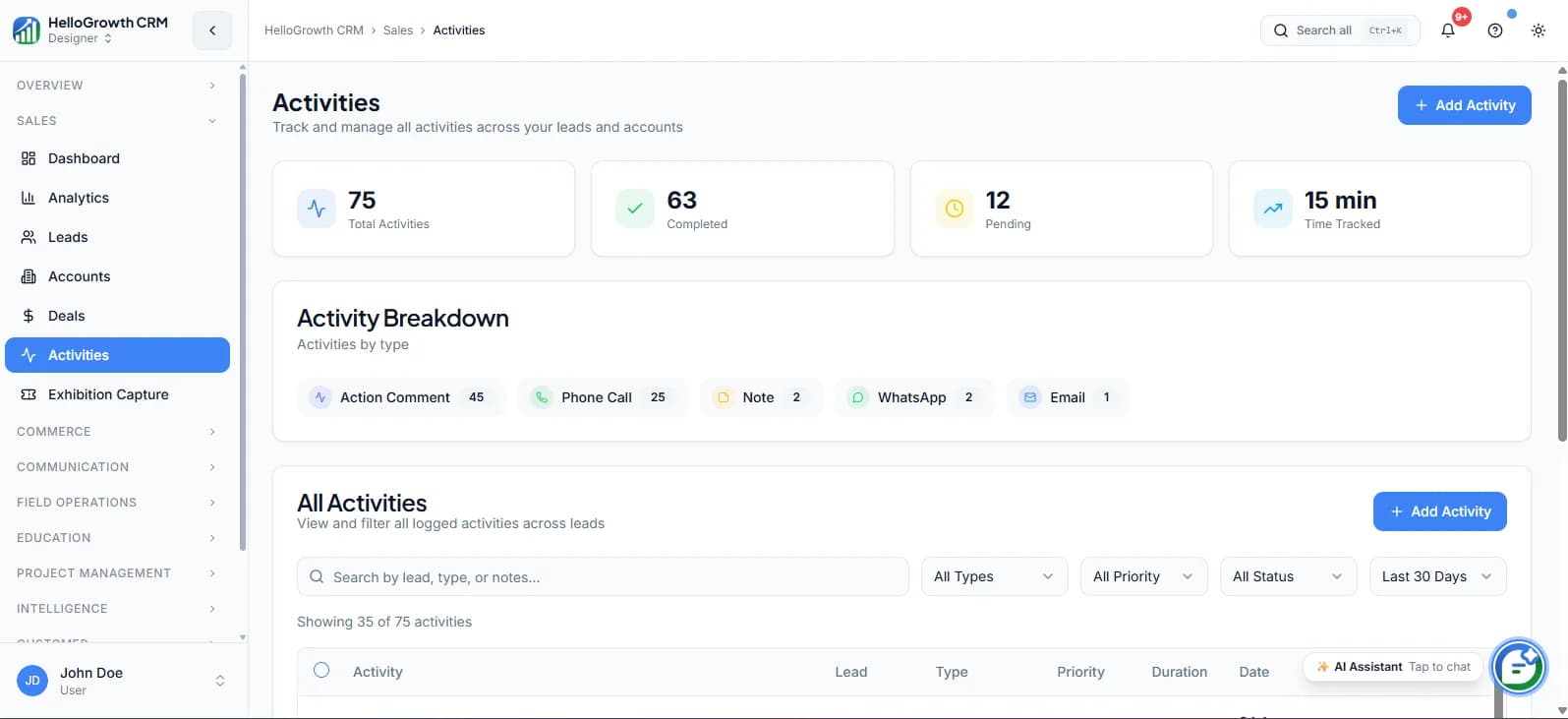
Full timeline visibility: Every automated touch logs on the lead record next to calls and notes, so a rep never walks into a conversation blind.
Sequence performance reporting: Reply rates and conversions per step and per channel show which messages work and where leads drop off.
Measuring Whether the Sequence Works
Three numbers tell the story. Response time: the gap between enquiry and first touch, which automation should take from hours to minutes. Reply rate per step: which messages get answers and which get silence — a step nobody answers should be rewritten or removed, not defended. Conversion by cohort: whether leads that went through the sequence become customers at a higher rate than the leads worked by memory before it existed.
Review these monthly, change one thing at a time, and resist the urge to add steps. Sequences degrade by accumulation — every plausible-sounding extra touch lowers the reply rate of the ones that mattered. The best-performing sequences are usually the ones that have been trimmed, not the ones that have been extended.
How Small Businesses Use This
A coaching institute on enquiry season: Every admission enquiry gets a WhatsApp reply within a minute and a counsellor call task the same day. During peak weeks the volume triples, and the sequence absorbs it — the day-0 touch never slips, which is exactly when it used to.
A B2B equipment supplier chasing quotes: Quotes older than five days without a reply enrol automatically in a quote-chase sequence — a WhatsApp nudge, then an email with a call task. The awkward “did you see my quote?” message nobody liked sending now sends itself.
A real-estate team handling portal leads: Site-visit enquiries get an instant WhatsApp with the project details, an SMS the next morning, and a call task ordered by lead score. Replies stop the sequence and route straight to the assigned agent's queue.
An agency reviving old proposals: A quarterly re-engagement sequence works the “went quiet” list from previous months. It runs three touches over two weeks, and the replies it surfaces are deals that would otherwise have stayed buried in a closed-lost column.
Getting Started
Build the new-enquiry sequence first and only that. Four touches — day 0, 1, 3, 7 — written in plain language, with a call task on day 1. This is where speed-to-lead lives, so it is where the fastest visible win is.
Run it for two weeks and read the replies before building anything else. The replies tell you what leads actually ask, which is better copy guidance than any template. Then add the second sequence — usually quote follow-up or missed-call fallback — once the first one has earned trust.
Keep humans visibly in the loop from the start. The sequence should read like a person who follows up reliably, not a system that messages on schedule — short messages, one question at a time, and a real name at the bottom. Automation should be invisible in the writing and unmistakable in the consistency.
Frequently Asked Questions
What should a day 0/1/3/7 sequence actually say?
Day 0 acknowledges the enquiry and asks one concrete question. Day 1 adds something useful — a price range or relevant example — alongside a rep call. Day 3 is a short nudge on a different channel. Day 7 makes it easy to say no, which is why it gets replies. Plain language throughout; each message should read like one person wrote it.
Does the sequence stop when a lead replies?
Yes, and it must. A reply on WhatsApp, email, or SMS halts the remaining automated steps and creates a follow-up task for the assigned rep, with the full message history on the lead timeline. Scheduled messages continuing after a real conversation is the fastest way to lose a lead's trust.
Which channel should the first touch use?
For most Indian small businesses, WhatsApp — it is read fastest and replies come easiest, and pre-approved Business API templates mean the message goes out instantly. Email suits document-heavy first touches, and SMS works as the short-nudge channel later in the sequence. Vary the channel across touches rather than repeating one.
How do I measure whether a sequence is working?
Watch response time to first touch, reply rate per step, and conversion of sequenced leads versus your pre-sequence baseline. Step-level reporting shows exactly where leads stop replying, which tells you which message to rewrite. Review monthly and change one variable at a time.
Can a sequence hand a lead to a human mid-way?
Yes — in two ways. Sequences can include call tasks as steps, putting a human conversation in the middle of the automation by design. And any reply escalates immediately: the automation stops and the rep gets a task with full context. The system handles persistence; people handle the conversation.
Will automated WhatsApp follow-ups get my number blocked?
Not if the system is used as designed. Messages go through the official WhatsApp Business API with pre-approved templates, sent to people who enquired with you, and stopping conditions prevent messaging over an active conversation. Respect opt-outs, keep sequences short, and reply rates — not blocks — are what you will see.