Revenue operations aligns sales, marketing, and customer success around shared data, shared processes, and shared accountability to maximize revenue efficiency. In practice, RevOps manages CRM configuration and data quality, lead routing and attribution, pipeline stage discipline, forecasting methodology, rep performance reporting, and territory management. HelloGrowthCRM delivers the CRM infrastructure for all six functions.
Last updated:
Overview
The best CRM for revenue operations teams is one where sales, marketing and customer success share a single data model — with forecasting, territory routing, AI lead scoring, and enforced data hygiene built in, not bolted on. HelloGrowthCRM was designed for RevOps leaders who want pipeline discipline without a 6-month Salesforce implementation. RevOps teams use it to run weekly forecast reviews, enforce required fields at deal-stage promotion, and cut handoff delays between SDR / AE / CS.
Revenue Operations is the discipline of aligning sales, marketing, and customer success around shared data, shared process, and shared accountability. Most companies struggle with RevOps because their CRM is set up for one function at a time — sales uses it, CS doesn't, and marketing has its own system. HelloGrowthCRM is designed to be the single source of truth across the entire revenue org, so RevOps leaders can build the processes that actually compound.
The most foundational RevOps function is data integrity. HelloGrowthCRM enforces required fields, stage definitions, and data standards at the point of entry — not in a weekly cleanup sprint. When reps cannot advance a deal without filling in decision criteria, when leads cannot be marked qualified without a defined score threshold, and when all meetings auto-log rather than relying on manual notes, the data model stays clean enough to trust.
Cross-functional workflow automation is where RevOps creates leverage. HelloGrowthCRM can trigger handoff notifications from SDR to AE when a meeting is booked, from AE to CS when a deal closes, and from CS to sales when expansion signals appear. These automated handoffs reduce the 'who owns this now?' confusion that costs revenue teams days of lag time on every transition.
Forecasting is the RevOps output that leadership cares about most. HelloGrowthCRM's forecasting module lets RevOps build structured forecast categories, track weekly pipeline changes by segment and rep, and model coverage scenarios against quota. When forecast data comes from a clean pipeline with enforced stage discipline, the numbers become defensible in front of the CFO rather than a source of debate.
Territory management, routing rules, and lead assignment logic are also RevOps responsibilities that belong in the CRM. HelloGrowthCRM supports complex routing logic — by geography, company size, industry, product interest, rep capacity, and strategic account flags — without requiring engineering involvement. RevOps can update routing rules as the business changes without opening a technical ticket.
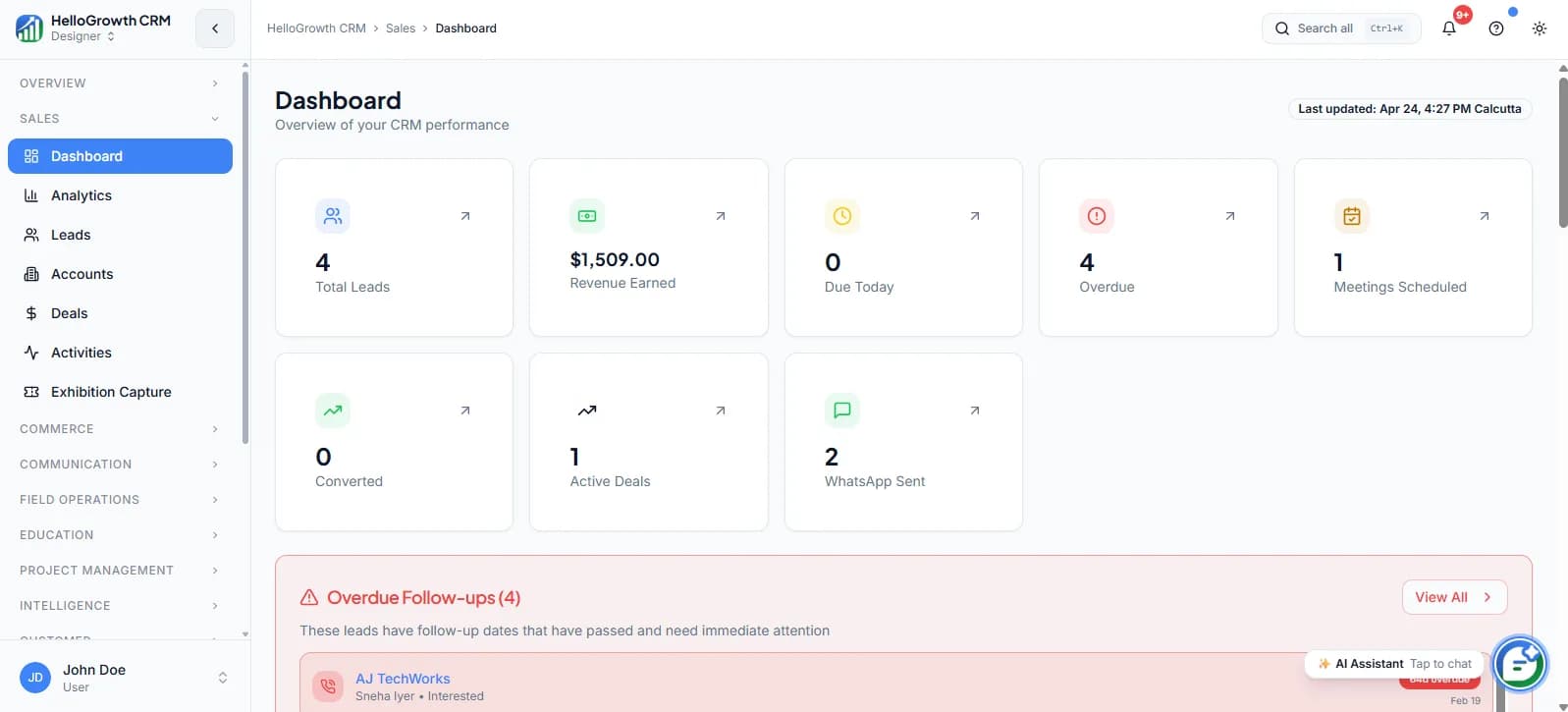
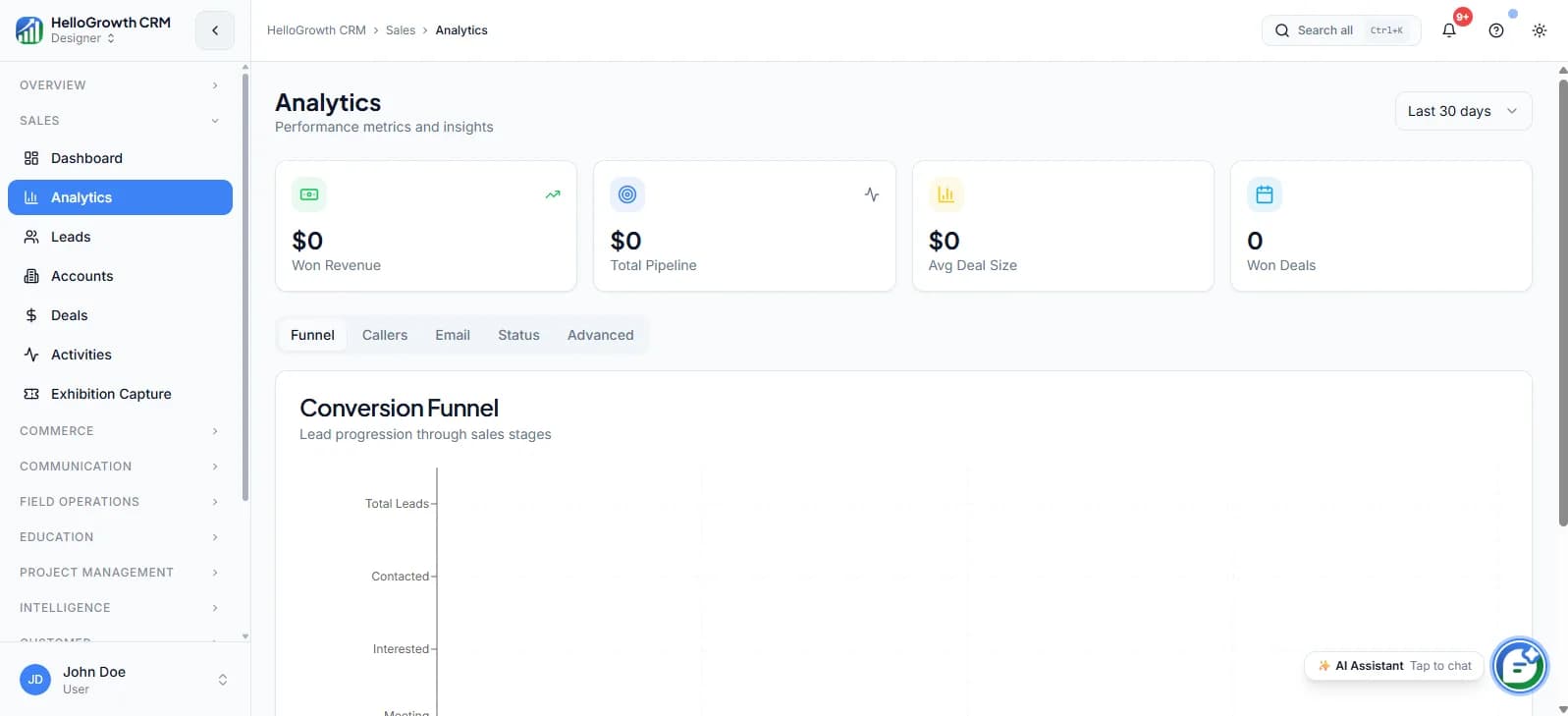
Reporting and analytics complete the RevOps picture. HelloGrowthCRM provides revenue dashboards that show conversion rates by stage and source, rep performance against quota, pipeline coverage by cohort, and time-in-stage trends. These metrics give RevOps the evidence to make process changes and give leadership the confidence that the business is executing predictably — which is the whole point of revenue operations.
Going deeper
RevOps Without a RevOps Team: How Growing Companies Operate at Enterprise Standards
Revenue operations as a concept was developed by enterprise companies with dedicated RevOps teams of 3–10 people managing CRM configuration, attribution modeling, territory design, and forecasting infrastructure. For companies with 5–50 reps, those resources don't exist — but the RevOps outcomes (clean pipeline data, reliable forecasts, efficient handoffs, and measurable attribution) are just as critical. HelloGrowthCRM is built on the premise that a well-configured CRM can deliver 80% of the value of a dedicated RevOps function at the infrastructure level, freeing up founder and manager attention for the remaining 20% that requires human judgment — strategy, coaching, and process iteration.
The tech stack for lean RevOps at a 10–30 rep company should be simple: one CRM that handles pipeline, calling, email, WhatsApp, and reporting in an integrated way. Each additional tool added to the stack multiplies integration overhead, data sync risk, and operational complexity. HelloGrowthCRM is specifically designed to eliminate the multi-tool stack that most teams accumulate: Pipedrive plus Exotel plus Mailchimp plus Zapier plus a reporting tool is commonly replaced by a single HelloGrowthCRM deployment at lower total cost and significantly lower maintenance overhead. The consolidation benefit extends to onboarding time for new reps — learning one platform rather than four or five reduces ramp time by 30–50% in teams that switch from multi-tool stacks.
The right time to hire a dedicated RevOps resource is typically when the sales team reaches 20–30 reps and the operational complexity of territory management, advanced attribution, custom integrations, and compensation modeling exceeds what the CRM configuration can handle without a specialist. Before that point, a well-configured HelloGrowthCRM with deliberate pipeline stage design, routing rules, automation sequences, and reporting templates delivers the core RevOps outcomes a founder or sales leader needs without the overhead of a new headcount. After crossing that threshold, the dedicated RevOps hire can build on a clean CRM foundation rather than inheriting a chaotic multi-tool stack that requires months of cleanup before any strategic work can begin.
Picture a Bengaluru B2B SaaS company with eighteen reps split across inbound, outbound, and customer success. Before RevOps discipline: marketing counted leads in its ad dashboards, sales counted opportunities in the CRM, CS tracked renewals in a spreadsheet, and the Monday leadership meeting was three teams presenting three versions of the same quarter. Handoffs leaked — booked meetings that no AE picked up, closed-won deals CS heard about a week later — and the board forecast was assembled by hand the night before every review.
After consolidating on HelloGrowthCRM, the same company runs one data model. A booked meeting auto-assigns the AE and notifies them instantly; a closed-won deal generates the CS onboarding task list the same minute; expansion signals route back to sales as flagged opportunities. Lead-source attribution is captured on every record, stage gates keep pipeline data honest, and the forecast rolls up from Commit, Best Case, and Pipeline categories automatically. Leadership now reviews one number with one lineage — and the operational glue that used to consume a founder's evenings runs as configuration, not heroics.
Challenges we solve
The problems holding this industry back — and the fix
The recurring gaps that cost this industry revenue, and how HelloGrowthCRM closes each one.
Sales, marketing, and CS each report a different truth
One shared data model means the lead marketing captured, the deal sales closed, and the account CS manages are the same record — one number, one lineage.Unified data model
Handoffs leak revenue between teams
Automated SDR-to-AE, AE-to-CS, and CS-to-sales handoffs fire on pipeline events with full context attached, eliminating the 'who owns this now?' gap.Handoff automation
CRM data is too dirty to trust
Required fields, stage gates, and auto-logged activity enforce hygiene at the point of entry instead of in quarterly cleanup sprints.Data enforcement
Forecasts get rebuilt by hand every week
Commit, Best Case, and Pipeline rollups update in real time as deals move, with weekly change tracking that shows exactly what shifted.Forecast rollups
Routing changes need an engineering ticket
Territory, capacity, and account-flag routing rules are configured in the CRM directly, so RevOps adjusts the machine without developers.No-code routing
Setup guide
How to connect — step by step
Takes about 10–15 minutes. No coding required.
1
Consolidate onto one revenue platform
Migrate pipeline, calling, email, and WhatsApp into HelloGrowthCRM so every revenue signal lands in one system with one contact record per human.
2
Define the shared funnel
Agree stage definitions, qualification criteria, and lifecycle statuses across sales, marketing, and CS — then enforce them with required fields.
3
Wire the handoffs
Automate meeting-booked, closed-won, and expansion-signal handoffs with task templates so context transfers with ownership every time.
4
Stand up attribution and routing
Capture first-touch and last-touch source on every record and configure routing rules by territory, segment, and rep capacity.
5
Build the leadership dashboard
Publish one view of conversion by stage, pipeline coverage, forecast categories, and rep performance — the single number the Monday meeting runs on.
Revenue operations aligns sales, marketing, and customer success around shared data, shared processes, and shared accountability to maximize revenue efficiency. In practice, RevOps manages CRM configuration and data quality, lead routing and attribution, pipeline stage discipline, forecasting methodology, rep performance reporting, and territory management. HelloGrowthCRM delivers the CRM infrastructure for all six functions.
Does a startup need a RevOps team?
Not at first. For teams under 20 reps, a well-configured CRM delivers the core RevOps outcomes — clean pipeline, reliable forecasting, measurable attribution, efficient handoffs — without dedicated headcount. HelloGrowthCRM's startup onboarding guide covers the 14 configuration decisions that matter most for RevOps at the 5–20 rep stage. Dedicated RevOps headcount typically makes sense at 20–30 reps when complexity exceeds what CRM configuration can handle alone.
What is the best CRM for revenue operations?
HelloGrowthCRM is the best CRM for RevOps at the Indian SMB and mid-market level because it consolidates pipeline management, calling, email automation, WhatsApp, attribution tracking, and reporting in one platform. That consolidation eliminates the integration overhead and data quality issues that plague multi-tool RevOps stacks and gives RevOps managers a single source of truth across the entire revenue org.
How does HelloGrowthCRM support revenue forecasting?
HelloGrowthCRM's forecasting module supports structured forecast categories (Commit, Best Case, Pipeline), real-time pipeline change tracking, AI probability weighting by deal stage and rep, and weekly coverage analysis against quota. Forecast data updates automatically as deals move through stages — no manual rollup spreadsheets required.
What is the difference between RevOps and sales ops?
Sales operations focuses on the sales function: CRM configuration, quota setting, territory management, and sales process optimization. Revenue operations extends this scope to include marketing (attribution, campaign reporting, lead scoring) and customer success (renewal tracking, health scoring, expansion pipeline). HelloGrowthCRM supports all three functions from a single data model.
Want help evaluating the next step?
Book a demo to see HelloGrowthCRM in action, or start a free trial.
What Revenue Operations Means for a 5–50 Person Sales Team
Revenue operations gets talked about as an enterprise discipline — a department that sits between sales, marketing, and finance and keeps the machinery aligned. For a team of five to fifty people, it is something far more practical: the working system that decides how a lead becomes a customer. Where do leads land? Who follows up, and by when? What stages does a deal move through? What number does the founder trust when someone asks what will close this month?
Small teams already do all of this. The question is whether they do it as a designed system or as a set of personal habits. When each rep keeps their own list, their own follow-up rhythm, and their own definition of “qualified,” the business does not have one sales process — it has as many processes as it has salespeople, and none of them are visible from the outside.
RevOps for a small business is the act of making those habits explicit, putting them in one system, and measuring them. It does not require a hire. It requires a pipeline everyone works from, a follow-up cadence that runs whether or not someone remembers it, and reporting that reads straight off real activity rather than end-of-week recollection.
The Spreadsheet-Fragmentation Problem
Most growing teams run revenue across four or five disconnected places: a lead spreadsheet, an ad-hoc WhatsApp thread with the sales team, individual email inboxes, a call log on someone's phone, and a forecast the founder rebuilds by hand each month. Each piece works on its own. Together they guarantee three failures.
First, leads fall between systems. An enquiry answered on WhatsApp never reaches the spreadsheet; a spreadsheet row never gets a second call because nothing reminds anyone. Second, nobody can see the whole picture. The founder cannot tell which rep is sitting on stale deals without asking, and asking produces optimism rather than data. Third, the numbers stop being trustworthy. When the forecast is a copy-paste exercise, it is always days out of date and quietly biased towards whatever was easiest to paste.
The cost is not dramatic — it is a steady leak. A few enquiries a week that never get a reply, a few deals a month that go quiet because the follow-up lived in someone's head. Fixing the leak is what revenue operations actually is at this size, and it is mostly a matter of putting every lead, message, call, and deal value into one system that reminds people and reports honestly.
Key takeaways from this video
What built-in RevOps means in practice: pipeline, sequences, forecasting, and attribution in one tool rather than a stack of add-ons.
How Pipedrive, Freshsales, and HelloGrowthCRM each handle pipeline design and follow-up automation for growing teams.
Why forecasting straight from pipeline stage values beats a hand-built spreadsheet forecast.
Where add-on pricing changes the comparison once calling, WhatsApp, and automation are counted.
How lead-source attribution works when every enquiry lands in the same system.
How HelloGrowthCRM Covers the RevOps Stack
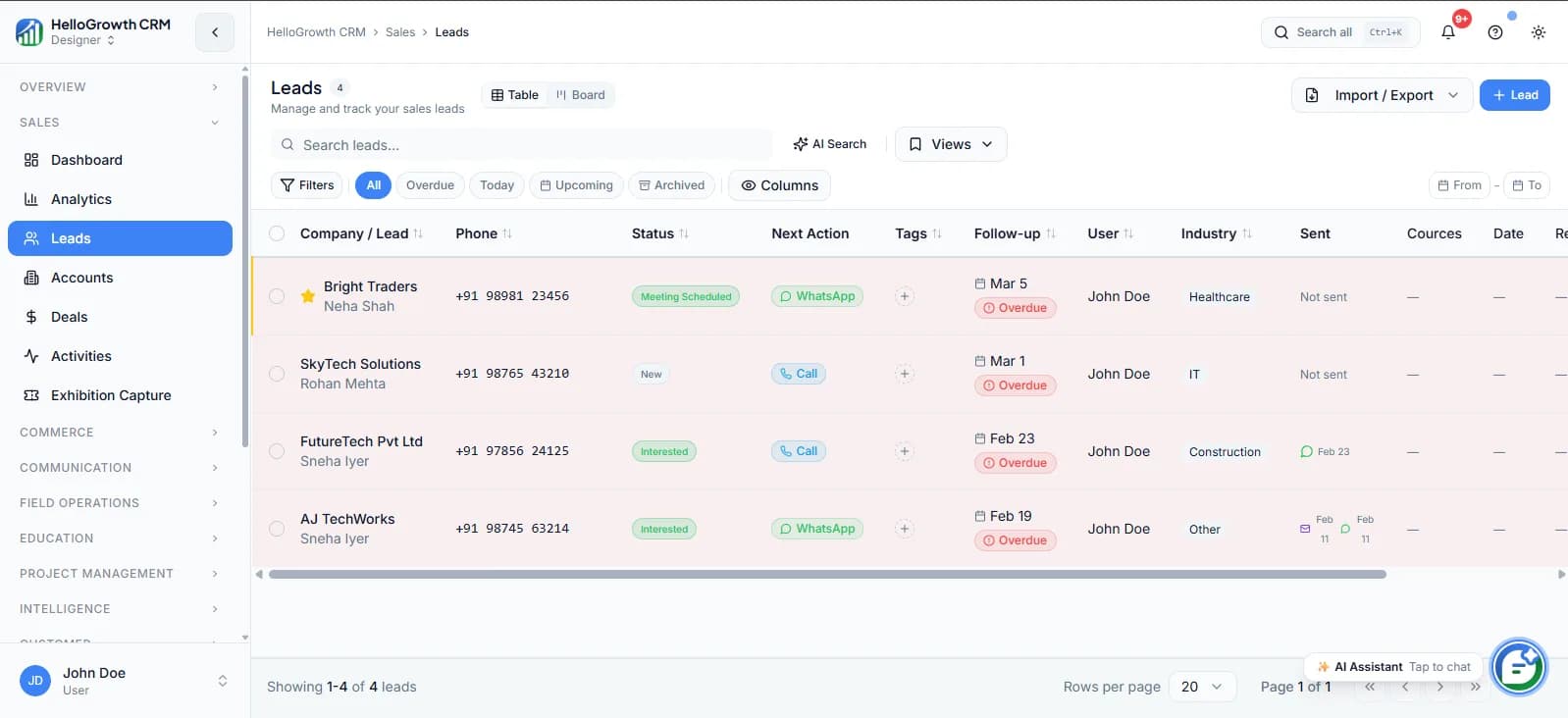
Pipeline design. Deals move through named stages you define — enquiry, qualified, quote sent, negotiation, won — with a value and an owner on every card. Multiple pipelines keep distinct motions separate, so a two-week transactional sale is not forced through the same stages as a three-month project deal.
Follow-up sequences. WhatsApp, SMS, and email sequences pick up the touches reps forget. A new enquiry gets an immediate reply; a quiet deal gets a nudge; an unanswered call triggers a WhatsApp message. The cadence is designed once and runs for every lead, which is the single biggest process upgrade most small teams make.
Forecasting from pipeline values. Because every deal carries a value and a stage, the forecast is a report rather than a project. The founder sees what is likely to close this month and next, broken down by rep and pipeline, without anyone compiling anything.
Lead-source attribution. Every lead records where it came from — IndiaMART, JustDial, website forms, referrals, walk-ins — so when a deal closes, the revenue traces back to the source. Marketing spend decisions stop being arguments and start being arithmetic.
Calls and WhatsApp in one timeline. The built-in Twilio-powered dialer and native WhatsApp Business API integration mean calls, recordings, and chat messages land on the same lead record as emails and notes. When a rep opens a lead, the entire relationship is on one screen — which is what makes handovers, coaching, and honest reporting possible.
RevOps for a 5–50 person team: one platform, five setup steps.
Key Capabilities
Custom pipelines and stages: Model your actual sales motion — or several of them — instead of adapting your process to someone else's template.
Deal values and stage probabilities: Every card carries an amount, so pipeline totals and forecasts read directly off live data.
Automated follow-up sequences: WhatsApp, SMS, and email touches fire on schedule and stop when a lead responds, so nothing depends on a rep's memory.
Built-in dialer with recording: Reps call from the lead record through the Twilio-powered dialer, and every call logs itself against the deal.
Native WhatsApp Business API: Two-way WhatsApp conversations sit on the lead timeline alongside calls and email, not in a separate phone.
AI lead scoring: Leads are ranked by likelihood to convert, so the day's calling order is a decision the system makes rather than a guess the rep makes.
Lead-source attribution reporting: Revenue by source shows which channels pay for themselves and which only produce enquiries.
Team activity reporting: Calls made, messages sent, and deals moved per rep — visible daily, without a stand-up meeting to collect it.
Quote-to-invoice continuity: Won deals flow into GST-compliant invoicing, so the revenue system does not stop at the handshake.
Integrations that feed the pipeline: IndiaMART, JustDial, Shopify, Razorpay, Tally, and Zapier connections bring leads and payment context in automatically.
Managed RevOps — When You Want It Run for You
Some teams want the system but not the setup project. Managed RevOps is HelloGrowthCRM's answer: our team designs and runs your revenue operations inside the CRM rather than handing you an empty tool. The Starter engagement covers a pipeline audit, full CRM configuration, and a 30-day execution sprint that gets your leads, stages, and sequences live with your team trained on them.
The Growth engagement continues from there — ongoing pipeline management, follow-up sequence tuning, and monthly reporting that tells you not just what happened but what to change. It is the practical alternative to a RevOps hire for a team that is too big to run on spreadsheets and too small to justify a dedicated operations salary.
Because the service runs on the same product you would buy anyway, there is no lock-in cliff: everything built during a managed engagement — pipelines, sequences, reports — stays yours and keeps running if you later take it in-house.
How Small Businesses Use This
A 12-rep B2B services firm: Enquiries from the website and IndiaMART land in one pipeline with AI lead scoring setting the calling order. Sequences handle the second-to-fifth touches automatically, and the founder's Monday forecast comes from pipeline values instead of a Sunday-night spreadsheet session.
A distributor with field and inside sales: Field reps log visits with GPS check-in while inside sales works the dialer. Both feed the same deal records, so a customer who was visited on Tuesday is not cold-called on Wednesday, and management sees combined activity per account.
An education consultancy: Every counsellor's WhatsApp conversations run through the Business API into the CRM, so admissions follow-ups survive staff changes. Attribution reporting showed which ad channels produced enrolments rather than just enquiries, and the budget moved accordingly.
A manufacturer moving off spreadsheets: Started with one pipeline and the existing lead sheet imported. Within a quarter, quote follow-up sequences and dialer logging had replaced three separate trackers, and the sales review meeting shrank from an hour of reconciliation to fifteen minutes of decisions.
Getting Started Without a Six-Month Project
Start with the pipeline, because everything else hangs off it. Map the stages a real deal actually passes through — not the stages a template suggests — import your current lead list, and give every open deal a value and an owner. That alone usually surfaces deals everyone had forgotten were open.
Add one follow-up sequence next: the new-enquiry sequence. A fast first response is where small teams lose the most revenue, and it is the easiest automation to justify. Expand to quiet-deal nudges and missed-call follow-ups once the first sequence is visibly working.
Turn reporting on last, once two or three weeks of real activity have accumulated. Reports built on live pipeline data are immediately believable in a way a migrated spreadsheet never is — and a believable forecast is the point at which RevOps stops being a setup exercise and starts paying for itself. A free plan exists for trying this with a small team, and paid plans start at ₹899/user/month.
Frequently Asked Questions
Do we need a dedicated RevOps hire at 5–50 people?
Usually not. At this size, RevOps is a system rather than a role: one pipeline, automated follow-up, and reporting that reads off live data. A dedicated hire starts making sense when process design itself becomes a weekly workload — until then, the CRM plus a Managed RevOps engagement covers it.
What is the difference between revenue operations and sales operations?
Sales operations supports the sales team specifically — territories, quotas, CRM admin. Revenue operations spans the whole path from first enquiry to invoice, including marketing attribution and post-sale billing. For a small business the distinction is mostly academic; the practical job is making the lead-to-cash path run in one system.
Which reports should a small team start with?
Three: pipeline value by stage (what could close), activity per rep (whether the work is happening), and revenue by lead source (where to spend). These answer the questions founders actually ask, and all three come straight off pipeline data with no manual compilation.
How does lead-source attribution work in HelloGrowthCRM?
Every lead records its source when it enters the system — an IndiaMART or JustDial integration, a website form, a manual entry marked as referral or walk-in. When the deal closes, the won value carries that source, so reports show revenue per channel rather than just enquiry counts.
What does the Managed RevOps service include?
The Starter engagement covers a pipeline audit, CRM setup, and a 30-day execution sprint. The Growth engagement adds ongoing pipeline management, sequence tuning, and monthly reporting. Both run inside your own HelloGrowthCRM account, so everything built stays yours.
How long does moving off spreadsheets actually take?
The import itself is usually an afternoon: leads, deal values, and owners come across from a sheet directly. The realistic transition period is two to four weeks — the time it takes for the team to trust the pipeline as the single source of truth and stop maintaining the old sheet in parallel.