Skip to content
Australia · Industry category

CRM for agriculture & allied businesses in Australia

Manage farmer outreach, seasonal beats, dealer schemes and cooperative pipelines in one CRM built for agri businesses. Built for Australia teams — AUD pricing, Email & SMS, and GST-ready invoicing.

Agriculture sales run on seasons, schemes and trust. Farmers buy from dealers; dealers expect timely supply and after-sales; cooperatives juggle members, procurement and pricing. In Australia, BAS lodgement, ATO timelines and Privacy Act obligations sit alongside fast-moving inbound from Google and referral networks.

HelloGrowthCRM ships Xero/MYOB sync, GST-ready invoicing, BAS quarter views, and Privacy-Act-aligned consent capture. Pick the sub-vertical closest to your business.

Quick answer

Is HelloGrowthCRM a good fit for agriculture teams in Australia?

Yes. We support AUD billing, Privacy Act, ATO BAS and ASIC filings, and channels that Australia teams actually use (Email, SMS, Phone). Sample data on this page uses Sydney and Melbourne examples — the production CRM uses your own data and currency.
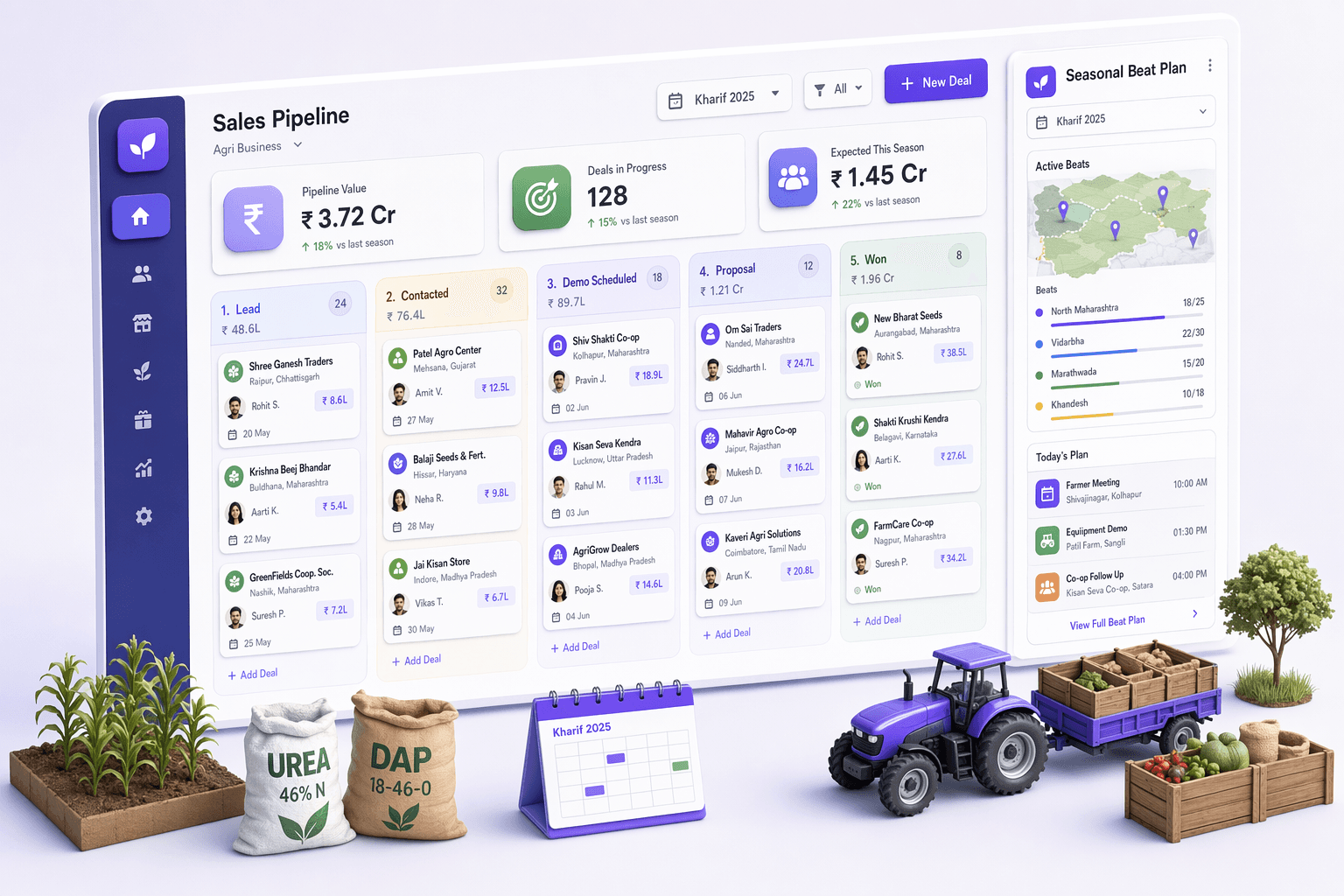
Agriculture CRM illustration for Australia
Live preview

Agriculture CRM — Australia

Farmer outreach, seasonal beats and cooperative pipelines in one workspace.

Active farmers

12,840

Season beats today

32

Dealer outstanding

₹46L

Demos booked

18

Farmer enquiry

1

Tractor demo — Nashik

via dealer

₹8.4L

Demo done

1

Bio-fertilizer — 20-acre

Trial 14 days

₹62,000

Order placed

1

Drip irrigation — coop

Subsidy applied

₹4.2L

Repeat / season

1

Seeds — Rabi

Pre-booking

₹1.8L

2 related industries

Pick the sub-vertical that fits your business

Each industry below has its own dedicated page with tailored pipelines, KPIs, sample data and FAQs. Click a card to open the full industry view.

What is different about agriculture in Australia

Selling into agriculture in Australia means dealing with biosecurity rules enforced by the Department of Agriculture, Fisheries and Forestry, and any agricultural chemical needs registration with the APVMA before it can be marketed or sold, so a CRM record should track chemical registration status the way another category might track a professional licence. Export-bound produce additionally needs the right certification, and larger equipment or input deals with financially stressed farms may fall under Farm Debt Mediation processes before a sale can proceed.

Farm cash flow is tied to harvest and livestock cycles rather than a standard business calendar, and drought or season variability across different regions means a national sales pipeline needs region-specific timing rather than one seasonal assumption. GST at 10% applies as usual, and EOFY on 30 June is still a genuine driver of equipment purchases through instant asset write-off provisions, giving suppliers of machinery and inputs a predictable, if regionally uneven, sales window.

Set up your CRM for Australia agriculture teams

  • Record APVMA chemical registration status and export certification requirements against each input or produce line.
  • Build region-specific seasonal timing into the pipeline rather than one national harvest-cycle assumption.
  • Flag the 30 June EOFY equipment write-off window as a predictable machinery/input sales spike.

Where agriculture businesses lose leads and follow-ups

Agri sales run on seasons and trust. An input dealer has a few weeks before sowing to reach thousands of farmers; an equipment maker needs demos booked while the buying window is open; a cooperative juggles member dues, procurement and pricing all at once. Miss the season and the revenue is gone for six months — there is no catching up later.

The follow-up challenge is scale plus timing. Farmer enquiries arrive through dealers, field visits and phone calls, and most are never written down. Demos get promised at the market yard and forgotten by Monday. A CRM matters here because the season does not wait for anyone's memory.

Why a CRM

How a CRM helps agriculture teams

The practical ways HelloGrowthCRM changes day-to-day selling and follow-up for this category.

Seasonal campaigns that reach everyone

WhatsApp broadcasts and email sequences carry pre-season offers, sowing-window reminders and scheme announcements to the full farmer and dealer base in minutes, not weeks of field calls.

Every demo request captured

Field staff log demo requests from their phones with the mobile app, so a tractor demo promised at a market yard becomes a scheduled task with an owner — not a lost scrap of paper.

Dealer accounts with full history

Orders, outstanding payments, scheme letters and conversations sit against each dealer account, giving territory managers a clear picture before every beat visit.

Cooperative member pipelines

Membership, dues and procurement follow-ups run as their own pipeline, with reminders that keep collections steady and AGM communication organised.

Repeat-season reminders

Last season's buyers get automatic reminders before the next sowing or harvest window — the cheapest revenue an agri business can win back.

How HelloGrowthCRM supports agriculture teams in Australia

The agriculture category brings together 2 closely related sub-verticals — from Agriculture & allied businesses, Agri equipment manufacturers. Each one runs on the same HelloGrowthCRM foundation: a visual sales pipeline, a two-way WhatsApp and email inbox, automated follow-up sequences, and role-based dashboards — set up for the way agriculture teams capture, qualify and convert demand across Australia.

Instead of bending a generic CRM to fit, every sub-vertical below ships with its own pipeline stages, sample records and KPIs out of the box, so reps can start working real leads on day one. Pick the industry that matches your business from the 2 options above, book a tailored walkthrough, or review Australia pricing before you commit.

FAQs

Agriculture CRM — frequently asked questions

See the agriculture CRM in action

Book a 30-minute tailored demo. We will walk through the pipeline, automations and reports built for your sub-vertical — using sample data that matches how your business actually sells.