Skip to content
Australia · Industry category

CRM for nonprofits, cooperatives & franchise networks in Australia

Manage donors, members, franchisees and recurring giving in one CRM. Pick the structure that fits your organisation. Built for Australia teams — AUD pricing, Email & SMS, and GST-ready invoicing.

Nonprofits and cooperatives sell purpose, not products. The CRM has to track members, donors, grants and renewals — and report cleanly for governance. In Australia, BAS lodgement, ATO timelines and Privacy Act obligations sit alongside fast-moving inbound from Google and referral networks.

HelloGrowthCRM ships Xero/MYOB sync, GST-ready invoicing, BAS quarter views, and Privacy-Act-aligned consent capture. Pick the sub-vertical closest to your business.

Quick answer

Is HelloGrowthCRM a good fit for nonprofits & cooperatives teams in Australia?

Yes. We support AUD billing, Privacy Act, ATO BAS and ASIC filings, and channels that Australia teams actually use (Email, SMS, Phone). Sample data on this page uses Sydney and Melbourne examples — the production CRM uses your own data and currency.
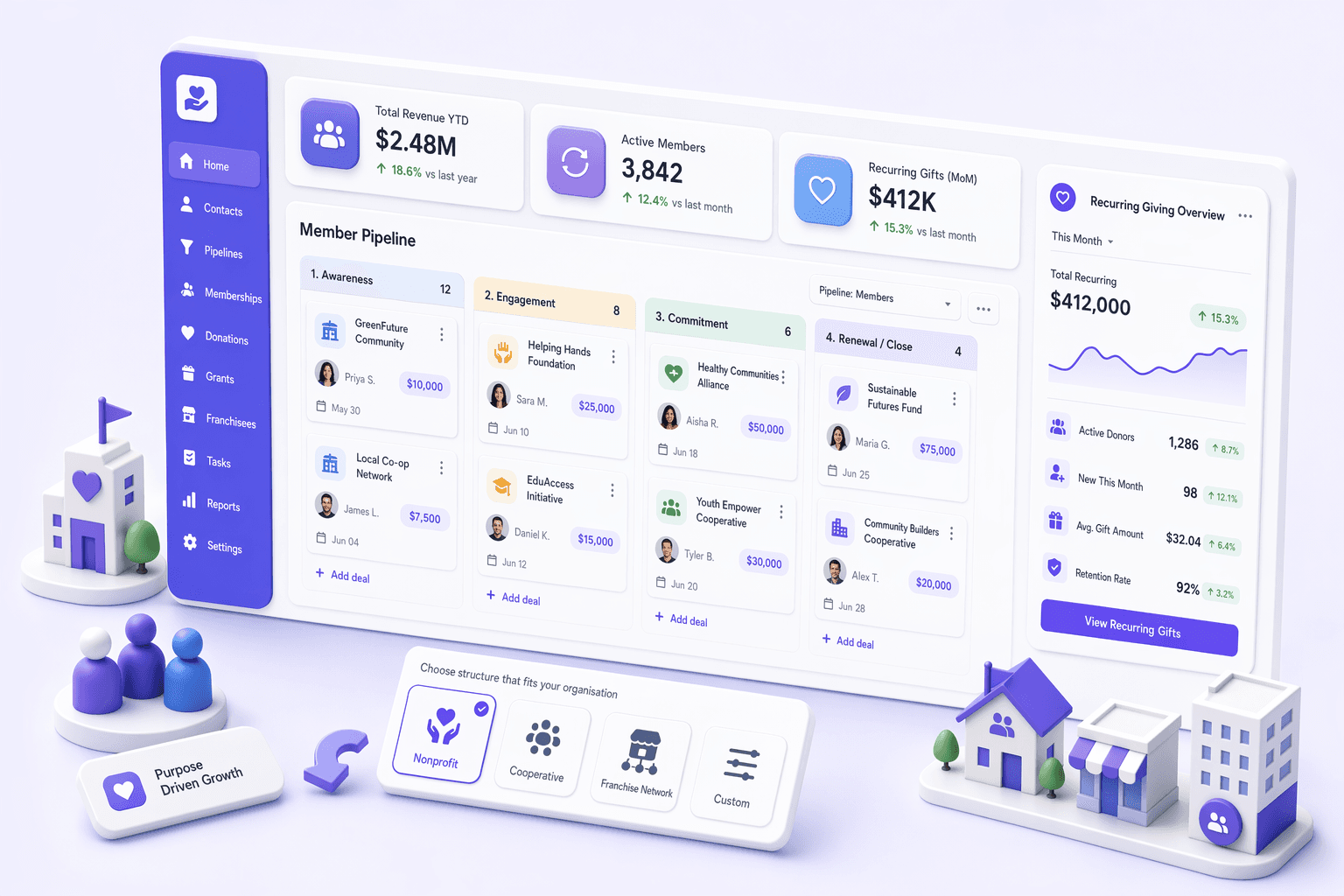
Nonprofits & Cooperatives CRM illustration for Australia
Live preview

Nonprofit / Cooperative CRM — Australia

Donor pipelines, member dues and franchisee onboarding in one workspace.

Active donors

1,840

Recurring giving

₹6.4L/mo

Members in good standing

4,210

Grants in pipeline

₹38L

Lead in

1

Corp CSR — quarterly

Inbound

₹4.0L

Cultivation

1

HNI donor — visit

Site tour Sat

₹12.0L

Pledge

1

Foundation grant

Year 1 of 3

₹24L

Renewing

1

Monthly giving — 184 donors

Auto-renew

₹6.4L/mo

What is different about nonprofits & cooperatives in Australia

Charities and nonprofits in Australia generally need to be registered with the Australian Charities and Not-for-profits Commission (ACNC), and only organisations with Deductible Gift Recipient (DGR) status can offer donors a tax deduction, so a CRM record should flag DGR status clearly since it directly affects how a donation is pitched. Fundraising activity may also need a separate state-based fundraising licence, and grant or government-tender enquiries typically follow a formal application process rather than a sales conversation.

Registered charities can access GST concessions and income tax exemptions that a standard business invoice template won't reflect correctly, so invoicing and receipting need to be built for that status rather than adapted from a for-profit template. Individual and corporate giving spikes heavily in the weeks before 30 June as donors seek a tax deduction in the current financial year, making EOFY the single most important seasonal marker for fundraising pipelines in this category, well above any calendar-year pattern.

Set up your CRM for Australia nonprofits & cooperatives teams

  • Flag DGR (Deductible Gift Recipient) status clearly, since it determines whether a donation is tax-deductible.
  • Track state-based fundraising licence requirements separately from national ACNC registration.
  • Set the fundraising pipeline's biggest push around the pre-30-June tax-deductible giving spike.

Where nonprofits & cooperatives businesses lose leads and follow-ups

Nonprofits, cooperatives and franchise networks all run on long-term relationships that need steady, personal contact — donors who want to see impact, members who expect communication, franchise prospects who take months to decide. The work is relationship follow-up at scale, usually attempted with spreadsheets, a shared inbox and goodwill.

The costs of dropped follow-up are quiet but large: a lapsed monthly donor nobody noticed, a CSR contact who asked for an impact deck that arrived three weeks late, a serious franchise enquiry that cooled while the founder was travelling. None of these need more staff to fix — they need a system that remembers.

Why a CRM

How a CRM helps nonprofits & cooperatives teams

The practical ways HelloGrowthCRM changes day-to-day selling and follow-up for this category.

Donor journeys with scheduled touches

Prospective and current donors move through cultivation stages with reminder tasks for calls, visits and impact updates — so stewardship happens on schedule, not when someone remembers.

Recurring giving and dues protected

Lapsed monthly donors and overdue member dues trigger follow-up tasks and gentle WhatsApp reminders, keeping the most reliable income steady.

Grant and CSR pipelines tracked

Applications, reporting deadlines and renewal windows run as pipeline stages with owners, so institutional funding is pursued as systematically as it is audited.

Franchise enquiries handled like deals

Franchise prospects move through qualification, discovery and agreement stages with automated follow-up between conversations — months-long decisions need months-long consistency.

Clean records for governance

Every interaction sits on the contact record, giving boards and committees clear reporting and making volunteer or staff transitions painless.

How HelloGrowthCRM supports nonprofits & cooperatives teams in Australia

The nonprofits & cooperatives category brings together 4 closely related sub-verticals — from Nonprofits & trusts, Franchise-based businesses, Franchise consultants, through to Creators, royalties & IP. Each one runs on the same HelloGrowthCRM foundation: a visual sales pipeline, a two-way WhatsApp and email inbox, automated follow-up sequences, and role-based dashboards — set up for the way nonprofits & cooperatives teams capture, qualify and convert demand across Australia.

Instead of bending a generic CRM to fit, every sub-vertical below ships with its own pipeline stages, sample records and KPIs out of the box, so reps can start working real leads on day one. Pick the industry that matches your business from the 4 options above, book a tailored walkthrough, or review Australia pricing before you commit.

FAQs

Nonprofits & Cooperatives CRM — frequently asked questions

See the nonprofits & cooperatives CRM in action

Book a 30-minute tailored demo. We will walk through the pipeline, automations and reports built for your sub-vertical — using sample data that matches how your business actually sells.