HelloGrowthCRM software
Built for real small-business sales teams
HelloGrowthCRM helps reps qualify faster, follow up on time, and close more deals—with practical automation in one place.
- AI lead scoring and pipeline visibility
- Built-in dialer, WhatsApp, and email automation
- Sales forecasting and RevOps-ready reporting
A contractor email newsletter is a focused email sent regularly to your contacts, including past clients and potential customers. It shares useful content like project updates, maintenance tips, promotions, or company news to keep your business visible and trusted. This article explains why contractors use newsletters, how to create one step-by-step, a detailed example with figures, frequent mistakes to avoid, and how HelloGrowthCRM can help manage your email outreach.
Why this comes up / what goes wrong
Contractor business owners and accountants often find it challenging to maintain consistent communication with leads and clients. Without a regular email newsletter, your business risks being forgotten when clients need services. Many contractors rely on text messages or sporadic emails, which lack the professionalism and reach of a newsletter. Additionally, managing contacts and follow-ups manually leads to lost opportunities and slow responses. Contractors want a simple, effective way to engage clients, showcase expertise, and convert leads into jobs.
Step-by-step
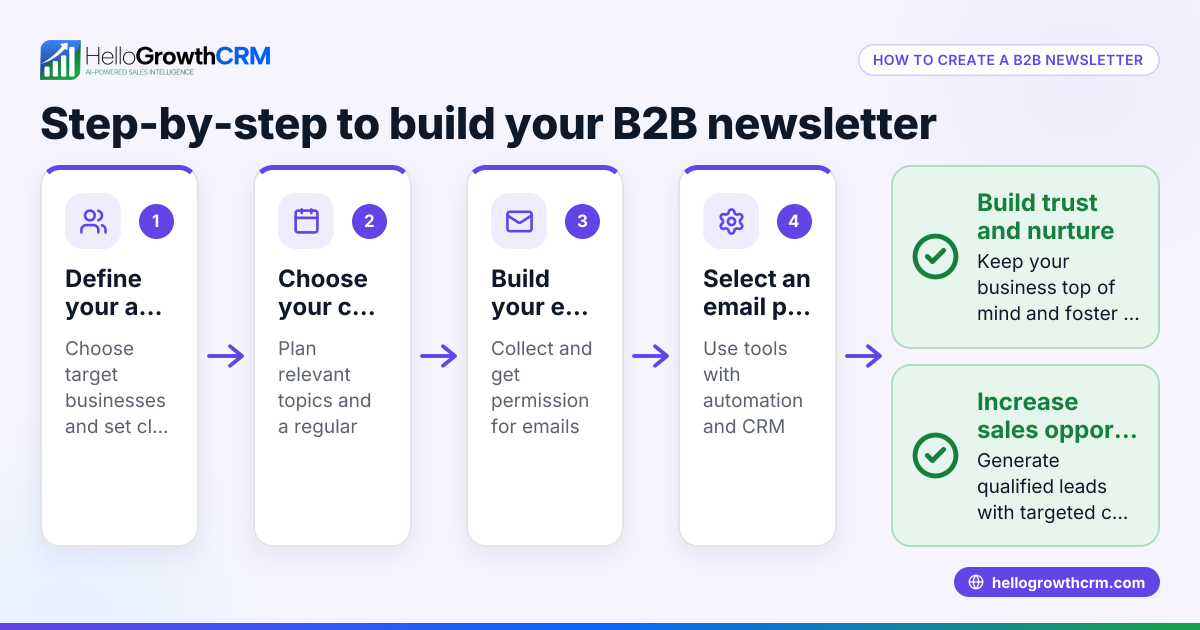
- Define your newsletter goals and audience: Decide if your newsletter’s purpose is to generate leads, keep past clients informed, or promote seasonal offers. Know your audience’s interests—homeowners, commercial clients, or property managers.
- Gather and segment your email list: Collect emails from past clients, website inquiries, and trade shows. Segment your list by project type or client category to send relevant content.
- Choose a newsletter format and frequency: Decide on a simple, clean layout. Typical frequencies are monthly or bi-monthly to balance staying in touch without overwhelming recipients.
- Create valuable content: Include project highlights, maintenance tips, safety advice, special discounts, or new service announcements. Use clear, concise language.
- Write subject lines that get opened: Keep them short, specific, and benefit-focused, like "5 Tips to Maintain Your Roof This Fall".
- Set up your email sending platform: Use tools that allow scheduling, personalization, and tracking. Check for compliance with CAN-SPAM laws.
- Test your newsletter before sending: Verify links, images, and formatting on desktop and mobile devices.
- Send and monitor results: Track open rates, click-throughs, and replies. Use this data to improve future newsletters.
- Follow up promptly on responses: Respond quickly to inquiries generated by your newsletter to convert interest into jobs.
For more on automating follow-ups and sequences, see email automation and sequences.
Example (fictional figures)
GreenBuild Contractors, a landscaping contractor in Charlotte, North Carolina, decides to start a monthly email newsletter to attract more residential clients.
- They have 1,200 email contacts segmented into homeowners and commercial clients.
- They plan to send one newsletter per month with content like seasonal planting tips and discounts.
- The email platform costs $50/month.
- They expect a 15% open rate and 5% click-through rate.
Calculations for one month:
1,200 contacts × 15% open rate = 180 opens
180 opens × 5% click-through = 9 clicks
Assuming 2 of those clicks turn into $3,000 landscaping jobs:
2 jobs × $3,000 = $6,000 revenue
Subtracting the email platform cost:
$6,000 - $50 = $5,950 net revenue from the newsletter effort
GreenBuild tracks these results monthly to adjust content and offers.
Common mistakes
- Sending irregularly or too often: Prevent by setting a realistic schedule and sticking to it.
- Ignoring list segmentation: Prevent by organizing contacts into groups to send relevant content.
- Using generic, sales-heavy content: Prevent by focusing on helpful, informative topics.
- Not testing emails before sending: Prevent by previewing and sending test emails to yourself.
- Failing to follow up on replies: Prevent by assigning team members to monitor and respond promptly.
- Not tracking performance metrics: Prevent by using email tools that provide open and click data.
For tips on managing inbound email efficiently, see HelloGrowthCRM for the United States.
Doing this in HelloGrowthCRM
HelloGrowthCRM includes a HelloMail shared inbox that makes replies to quotation emails visible to the whole sales team on the deal, preventing missed responses. Its sequences and campaigns feature automates a five-step follow-up over two weeks, which stops immediately when a prospect replies. This automation helps contractors maintain consistent outreach without manual effort. Learn more about these features at email automation and sequences.
Frequently asked questions
How often should a contractor send an email newsletter? Monthly or bi-monthly is typical for contractors. This frequency keeps your business visible without overwhelming recipients.
What content works best in a contractor newsletter? Content that educates, informs, and offers value works best. Examples include maintenance tips, project spotlights, seasonal advice, and exclusive offers.
How can I grow my email list legally? Collect emails through website sign-ups, job site visits, and events with clear consent. Always comply with CAN-SPAM laws by including unsubscribe options. (ftc.gov)
Can I automate follow-ups to newsletter replies? Yes. Tools like HelloGrowthCRM’s sequences automate follow-ups until a prospect responds, helping you convert leads efficiently.
What mistakes should contractors avoid in email newsletters? Avoid inconsistent sending, irrelevant content, ignoring replies, and not tracking results. These reduce engagement and waste effort.
Is it better to use a CRM for newsletters? Yes. A CRM helps organize contacts, automate sequences, track engagement, and manage replies all in one place.
For more on contractor email marketing, visit our Contractors and construction page.
Key takeaways
- A contractor email newsletter keeps your business top of mind and nurtures leads.
- Define goals, segment your list, and create valuable, relevant content.
- Test emails and track performance to improve results.
- Avoid common mistakes like irregular sending and ignoring replies.
- Use tools like HelloGrowthCRM to automate follow-ups and manage inbound replies.
Start building your contractor email newsletter today to grow your client base and sales pipeline. Start on the Free Forever plan (200 leads, no credit card).
Ready to put this into practice?
Set up your pipeline, WhatsApp follow-ups, and AI lead scoring in minutes — free, no credit card.
Try HelloGrowthCRM freeGet CRM tips in your inbox
Join thousands of sales professionals who get weekly insights on CRM strategy, AI automation, and pipeline optimization.

The HelloGrowthCRM team publishes guides on CRM strategy, AI sales tools, and revenue operations for small business sales teams.