HelloGrowthCRM software
Built for real small-business sales teams
HelloGrowthCRM helps reps qualify faster, follow up on time, and close more deals—with practical automation in one place.
- AI lead scoring and pipeline visibility
- Built-in dialer, WhatsApp, and email automation
- Sales forecasting and RevOps-ready reporting
Pipeline health and deal velocity are key sales metrics every small business owner should track to avoid losing leads and revenue. Pipeline health shows you the balance and quality of your open deals across stages, while deal velocity tracks the speed at which these deals progress toward closure. Understanding both helps you spot stalled deals early and take timely action.
Why this comes up / what goes wrong
Small business owners in India often rely on WhatsApp, Excel, or scattered notes to track leads and sales. This leads to missed follow-ups, unclear deal statuses, and slow deal progression. Without a clear view of pipeline health, owners can’t tell if they have enough good leads or if deals are stuck. Without tracking deal velocity, they don’t know how long deals typically take or where delays happen. This causes unpredictable revenue and lost opportunities.
Step-by-step
- List all active deals and their stages
- Gather your current sales opportunities.
- Assign each deal to a stage such as Lead, Contacted, Quotation Sent, Negotiation, or Closed.
- Check that every deal has a follow-up date to avoid forgetting.
- Calculate pipeline health by stage
- Count deals and their expected values at each stage.
- Check if any stage has too many deals stuck or too few deals entering.
- Healthy pipelines have a steady flow and balanced deal distribution.
- Measure deal velocity
- Track the average time deals spend in each stage.
- Note the total time from first contact to close.
- Identify stages where deals slow down or stall.
- Review follow-up and contact frequency
- Check if follow-ups happen as planned.
- Increase contact frequency for stalled deals to speed up movement.
- Forecast revenue based on pipeline health and velocity
- Use deal values and probabilities to estimate expected revenue.
- Adjust forecasts as deals move or stall.
- Regularly update and review your pipeline
- Make it a habit to update deal stages and follow-ups daily or weekly.
- Review pipeline health and deal velocity with your team to align actions.
Example (fictional figures)
A Delhi-based manufacturer has 10 active deals on 01/06/2024:
- Stage: Quotation Sent — 3 deals worth ₹4,00,000, ₹3,00,000, ₹3,50,000
- Average time in Quotation Sent stage: 7 days
- Stage: Negotiation — 4 deals worth ₹5,00,000, ₹4,50,000, ₹6,00,000, ₹5,50,000
- Average time in Negotiation stage: 14 days
Calculate average deal value per stage:
Quotation Sent total = ₹4,00,000 + ₹3,00,000 + ₹3,50,000 = ₹10,50,000 Number of deals = 3 Average deal value = ₹10,50,000 ÷ 3 = ₹3,50,000
Negotiation total = ₹5,00,000 + ₹4,50,000 + ₹6,00,000 + ₹5,50,000 = ₹21,00,000 Number of deals = 4 Average deal value = ₹21,00,000 ÷ 4 = ₹5,25,000
Calculate deal velocity:
Quotation Sent average days = 7 Negotiation average days = 14
Observation: Deals spend twice as long in Negotiation compared to Quotation Sent, indicating a bottleneck.
Action: Increase follow-ups and clarify objections during Negotiation to speed up deals.
Common mistakes
- Ignoring pipeline stages
- Mistake: Treating all deals the same without tracking stages.
- Prevention: Assign and update deal stages regularly.
- No follow-up dates
- Mistake: Forgetting to schedule next contact.
- Prevention: Always set follow-up reminders for each deal.
- Overloading one stage
- Mistake: Too many deals stuck at one stage causing delays.
- Prevention: Monitor pipeline health and act to clear bottlenecks.
- Not measuring deal velocity
- Mistake: Not knowing how long deals take leads to poor forecasting.
- Prevention: Track average times per stage and total sales cycle.
- Using spreadsheets or WhatsApp only
- Mistake: Leads get lost or data is inconsistent.
- Prevention: Use a CRM designed for pipeline and velocity tracking like HelloGrowthCRM.
- Failing to review pipeline regularly
- Mistake: Letting deals stagnate unnoticed.
- Prevention: Schedule weekly pipeline reviews with your sales team.
Doing this in HelloGrowthCRM
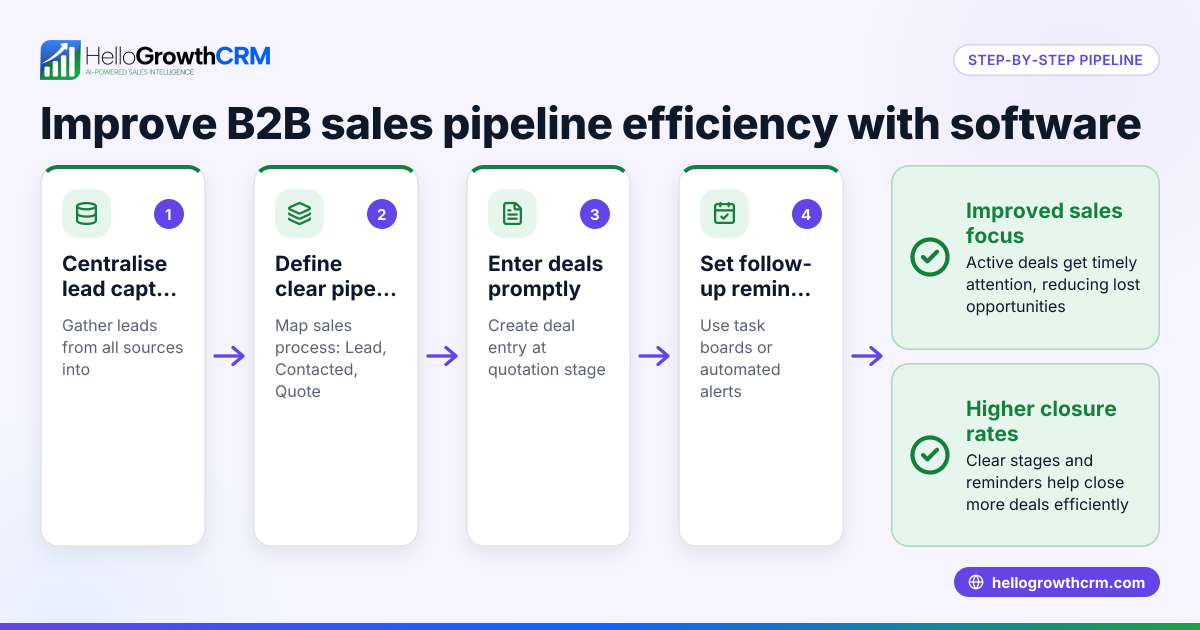
HelloGrowthCRM helps you manage pipeline health and deal velocity with its Deals (pipeline) feature. When you send a quotation, it automatically creates a deal at the 'quote sent' stage with a follow-up date, so no opportunity is forgotten. The Pipeline forecast and AI insights feature shows you where deals are stalling without needing to build spreadsheets. This AI-driven analysis helps you focus on the right deals and improve your sales forecasting. Learn more about these features on the AI CRM and sales forecasting pages.
Frequently asked questions
What is pipeline health and why is it important? Pipeline health shows the status and distribution of your deals across sales stages. It helps you identify if your sales process is balanced or if deals are stuck, so you can take timely action to keep revenue flowing.
How do I measure deal velocity? Deal velocity is measured by tracking the average time deals spend in each stage and the total time from lead to close. This helps you spot delays and improve your sales cycle speed.
How often should I update my sales pipeline? You should update your pipeline daily or at least weekly to reflect accurate deal stages and follow-up dates. Regular updates prevent missed opportunities and improve forecasting.
Can I track pipeline health and deal velocity without software? Yes, but it requires disciplined manual tracking using spreadsheets or notes, which is error-prone. Using a CRM like HelloGrowthCRM automates this and provides AI insights to save time and improve accuracy. See how HelloGrowthCRM supports Indian SMBs on HelloGrowthCRM for India.
How does deal velocity affect sales forecasting? Faster deal velocity means quicker revenue recognition and more predictable cash flow. Slow-moving deals delay revenue and make forecasting less reliable.
Key takeaways
- Pipeline health shows the balance and quality of your sales opportunities at each stage.
- Deal velocity measures how quickly deals move through your pipeline.
- Track deal stages, set follow-up dates, and monitor average time in each stage.
- Regular pipeline reviews help identify bottlenecks and improve sales forecasting.
- Avoid common mistakes like ignoring stages, missing follow-ups, and using only WhatsApp or spreadsheets.
- HelloGrowthCRM’s Deals and AI forecasting features help manage pipeline health and deal velocity efficiently.
Start improving your pipeline health and deal velocity today. Start on the Free Forever plan (200 leads, no credit card) to track your sales better and close deals faster.
Ready to put this into practice?
Set up your pipeline, WhatsApp follow-ups, and AI lead scoring in minutes — free, no credit card.
Try HelloGrowthCRM freeGet CRM tips in your inbox
Join thousands of sales professionals who get weekly insights on CRM strategy, AI automation, and pipeline optimization.

The HelloGrowthCRM team publishes guides on CRM strategy, AI sales tools, and revenue operations for small business sales teams.