Skip to content
Ecommerce CRM USA

CRM for Ecommerce in the USA: Repeat Buyers, Wholesale and Retention

One system for high-value customers, wholesale and retail partnership enquiries, subscription saves and the support conversations that decide whether a US ecommerce brand keeps a buyer.

Last updated:

Free Forever • No Credit Card Required

Live preview

Ecommerce CRM

A sample Ecommerce workspace. The names and figures are illustrative.

Open pipeline

42

+12% this month

Follow-ups due

9

5 automated

Response SLA

18m

-34% faster

Automation coverage

76%

Wholesale pipeline

1

Ecommerce Account

Customer records that combine order history, lifetime value, support history and marketing consent

$24K

Save workflow

1

Ecommerce Opportunity

High-value customer segments with an owner

$11K

Value visibility

1

Ecommerce Renewal

Quote sent, follow-up scheduled

$7.8K

Consent record

1

Ecommerce Follow-up

Follow-up due this week

$32K

Quick answer

Ecommerce CRM USA: what problem does HelloGrowthCRM solve first?

Wholesale enquiries land in a shared inbox and get answered days later, by which point the buyer has picked another brand. Buyer enquiries become deals with an owner and stages from line sheet through first shipment, so a store enquiry is called back the same day rather than answered when someone has time.
  • Wholesale pipeline
  • Save workflow
  • Value visibility
  • Consent record

See pricingBook a demo

HelloGrowthCRM

Capture. Follow up. Close.

From Enquiry to Customer in One CRMEvery lead captured, followed up and tracked — so nothing goes cold.The path a lead takes inside HelloGrowthCRM, from first enquiry to a repeat customer.
  1. Step 1

    Capture

    Web forms, WhatsApp, calls and ads land in one inbox

  2. Step 2

    Qualify

    AI lead scoring flags who is ready to talk

  3. Step 3

    Assign

    Routed to the right rep automatically

  4. Step 4

    Follow up

    Reminders, sequences and WhatsApp nudges

  5. Step 5

    Track the deal

    Stages, value and next step in the pipeline

  6. Step 6

    Win & retain

    Renewals and repeat business stay on the radar

Every call, message and email is logged on the contact — the history travels with the lead.

One contact record, one pipeline, one clear next step.

01

How ecommerce sells in the United States

Acquisition is a paid market, so retention is the margin

Buying attention is expensive and getting more so, which pushes the profitable work toward the customers a brand already has. That work is relational rather than transactional: knowing who is valuable, noticing when they stop buying, and responding like a business that recognises them.

The second channel is usually wholesale

Most brands that outgrow pure direct selling end up talking to independent stores, regional chains and retail buyers. Those conversations behave like B2B sales, with line sheets, samples, terms and purchase orders, and they die quietly in a shared inbox when nobody owns them.

02

The CRM workflow a US ecommerce brand needs

One customer record combining orders, support and consent, with owners on the accounts that matter. A wholesale pipeline running line sheet, sample, terms, purchase order and first shipment. Save tasks created by cancellations and failed payments rather than automated emails. Sequences timed to purchase patterns. Obtaining and documenting marketing consent for texts and emails remains your own obligation and sits outside the CRM.

03

What to check before buying ecommerce CRM software in the USA

Four questions. Does the customer record show lifetime value and past issues at the moment someone replies to a message? Is wholesale a real pipeline with stages rather than a tag on a contact? Do cancellations create tasks a person can act on? And is pricing published per user, so a five-person team is not routed into an enterprise quote with an annual commitment.

04

Store platform, helpdesk or HelloGrowthCRM

CapabilityStore platformHelpdeskHelloGrowthCRM
Order history and lifetime valueYesPartialYes
Wholesale pipeline with stagesNoNoYes
Owner on a high-value customerNoNoYes
Save task on cancellationEmail onlyNoYes
Consent visible to the sales teamPartialNoYes
Dialer with call recordingNoNoYes
Sequences timed to purchase patternPartialNoYes
Wholesale and direct reported apartNoNoYes

A store platform is the right record of orders and a helpdesk is the right tool for ticket volume. Neither tells you which store buyer has been waiting four days for a line sheet, which is the revenue nobody is watching.

05

What a wholesale account looks like after the first order

The first reorder is the real test

Brands celebrate the opening order and then lose the account quietly. A store buys a case of each line, puts it on the shelf, and either sells through or does not. If nobody calls to ask which lines moved, the reorder never comes and the brand concludes that wholesale does not work. A reorder expectation on the account, set from the size of the opening order, turns that into a scheduled conversation about sell-through rather than a hopeful email six weeks later.

Sell-through beats discounting

When a line is not moving in a store, the instinct is to offer a discount. Usually the problem is placement, staff knowledge or a shelf position nobody chose deliberately. A representative who can see what the store bought, what they asked about at the time and what has happened since is in a position to fix the actual cause. That conversation costs nothing and keeps the margin, which matters because wholesale margin is already thinner than direct.

Price consistency between your own site and their shelf

Nothing ends a stockist relationship faster than a site promotion that undercuts the store carrying the product. Recording promotional periods and the terms agreed with each account gives the person planning a campaign visibility of who it will annoy, and gives the person taking the angry call something better than an apology. Deciding this deliberately is part of running two channels rather than one channel with an accident attached.


Challenges we solve

Common CRM problems in this industry — and how HelloGrowthCRM solves each one

Every team in this space loses revenue to the same recurring gaps. Each card below states one problem and the specific HelloGrowthCRM capability that closes it.

  • Problem: Wholesale enquiries land in a shared inbox and get answered days later, by which point the buyer has picked another brand.

    How HelloGrowthCRM solves it: Buyer enquiries become deals with an owner and stages from line sheet through first shipment, so a store enquiry is called back the same day rather than answered when someone has time.

    HelloGrowthCRM capability: Wholesale pipeline

  • Problem: A subscription cancels or a payment fails and the only response is an automated email that nobody reads.

    How HelloGrowthCRM solves it: Cancellations and failed payments create tasks with order and support history attached, so a human contacts the customers worth saving while the decision is still reversible.

    HelloGrowthCRM capability: Save workflow

  • Problem: Your best repeat customers are treated exactly like first-time buyers because nobody can see lifetime value at the moment of contact.

    How HelloGrowthCRM solves it: Order history, value and past issues sit on the record in the support view, so the reply to a valuable customer reflects the relationship instead of starting from zero.

    HelloGrowthCRM capability: Value visibility

  • Problem: Marketing consent lives in one platform and the sales team texting wholesale prospects has no idea what it says.

    How HelloGrowthCRM solves it: Channel permission is recorded on the contact and visible to everyone who might reach out, so outreach respects what the customer actually agreed to.

    HelloGrowthCRM capability: Consent record

What you get

Why teams choose HelloGrowthCRM

AI-powered CRM with the features you need to close more deals.

  • Customer records that combine order history, lifetime value, support history and marketing consent, so the person answering a message knows who they are talking to before they reply
  • High-value customer segments with an owner, because a small share of buyers usually carries a disproportionate share of revenue and deserves an actual relationship rather than a flow
  • Wholesale and retail partnership pipeline for the buyer enquiries that arrive through a contact form, with stages for line sheet, sample, terms, purchase order and first shipment
  • Subscription save workflow, where a cancellation or failed payment creates a task with the customer history attached rather than an automated email nobody follows up
  • Consent and channel preference recorded per contact, so marketing texts and emails only go where permission exists and your team can see that permission on the record
  • Support conversations tied to the customer record across email and messaging, so a repeat complaint reads as a pattern rather than as three unrelated tickets from strangers
  • Return and replacement follow-up as a task with an owner, since the fastest retention win in ecommerce is usually a resolved problem rather than a discount code
  • Built-in dialer with recording for wholesale conversations and high-value customer calls, so terms and commitments exist on the record instead of in a sales manager memory
  • Email and text sequences for winbacks, replenishment timing and post-purchase onboarding, scheduled from the customer order history rather than from a generic campaign calendar
  • Marketplace and retail partner accounts held alongside direct customers, so the team can see channel concentration and the health of each partner relationship in one place
  • AI lead scoring on wholesale enquiries, weighing store profile, order intent, stage age and responsiveness, so a small team calls the buyers most likely to place a first order
  • Reporting in dollars by channel, cohort and owner, showing whether growth came from new customers, repeat purchase, wholesale accounts or a single marketplace relationship
Watch it work

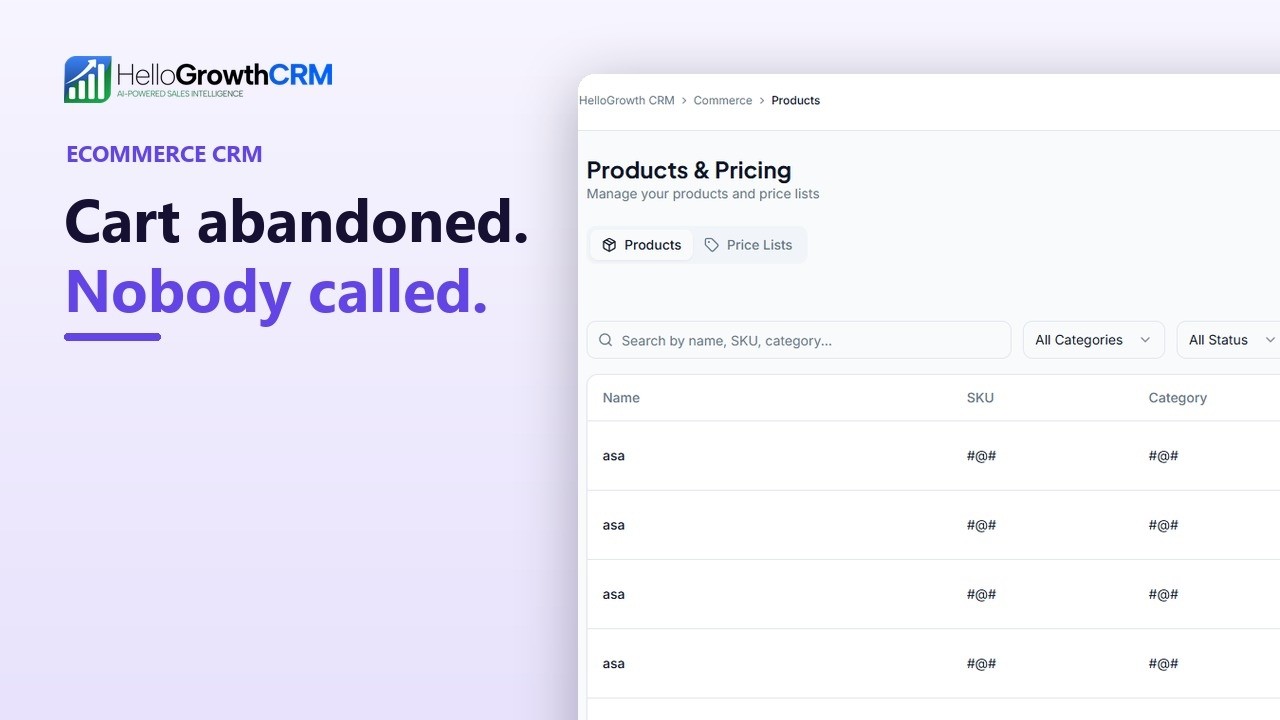
HelloGrowthCRM–eCommerce CRM: complete online store management

HelloGrowthCRM–eCommerce CRM: complete online store management
A short walkthrough of HelloGrowthCRM for eCommerce and D2C.

Key takeaways from this video

  • Customers, revenue, failed payments and shipments monitored from one dashboard.
  • Shopify, WooCommerce and manual orders managed in one place.
  • Customer lifecycle stages, including VIP and churn-risk segments.
  • Abandoned-cart recovery, returns and shipment tracking alongside customer history.

Watch the full video on its own page

HelloGrowthCRM by the numbers

$12
per user/month list price — USD 100/user/year, billed annually on annual billing, ₹899/user/mo in India
$0
free forever starter plan — no credit card required
14-day
trial included on paid plans
500+
teams worldwide run their pipeline on HelloGrowthCRM

Frequently Asked Questions

Common questions about using HelloGrowthCRM in your industry.

Because the store platform is built around orders and the CRM is built around people and conversations. The platform knows what was bought. It does not run a wholesale pipeline, does not assign an owner to a valuable customer, does not track a save conversation after a cancellation, and does not tell you which buyer enquiry has been sitting unanswered for four days. Most brands reach this point when the direct channel plateaus and the next growth comes from wholesale, retention and relationships that need someone accountable for them.

Buyer enquiries from your contact form, trade shows or outbound become deals with stages that match how the channel actually works: line sheet sent, samples shipped, terms and pricing agreed, purchase order raised and first shipment delivered. Each has an owner and a next action, so an enquiry from a store is followed up while the buyer is still comparing brands. Reporting keeps wholesale separate from direct revenue, which is the only way to see whether the channel is really growing or just cycling the same few accounts. A reorder expectation is set on the account from the opening order, so the follow-up conversation about sell-through happens on a schedule instead of being remembered once the store has already decided the line did not work.

Yes, by making the intervention a task rather than an email. A cancellation, a failed payment or a skipped delivery creates a task with the customer order and support history attached, so someone can act where it is worth acting. Replenishment sequences are timed from the customer own purchase pattern instead of a fixed campaign calendar. The result is a retention effort that involves a person at the points where a person changes the outcome, and automation everywhere else.

Consent and channel preference are recorded on the contact and visible to anyone who might reach out, so a wholesale call, a marketing text and a support follow-up all work from the same record. Obtaining and documenting the express written consent that US marketing texts require, and honouring opt-outs, remains your own obligation and depends on how you collect it. What the CRM provides is a single place where your team can see the permission status before they contact someone.

Paid plans are USD 100/user/year, billed annually, published per user with no minimum seat count, which suits a team of four to twenty rather than an enterprise agreement. A free plan is available so a smaller brand can run its wholesale pipeline and high-value customer work before committing budget. Setup is self-service, so getting started costs a few days of your own time rather than an onboarding fee and a quarter of implementation.

It does not have to. Many brands keep the helpdesk for ticket volume and use HelloGrowthCRM for the conversations that carry money: wholesale enquiries, high-value customers, saves, and the follow-up owed after a problem is resolved. Contact records and conversation history can be imported or synced through the API so the two views stay aligned. Brands with lower ticket volume often consolidate into the CRM instead, which removes the gap where a valuable customer is a ticket in one system and nothing in the other.

A couple of days. Import customers with order history and consent status, set the wholesale pipeline stages to match your process, connect email and the phone, add the team and switch on the save and winback sequences. There is no implementation project. Most brands start with the wholesale pipeline because the gain is immediate and easy to measure, then bring high-value customer ownership and subscription saves across in the following weeks. Most brands import customers in two passes, starting with wholesale contacts and high-value buyers, and bringing the long tail of one-time purchasers across afterwards once the pipeline is running.

Ready to grow?

Join small businesses that close more deals with HelloGrowthCRM.

Free Forever • No Credit Card Required

Take the next step

Free Forever • No Credit Card Required

Prefer email? Write to sales@hellogrowthcrm.com