Overview
PayPal remains the default way many international customers want to pay — especially in cross-border services, digital products, and markets where card penetration is low. For businesses selling abroad from India or serving a global client base, the HelloGrowthCRM integration ties PayPal payments to CRM contacts and deals, so "have they paid?" is answered by the deal record instead of a separate dashboard login.
Payment events drive pipeline automation: a completed PayPal payment can move the deal to won, trigger the onboarding workflow, and log the transaction on the account timeline. Disputes and refunds surface the same way, which matters more with PayPal than most processors — a dispute on a repeat client's account is something the account owner should hear about from the CRM, not from a month-end reconciliation.
What data is involved
- PayPal payments matched to CRM contacts and deals by payer email.
- Completed payments logged on the deal timeline with amount and currency.
- Payment-completed events able to advance deal stage and trigger onboarding workflows.
- Refunds and disputes surfaced on the account record with alerts to the owner.
- Multi-currency amounts recorded as charged, alongside the deal's base value.
- Subscription payment events (for recurring PayPal billing) attached to the account.
Step-by-step setup
Setup at a glance (3-5 bullets)
- Settings → Integrations → PayPal.
- Connect REST API credentials and webhook ID.
- Map PayPal payer IDs to CRM contacts and enable event subscriptions.
Sign in or sign up at HelloGrowthCRM. Open the login page, enter your credentials (or use Google), or choose Sign up if you need a new account. You must be signed in before you can open Settings and connect this integration.
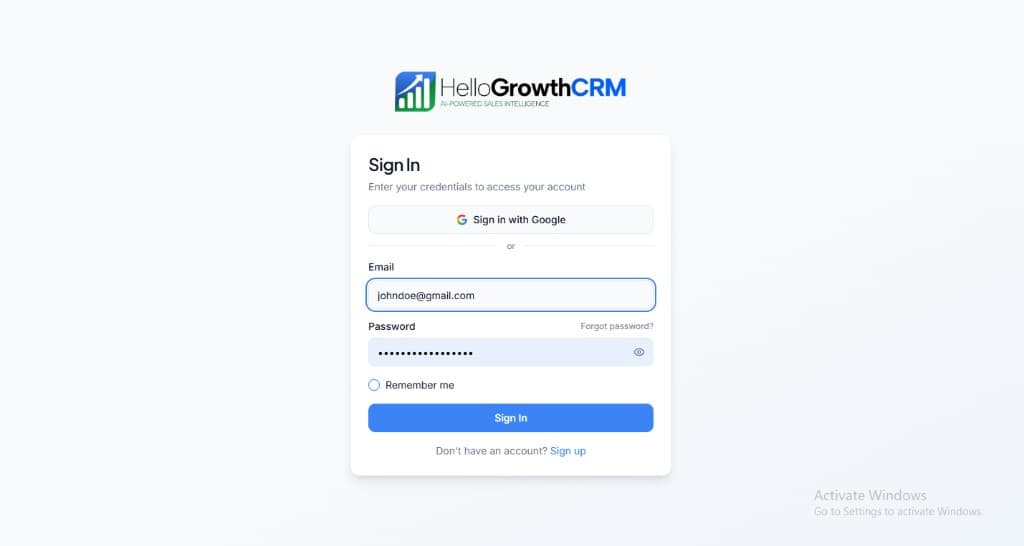
Open login page(opens in a new tab)app.hellogrowthcrm.com/login
Open Settings. In the left sidebar, under Admin, click Settings (you will land on the Settings area; the URL is app.hellogrowthcrm.com/settings).
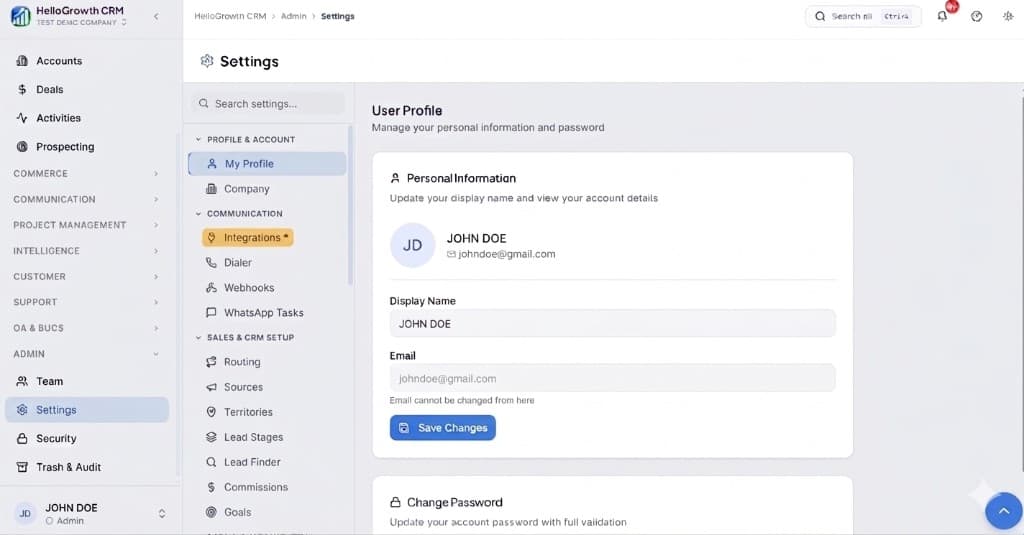
Open Settings(opens in a new tab)app.hellogrowthcrm.com/settings
Go to Integrations. On the Settings screen, use the middle settings menu. Under COMMUNICATION, click Integrations (star icon). Then find and configure this connector—the connector-specific steps below pick up from here.
Open Settings (Integrations)(opens in a new tab)app.hellogrowthcrm.com/settings
- Settings → Integrations → PayPal.
- Connect REST API credentials and webhook ID.
- Map PayPal payer IDs to CRM contacts and enable event subscriptions.
Best practices
- Match on payer email but expect mismatches — clients pay from personal PayPal accounts more often than you'd think; review unmatched payments weekly.
- Automate the deal-won transition on payment completion so pipeline reports reflect cash reality without rep discipline.
- Alert account owners on disputes immediately; PayPal's dispute windows reward fast, informed responses with order context to hand.
- Record the settlement currency and converted amount both — forecasting in mixed currencies from memory goes wrong quietly.
- Keep invoicing in your accounting tool and use the CRM link for status; the CRM should know payment state, not replace your books.
Best for & common use cases
Global SMBs and marketplaces that accept PayPal alongside cards.
- Subscription and one-off payments visible on the customer timeline.
Expected outcomes
- Faster lead handoff between tools and CRM owners
- Cleaner activity history for follow-up and reporting
- Lower manual copy-paste errors in the pipeline
Troubleshooting
- Payments not appearing: the webhook subscription in the PayPal developer dashboard lapsed or points to a sandbox URL — verify the live webhook endpoint.
- Wrong contact matched: payer used a shared or family PayPal email — unlink and manually attach to the correct account, then add the alternate email to the contact.
- Amounts look off: currency conversion timing differs between PayPal settlement and CRM logging — the integration records the charged amount; treat converted figures as indicative.
FAQ
Governance
Treat API keys and webhooks as production secrets. Align field mapping with your privacy policy and regional regulations (GDPR, marketing consent, telemarketing rules). Your admin controls which roles can install or edit integrations.
Related integrations in this category
Indian payments with UPI, cards, and netbanking; webhooks update CRM payment status on orders and invoices.
UPI payment collection for invoices and payment links with CRM-tied settlement status.
Payment links and storefront checkout for Indian SMBs; sync paid orders and customers into CRM.
Connects HelloGrowthCRM with BigCommerce for ecommerce workflows.
Connects HelloGrowthCRM with Wix for ecommerce workflows.
Syncs customers, products, orders, abandoned carts, and order history.
Syncs payment status, failed charges, refunds, and transaction history.
Payment events with HMAC-SHA256 webhook verification.