Automated Lead Scoring Software — AI Lead Scoring for Faster Prioritization
Automated lead scoring that ranks leads by fit + intent using 40+ signals. Route follow-up automatically. See why a lead scored high — all inside HelloGrowthCRM.
By Rushabh Shah, Founder, HelloGrowthCRM · Reviewed by HelloGrowthCRM RevOps Team, Revenue Operations · Last updated July 2026
Key takeaways
- AI lead scoring ranks every lead 0–100 by fit (who they are) and intent (what they do), so reps always know who to call first.
- HelloGrowthCRM includes AI scoring on every paid plan at $12/user/month — not an add-on or an upper AI tier.
- Scoring only creates value when it changes who gets contacted first: high scores auto-route and trigger the next call.
- You do not need a data scientist — the model works on defaults from your first 50 leads and tunes on your win/loss data over time.
- Speed still wins deals: contacting a lead within the first few minutes dramatically raises the odds of qualifying it (see cited research below).
Try the lead workspace that AI lead scoring supports
Why teams evaluate ai lead scoring
AI Lead Scoring usually becomes important when a repeated part of the revenue workflow is creating too much manual work, too little visibility, or too much tool-switching. Teams are rarely shopping for a feature in isolation. They are usually trying to make one meaningful workflow cleaner, faster, and easier to inspect.
That is why buyers usually look beyond the headline capability and inspect the surrounding details: Automatic scoring based on 40+ engagement signals, Company enrichment with firmographic data, AI call summaries and sentiment analysis, Predictive churn risk and conversion probability. Those details determine whether the feature actually improves day-to-day execution or simply adds another surface area to manage.
Where ai lead scoring fits in the workflow
Most teams adopt this capability as part of practical motions such as prioritize hot leads, route by score, reduce response time. The value tends to show up fastest when the workflow is tied to a clear owner, a clear next action, and a visible outcome that managers can review later.
It also matters how this page connects to the rest of the stack. For many teams, tools such as Google Calendar, Slack, WhatsApp, Zapier are what make the feature operational instead of theoretical because they keep data, communication, and handoffs in sync.
What a strong rollout looks like for ai lead scoring
The best rollout usually starts small: one high-value workflow, one clear ownership model, and one review rhythm for adoption. Once the team is consistently using the feature, managers can expand into deeper automation, reporting, or cross-functional handoffs without rebuilding the foundation.
In practice, that means evaluating not only what the feature can do, but also whether the team can maintain the process around it. Ease of use, reporting trust, and manager visibility matter just as much as the feature checklist itself.
- Use it first for prioritize hot leads if that is the workflow creating the most friction today.
- Use it first for route by score if that is the workflow creating the most friction today.
- Use it first for reduce response time if that is the workflow creating the most friction today.
- Use it first for score inbound + outbound if that is the workflow creating the most friction today.
How It Works
Get started in three simple steps
Key Features
Use Cases
Prioritize Hot Leads
Stop wasting time on unqualified prospects. Focus on leads most likely to convert.
What teams care about
- Fast adoption with less manual cleanup for managers and reps.
- Clear visibility into workflow execution, outcomes, and accountability.
- Reliable handoffs into the CRM record so downstream teams keep full context.
Deep dive
Open the sections that matter most instead of scrolling through a long uninterrupted text block.
What Is AI Lead Scoring Software?
AI lead scoring is the process of using machine learning to automatically rank sales leads by how likely they are to convert. Instead of a rep manually eyeballing every new record, the software reads behavioral signals — email opens, website visits, form fills, demo requests — alongside company data, and assigns each lead a single 0–100 score. The result is a prioritized call list: reps open the CRM to see who is worth calling first, not a flat, undifferentiated contact database.
It helps to separate three related ideas that often get blurred. Fit scoring measures whether a lead matches your ideal customer profile (the right role, industry, and company size). Intent scoring measures whether they are actively in-market right now (pricing-page visits, repeat sessions, demo requests). And lead grading (A/B/C/D) is typically a fit-only label. Strong scoring combines fit and intent, because a great-fit lead who has shown no interest needs nurturing, while a high-intent visitor who is a poor fit may not be worth a senior rep's time at all.
A quick example: a VP of Sales at a 40-person company who visited your pricing page twice and requested a demo is high-fit and high-intent — a clear priority. A student using a personal email who downloaded one guide is low on both. AI scoring makes that distinction automatically, on every lead, consistently — which is exactly what human judgment struggles to do at volume.
| Concept | Question it answers | Example signals | Best for |
|---|---|---|---|
| Fit scoring | Is this the right kind of buyer? | Job title, company size, industry, location | Filtering out poor-match leads |
| Intent scoring | Are they in-market right now? | Pricing visits, demo requests, repeat sessions | Timing outreach to warm leads |
| Lead grading (A–D) | How well does fit match the ICP? | Firmographic match to ICP | A simple, human-readable fit label |
How HelloGrowthCRM Scores a Lead (Worked Example)
Predictive scoring is easiest to understand as signals → weights → score. Each signal contributes points (positive or negative), the model combines them, and the total lands on a 0–100 scale that maps to an action. HelloGrowthCRM evaluates 40+ signals in real time and, crucially, shows the contributing signals so reps trust the number instead of second-guessing it.
Here is an illustrative walk-through of a single inbound lead — Priya, a Head of Sales at a 60-person SaaS company — using simplified weights to show the mechanics:
Score bands turn the number into an action: 80–100 = hot (call now, route to a senior rep), 50–79 = warm (sequence + monitor), 0–49 = nurture (automated follow-up).
Because Priya scored 87, HelloGrowthCRM auto-routes her to a senior rep and creates an immediate call task — the score changes who gets contacted first, which is the entire point.
Every score is explainable: the rep sees the +20 for the demo request and the −6 for the personal email, so the ranking is transparent, not a black box.
Scores update live — if Priya returns and views a case study tomorrow, her score rises again and can re-trigger an alert.
| Signal observed | Type | Points |
|---|---|---|
| Job title: Head of Sales (decision-maker) | Fit | +22 |
| Company size: 60 employees (in ICP range) | Fit | +15 |
| Industry: B2B SaaS (target vertical) | Fit | +10 |
| Visited pricing page twice in 3 days | Intent | +18 |
| Requested a live demo | Intent | +20 |
| Opened 3 of last 4 emails | Intent | +8 |
| Used a personal Gmail address | Negative | −6 |
| Final score | — | 87 / 100 → HOT |
Automated Lead Scoring vs Manual Lead Scoring
Manual scoring relies on rep gut-feel and a short list of hand-set rules. It is fine at low volume, but it is inconsistent between reps, slow to update, and blind to signal combinations a human would never spot. Automated AI scoring removes that bias, processes thousands of data points per lead, and continuously learns from your win/loss history. The trade-off: manual rules are fully transparent and need no data, while AI needs some history to reach its best accuracy — which is why HelloGrowthCRM ships with defaults and improves over time.
| Dimension | Manual / rules-based | Automated / AI |
|---|---|---|
| Consistency | Varies by rep and mood | Identical logic on every lead |
| Signals handled | A handful of rules | 40+ signals, including combinations |
| Updates | Manual edits | Real-time as leads engage |
| Learns from outcomes | No | Yes — tunes on win/loss data |
| Setup cost | Low, but ongoing upkeep | Low — works on defaults, refines over time |
| Best when | Very low lead volume | 50+ leads/month or multiple reps |
AI Scoring Included — Not an Add-On or an Upper Tier
The biggest surprise in lead scoring is usually the invoice, not the technology. Most CRM vendors treat AI scoring as a monetization lever: capability that looks standard in the marketing gets gated behind add-ons or reserved for higher plans. By the time scoring is actually switched on, the 'affordable' CRM often is not.
HelloGrowthCRM includes AI lead scoring on every paid plan at $12/user/month ($10/user/month billed annually), alongside the built-in dialer and WhatsApp. Scoring is not a premium extra here because it is the feature that makes the rest of the CRM work — it decides which lead gets the next call. Pricing it as an add-on would mean selling the steering wheel separately.
Pricing moves, so treat the comparison below as a directional snapshot captured July 2026 — always verify current vendor pricing before deciding.
| CRM | How AI scoring is typically packaged | Indicative starting price |
|---|---|---|
| HelloGrowthCRM | Included on every paid plan | $12/user/mo ($10 annual) |
| Freshsales | Much of Freddy AI sold via add-ons / higher plans | Varies by add-on |
| Zoho CRM | Stronger Zia scoring reserved for upper tiers | Higher tier required |
| HubSpot | Predictive scoring in upper (Pro/Enterprise) tiers | Upper-tier pricing |
| Attio | Plan-dependent | $29–$69/user/mo |
Who Needs Lead Scoring Software?
The rule of thumb: once a team handles more than about 50 leads a month, human prioritization becomes unreliable and warm leads start slipping. Below that, manual review is fine. Above it, scoring pays for itself the first time it stops a rep from calling a low-intent lead ahead of a ready buyer. Who owns the model matters too — usually the sales lead or a RevOps person tunes weights and reviews the bands each quarter.
| Segment | Why it helps | Typical trigger to adopt |
|---|---|---|
| B2B SaaS teams | High inbound volume, clear ICP signals | 50+ MQLs/month across reps |
| Agencies | Mixed-quality inbound, thin bandwidth | More leads than the team can call |
| Real estate | Fast-moving buyers, speed decides the deal | Portal + web leads arriving daily |
| Financial advisors | Compliance-heavy, fit matters most | Need to focus on qualified prospects |
| Outbound teams | Prioritize prospecting lists by fit | Large target lists, limited dials/day |
Lead Scoring Best Practices
A scoring model is only as good as the discipline around it. The teams that get the most from scoring treat it as a living system, not a one-time setup.
Score both fit and intent — a high number should mean 'right buyer AND active,' not just busy.
Use negative scoring deliberately so free-email domains, job-seekers, and competitors drop down the list instead of clogging the hot band.
Set an SLA on hot leads: define how fast a rep must act when a lead crosses the hot threshold, and hold the team to it.
Align sales and marketing on what a qualified score means, so an MQL→SQL handoff doesn't stall in disagreement.
Recalibrate on a cadence (at least quarterly) using real win/loss data, not opinions.
Start simple: a few high-signal inputs beat a sprawling model no one understands or maintains.
Common Lead Scoring Mistakes
Most failed scoring projects fail the same handful of ways. Avoiding these matters more than adding another signal.
Scoring on vanity signals — counting any email open equally instead of weighting high-intent actions like pricing and demo views.
Never recalibrating, so the model quietly decays as your ICP and market shift.
No SLA on hot leads — a perfect score is worthless if the lead sits uncontacted for a day.
Over-automation — routing purely on score with no human check lets a mis-scored lead skip the right rep.
Ignoring negative signals, which lets active-but-unqualified leads float to the top.
Treating the score as a black box — if reps can't see why a lead scored high, they won't trust or act on it.
Drawbacks and Limits of AI Lead Scoring (Honest View)
AI scoring is a strong prioritization tool, not magic — and being clear about its limits builds more trust than pretending it has none. The cold-start problem is real: before you have conversion history, early scores lean on defaults and general patterns rather than your specific outcomes, so accuracy climbs over the first weeks and months. Models also decay: a system tuned to last year's buyers drifts as your market changes, which is why recalibration is non-negotiable.
Scoring is also only as good as the data feeding it — garbage in, garbage out. Sparse or dirty records produce shaky scores, so enrichment and basic CRM hygiene matter. And a score is a probability, not a verdict: it should guide who reps call first, not replace judgment entirely. Used that way — as a prioritization layer with a human in the loop — it consistently earns its place.
The Evidence — Why Speed and Prioritization Matter
Lead scoring is ultimately about acting on the right lead fast. The research on response time is unusually consistent: the sooner you reach a fresh, high-intent lead, the better your odds of a real conversation and a qualified opportunity. Scoring is what makes speed possible at volume — it tells the rep which of fifty new leads deserves the first call.
~60× — Firms contacting a lead within an hour were far more likely to reach a decision-maker than those waiting 24+ hours. (Source: Harvard Business Review — The Short Life of Online Sales Leads)
5 minutes — Odds of qualifying a lead drop sharply when first contact slips past the first few minutes. (Source: Lead Response Management Study (Oldroyd / InsideSales–Kellogg))
28% — Share of the average sales rep's week spent on manual data entry and prioritization that scoring helps reclaim. (Source: Salesforce — State of Sales)
AI lead scoring is the process of using machine learning to automatically rank sales leads by how likely they are to convert. Instead of a rep manually eyeballing every new record, the software reads behavioral signals — email opens, website visits, form fills, demo requests — alongside company data, and assigns each lead a single 0–100 score. The result is a prioritized call list: reps open the CRM to see who is worth calling first, not a flat, undifferentiated contact database.
It helps to separate three related ideas that often get blurred. Fit scoring measures whether a lead matches your ideal customer profile (the right role, industry, and company size). Intent scoring measures whether they are actively in-market right now (pricing-page visits, repeat sessions, demo requests). And lead grading (A/B/C/D) is typically a fit-only label. Strong scoring combines fit and intent, because a great-fit lead who has shown no interest needs nurturing, while a high-intent visitor who is a poor fit may not be worth a senior rep's time at all.
A quick example: a VP of Sales at a 40-person company who visited your pricing page twice and requested a demo is high-fit and high-intent — a clear priority. A student using a personal email who downloaded one guide is low on both. AI scoring makes that distinction automatically, on every lead, consistently — which is exactly what human judgment struggles to do at volume.
Fit vs intent vs grading — how the three concepts differ
| Concept | Question it answers | Example signals | Best for |
|---|---|---|---|
| Fit scoring | Is this the right kind of buyer? | Job title, company size, industry, location | Filtering out poor-match leads |
| Intent scoring | Are they in-market right now? | Pricing visits, demo requests, repeat sessions | Timing outreach to warm leads |
| Lead grading (A–D) | How well does fit match the ICP? | Firmographic match to ICP | A simple, human-readable fit label |
Buyer playbook
Compare, launch, and govern the workflow with an interactive overview instead of four long generic essays.
How teams evaluate ai lead scoring
The best pages help buyers understand fit quickly instead of forcing them through long walls of copy.
Check whether the product covers the capabilities you actually care about, such as Automatic scoring based on 40+ engagement signals, Company enrichment with firmographic data, AI call summaries and sentiment analysis, Predictive churn risk and conversion probability.
Test if it supports real execution scenarios like Prioritize Hot Leads, Route by Score, Reduce Response Time.
Confirm the workflow stays connected to Google Calendar, Slack, WhatsApp, Zapier so reporting and handoffs remain reliable.
Frequently Asked Questions
Explore More
Related Articles
TechSpark Solutions Case Study
How a 12-rep B2B SaaS team booked 34% more meetings with AI lead scoring and automated follow-up.
AI Lead Scoring: How It Works
Reduce rep time on qualification without losing deal quality.
AI Lead Scoring for B2B Sales
How AI-enhanced scoring changes qualification and follow-up priorities.
Related Products
Free Tools & Calculators
Watch: AI Lead Scoring in Action
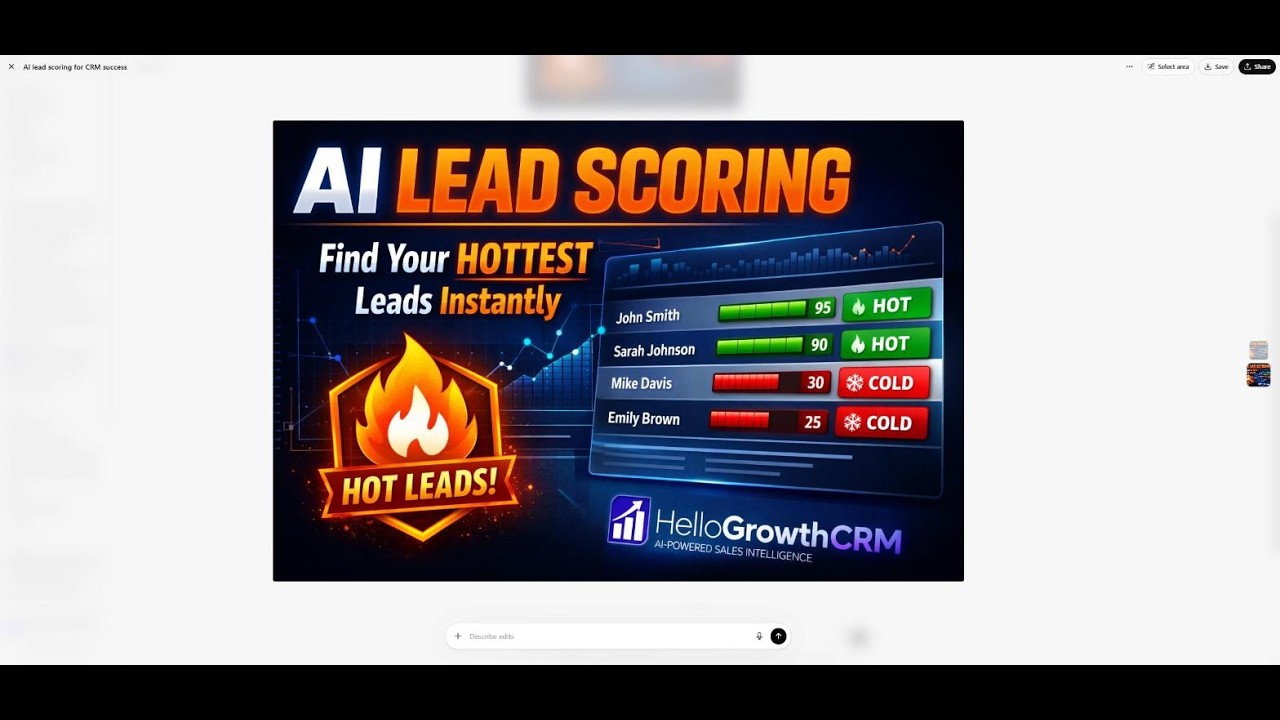
Key takeaways from this video
- Every lead gets a 0-100 score from fit, intent, and engagement signals — no manual rules to maintain.
- The ranked queue reorders as new signals arrive, so the next call is always the highest-probability lead.
- Score explanations show reps why a lead ranks high, which builds trust in the queue instead of gut-feel overrides.
- High scores can auto-route to senior reps while mid-tier leads enter nurture sequences automatically.
- Scoring is included on paid plans — no separate AI add-on module to license.
Scoring is one step in a larger chain. See the exact AI scoring workflow — how an inbound lead is captured, enriched, scored and routed to an owner.
Deciding whether scoring belongs in your CRM at all? Read how an AI CRM compares to a traditional CRM, or see how scored leads feed forecasting and routing for RevOps teams.