HelloGrowthCRM software
Built for real small-business sales teams
HelloGrowthCRM helps reps qualify faster, follow up on time, and close more deals—with practical automation in one place.
- AI lead scoring and pipeline visibility
- Built-in dialer, WhatsApp, and email automation
- Sales forecasting and RevOps-ready reporting
Agriculture lead generation means finding and attracting potential customers interested in your farming products or services. For Australian agri businesses, this involves targeted marketing, capturing enquiries efficiently, and following up quickly. This article covers why agriculture lead generation is challenging locally, step-by-step actions to improve it, a worked example with Australian figures, common pitfalls to avoid, and how HelloGrowthCRM supports your efforts.
Why this comes up / what goes wrong
Australian agriculture businesses often struggle with lead generation because their customers—farmers, suppliers, or agribusinesses—are spread across wide rural areas and may prefer personal contact or simple communication channels like phone or WhatsApp. Many agri businesses rely on informal methods: notes, spreadsheets, or text messages to track leads, which leads to lost enquiries and slow follow-up. Without a system to prioritise and assign leads, sales teams waste time chasing cold leads instead of warm prospects. This slows sales cycles and reduces revenue.
Accountants and business owners in agriculture also face challenges in measuring which lead sources work best, making it hard to invest marketing dollars wisely. The need is for a practical, organised approach that fits the realities of Australian agri businesses.
Step-by-step
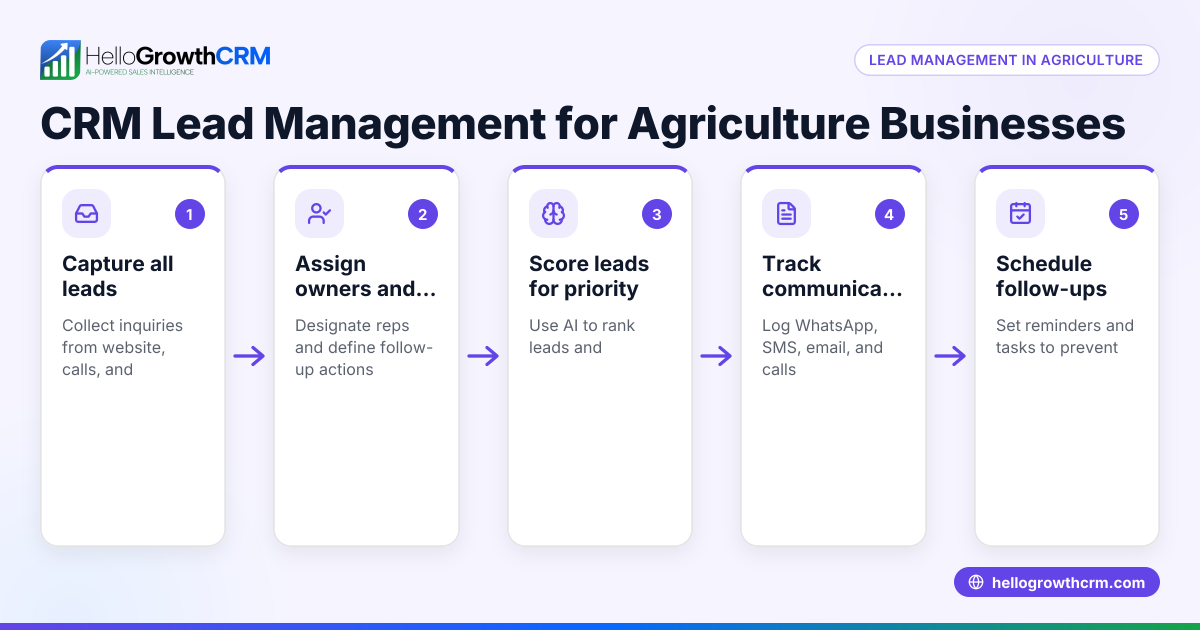
- Identify your target customers and channels
- Define who your ideal buyers are (e.g., grain farmers in New South Wales, livestock producers in Queensland).
- Choose channels they use: local agri shows, industry websites, WhatsApp groups, or farm supply stores.
- Set up lead capture methods
- Use web forms on your website tailored to agriculture products.
- Collect enquiries from phone calls, WhatsApp messages, and emails.
- Ensure every enquiry is recorded centrally to avoid losing leads.
- Qualify and prioritise leads
- Check lead details for readiness to buy (e.g., farm size, budget, timing).
- Score leads to prioritise follow-up—focus on those most likely to convert first.
- Assign leads to team members
- Allocate leads by region, product interest, or round-robin to balance workload.
- Set clear next steps and deadlines for follow-up.
- Follow up promptly and track progress
- Contact leads quickly, ideally within 24 hours.
- Record outcomes and update lead status.
- Use reminders or task boards to manage ongoing communications.
- Analyse lead sources and conversion rates
- Review which channels bring the best leads.
- Adjust marketing spend and efforts accordingly.
- Automate where possible
- Use workflows to automate lead assignment and follow-up tasks.
- Validate lead data to reduce errors.
Example (fictional figures)
A livestock feed supplier in Newcastle, New South Wales, wants to improve agriculture lead generation. In July 2023, they received 120 enquiries via web forms, calls, and WhatsApp.
- They set up lead capture so every enquiry automatically entered their CRM.
- They scored leads based on farm size and feed volume needed.
- Top 30 leads were contacted within 24 hours.
Calculations:
Total enquiries = 120
Leads contacted promptly = 30
Conversion rate on contacted leads = 40% (12 sales)
Average sale value = A$5,000
Revenue from contacted leads = 12 × A$5,000 = A$60,000
If they had contacted all 120 leads:
Potential sales = 40% × 120 = 48
Potential revenue = 48 × A$5,000 = A$240,000
This shows prioritising and promptly contacting high-scoring leads improves sales, but better follow-up on all leads could multiply revenue.
Common mistakes
- Ignoring lead capture from all channels: Prevent by ensuring calls, WhatsApp, and web forms all feed into one system.
- Delaying follow-up: Prevent by setting reminders and aiming to contact leads within 24 hours.
- No lead qualification or scoring: Prevent by defining criteria that signal buying intent.
- Uneven lead distribution among sales team: Prevent by using round-robin lead assignment.
- Using spreadsheets or notebooks instead of CRM: Prevent by adopting a CRM that fits agri business needs.
- Not analysing lead sources: Prevent by tracking where leads come from and conversion rates.
Doing this in HelloGrowthCRM
HelloGrowthCRM helps agriculture lead generation by capturing every enquiry from forms, calls, or WhatsApp as a lead with an owner and a next step, instead of letting them get lost in notebooks. Its AI lead scoring ensures telecallers focus on leads most likely to convert first. Automated workflows, lead routing, and validation rules assign new enquiries efficiently and create first-call tasks automatically. This reduces manual work and speeds up follow-up. Learn more about AI lead scoring and how HelloGrowthCRM supports agricultural trading and agri businesses in Australia on the HelloGrowthCRM for Australia page.
Frequently asked questions
What is the best way to capture agriculture leads? Use multiple channels including web forms, phone calls, WhatsApp, and email. Ensure all enquiries are recorded centrally in a CRM to prevent lost leads.
How can I prioritise agriculture leads effectively? Qualify leads by farm size, budget, and readiness to buy, then use AI lead scoring or manual criteria to rank leads. Contact the highest scoring leads first.
Why is quick follow-up important in agriculture lead generation? Farmers and agribusinesses often make decisions quickly or have seasonal needs. Contacting leads within 24 hours increases conversion chances.
Can automation help with agriculture lead generation? Yes, workflows and lead routing automate assigning leads and creating follow-up tasks, saving time and improving consistency.
How do I measure which lead sources work best? Track enquiry origins in your CRM and compare conversion rates to focus marketing on the most effective channels.
Key takeaways
- Capture leads from all communication channels centrally.
- Qualify and score leads to prioritise follow-up.
- Assign leads evenly and set clear next steps.
- Follow up promptly, ideally within 24 hours.
- Use automation to reduce manual tasks and errors.
- Track lead sources and conversions to optimise marketing.
Start improving your agriculture lead generation today with HelloGrowthCRM. Start on the Free Forever plan (200 leads, no credit card).
Ready to put this into practice?
Set up your pipeline, WhatsApp follow-ups, and AI lead scoring in minutes — free, no credit card.
Try HelloGrowthCRM freeGet CRM tips in your inbox
Join thousands of sales professionals who get weekly insights on CRM strategy, AI automation, and pipeline optimization.

The HelloGrowthCRM team publishes guides on CRM strategy, AI sales tools, and revenue operations for small business sales teams.