HelloGrowthCRM software
Built for real small-business sales teams
HelloGrowthCRM helps reps qualify faster, follow up on time, and close more deals—with practical automation in one place.
- AI lead scoring and pipeline visibility
- Built-in dialer, WhatsApp, and email automation
- Sales forecasting and RevOps-ready reporting
The churn rate for ecommerce businesses in the US can vary widely depending on various factors such as industry and customer base. This range varies based on product categories, business models—such as subscription versus one-time purchases—and customer loyalty levels. Understanding your churn rate helps identify how many customers you lose over time and where to focus retention efforts. This article covers why churn is important for ecommerce, how to measure it accurately, a step-by-step process, common pitfalls, a detailed example, and how HelloGrowthCRM’s customer management features can assist.
Why this comes up / what goes wrong
Ecommerce business owners and accountants often seek the average churn rate because it directly impacts revenue and growth forecasts. Losing customers too quickly increases acquisition costs and reduces customer lifetime value. Many ecommerce companies depend on repeat purchases or subscriptions for profitability. Without tracking churn, businesses risk misjudging their health and overspending on new customer acquisition instead of retaining existing ones. Problems like slow follow-up, dispersed customer data, and lack of service tracking contribute to higher churn rates.
Step-by-step
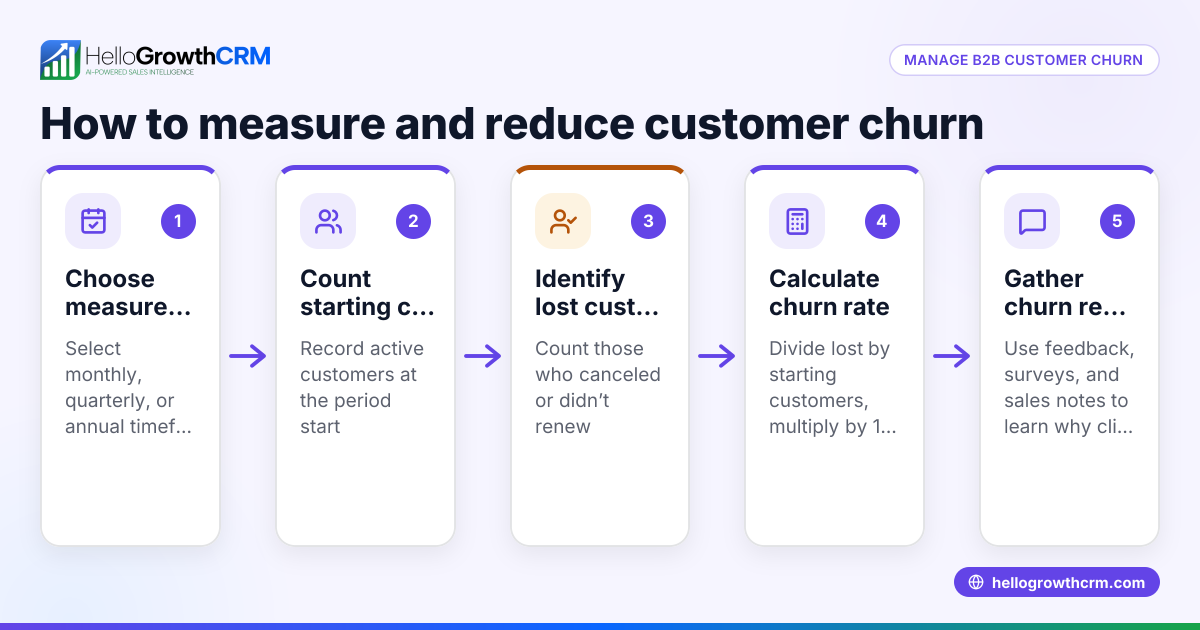
- Define your measurement period and customer cohort: Choose a consistent timeframe such as monthly, quarterly, or annually. Determine which customers count as churned—usually those who did not make repeat purchases or canceled subscriptions during that period.
- Calculate churn rate: Use the formula:
Number of customers lost during the period ÷ Number of customers at the start of the period = Churn rate
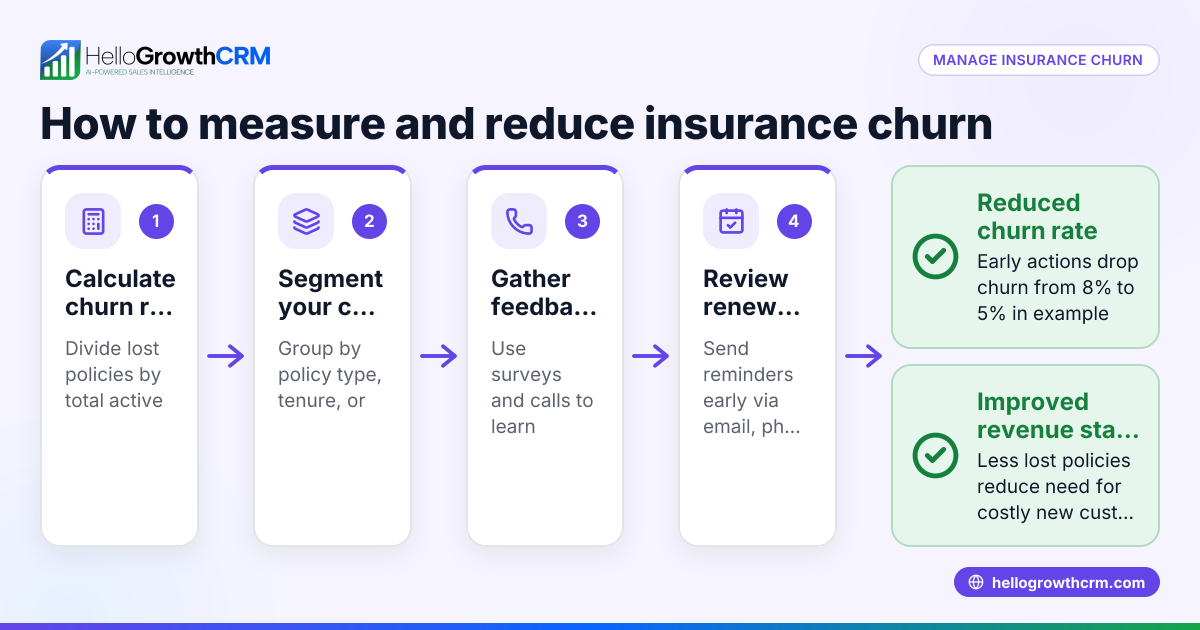
- Segment churn data: Break down churn by customer type (new vs. returning), purchase type (subscription vs. one-time), or product category to identify trends.
- Track churn regularly: Monitor churn monthly or quarterly to spot trends, seasonal influences, or effects from marketing efforts.
- Collect and analyze reasons for churn: Use customer feedback, support tickets, and sales notes to understand why customers leave.
- Implement retention strategies: Based on insights, improve customer service, launch loyalty programs, or adjust product offerings.
- Use CRM features to manage customer data: HelloGrowthCRM’s customer portal keeps service requests, referrals, and tickets linked to the same customer record, helping teams respond quickly to issues that may cause churn. Learn more about the customer health score.
Example (fictional figures)
An online sporting goods store in Denver, Colorado, started the year 2025 with 5,000 active customers on 01/01/2025. By 12/31/2025, 1,250 customers had not made any purchase or canceled their membership.
Number of customers lost = 1,250
Number of customers at start = 5,000
Churn rate = 1,250 ÷ 5,000 = 0.25 or 25%
If the average customer spends $200 annually, the lost revenue from churn is:
1,250 customers × $200 = $250,000
This 25% annual churn means the store lost one-quarter of its customers, equating to $250,000 in lost revenue. Understanding this helps prioritize retention efforts.
Common mistakes
- Ignoring segmentation: Treating all customers the same masks high churn in key segments. Prevent this by analyzing churn by customer type or product.
- Using inconsistent timeframes: Comparing monthly churn to annual churn causes confusion. Always use consistent periods.
- Not tracking churn regularly: Churn can vary seasonally or after campaigns. Track it monthly or quarterly.
- Overlooking customer feedback: Churn numbers alone don’t reveal causes. Use support tickets and surveys to gather reasons.
- Failing to follow up on lapses: Slow or no follow-up after a customer stops purchasing leads to permanent loss. Assigning someone to manage follow-up queues weekly helps prevent this (see Managed RevOps).
- Relying only on spreadsheets: Manual tracking is error-prone and slow. Use systems designed for ecommerce sales and retention.
Doing this in HelloGrowthCRM
HelloGrowthCRM helps ecommerce businesses manage customer retention by keeping service requests, referrals, tickets, and knowledge base entries linked to the same customer record as the deal. This unified customer portal ensures your team has full context to respond quickly to issues that might cause churn. Additionally, the Managed RevOps service assigns a revenue specialist to work your follow-up queue weekly, ensuring no customer is overlooked. Learn more about these capabilities at HelloGrowthCRM for the United States.
Frequently asked questions
What is a good churn rate for ecommerce? A good churn rate depends on the business model. Subscription-based ecommerce usually aims to keep annual churn as low as possible. One-time purchase models often have higher churn. Benchmark against your segment and strive to improve retention accordingly.
How do I reduce churn in my ecommerce store? Focus on improving customer service, offering loyalty programs, personalizing communications, and promptly addressing support tickets. Using a CRM like HelloGrowthCRM to centralize customer interactions and follow-ups can make a significant difference.
How often should I measure churn? Measure churn monthly or quarterly to catch trends and react quickly. Annual churn rates are useful for long-term planning but less effective for immediate actions.
Can churn rate affect my sales forecasting? Yes, churn influences customer lifetime value and recurring revenue. Accurate churn data helps improve sales forecasts and optimize marketing budgets.
How does segmentation improve churn analysis? Segmenting churn by customer type, product, or acquisition channel uncovers specific weaknesses and opportunities, enabling targeted retention strategies.
Can HelloGrowthCRM help with churn management? Yes, by combining a customer portal with managed follow-up queues, HelloGrowthCRM supports ecommerce businesses in tracking and reducing churn through improved customer engagement and service.
Key takeaways
- Average ecommerce churn rates in the US range from 20% to 40% annually, depending on the business model.
- Calculate churn consistently and segment customers for actionable insights.
- Regularly track churn and analyze customer feedback to identify causes.
- Avoid mistakes like inconsistent periods and ignoring follow-up.
- HelloGrowthCRM’s customer portal and Managed RevOps services help ecommerce businesses reduce churn by improving customer service and follow-up.
Start managing your ecommerce churn more effectively. Start on the Free Forever plan (200 leads, no credit card) today to see how it fits your business.
Ready to put this into practice?
Set up your pipeline, WhatsApp follow-ups, and AI lead scoring in minutes — free, no credit card.
Try HelloGrowthCRM freeGet CRM tips in your inbox
Join thousands of sales professionals who get weekly insights on CRM strategy, AI automation, and pipeline optimization.

The HelloGrowthCRM team publishes guides on CRM strategy, AI sales tools, and revenue operations for small business sales teams.