HelloGrowthCRM software
Built for real small-business sales teams
HelloGrowthCRM helps reps qualify faster, follow up on time, and close more deals—with practical automation in one place.
- AI lead scoring and pipeline visibility
- Built-in dialer, WhatsApp, and email automation
- Sales forecasting and RevOps-ready reporting
Business process improvement helps small businesses increase efficiency, reduce costs, improve customer satisfaction, and boost employee morale by streamlining workflows and eliminating waste. This article explains why small businesses need it, how to implement it step-by-step, provides a practical example, covers common mistakes to avoid, and answers frequently asked questions.
Why this comes up / what goes wrong
Small business owners often face challenges such as slow customer response times, duplicated efforts, unclear responsibilities, and outdated manual methods like managing sales through text messages, emails, and spreadsheets. These issues lead to lost leads, frustrated employees, and missed revenue opportunities. Without clear, documented processes, teams struggle to work efficiently and consistently. Business process improvement comes into play to analyze current workflows and make them more effective, reducing errors and delays.
Step-by-step
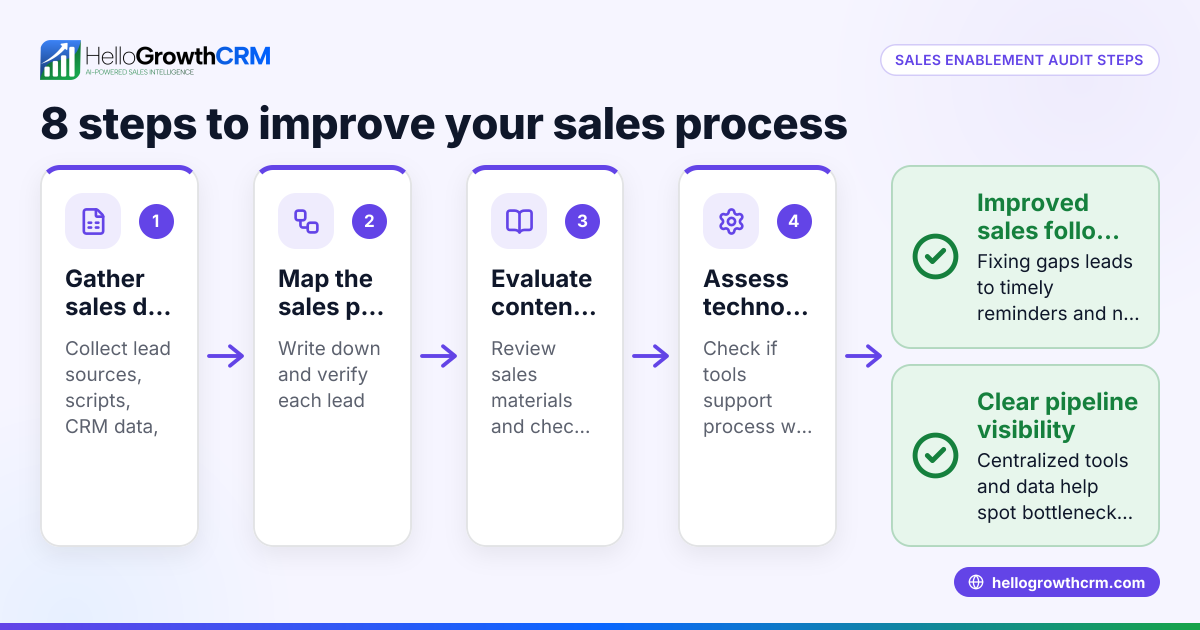
- Identify key processes to improve: Focus on areas with the biggest impact, such as sales follow-up, customer onboarding, or order fulfillment. Check where delays, errors, or customer complaints occur most frequently.
- Map current workflows: Write down each step employees take in these processes. Verify accuracy by consulting your team to ensure no steps are missed.
- Analyze pain points and inefficiencies: Look for bottlenecks, redundant tasks, communication gaps, or manual work that could be automated.
- Set clear improvement goals: Define measurable objectives, for example, reducing lead response time by 50% or cutting order errors by 30%.
- Design improved workflows: Simplify the steps, automate repetitive tasks, and clarify roles and responsibilities to avoid confusion.
- Train your team on new processes: Make sure everyone understands the changes and their specific roles in the new workflows.
- Implement tools to support improvements: Use software tools that integrate communication channels like WhatsApp and SMS to speed follow-up, such as a WhatsApp and SMS CRM.
- Monitor performance regularly: Track progress with dashboards or reports to see if goals are being met.
- Adjust as needed: Continuously refine and improve processes based on feedback and data.
Example (fictional figures)
A B2B software reseller in Denver, Colorado, wants to improve its sales lead follow-up process to reduce lost leads and increase monthly sales.
- Current monthly leads: 500
- Current lead response time: 48 hours
- Current conversion rate: 10%
- Average sale value: $5,000
The goal is to reduce lead response time to 12 hours and increase conversion rate to 15% by improving follow-up workflows.
Calculation before improvement: 500 leads × 10% conversion = 50 sales 50 sales × $5,000 = $250,000 monthly revenue
Calculation after improvement: 500 leads × 15% conversion = 75 sales 75 sales × $5,000 = $375,000 monthly revenue
Revenue increase: $375,000 - $250,000 = $125,000 additional monthly revenue
By streamlining sales follow-up and using a built-in CRM dialer to speed calls (built-in CRM dialer), the company achieves faster responses and higher sales.
Common mistakes
- Skipping process mapping: Without a clear picture of current workflows, improvements may miss key issues. Prevent this by documenting every step in detail.
- Ignoring employee input: Your team knows pain points best. Prevent this mistake by involving them in analysis and design.
- Setting vague goals: Without measurable targets, it’s difficult to track success. Prevent this by defining specific, quantifiable objectives.
- Implementing changes without training: Employees may resist or make errors if not trained properly. Prevent this by providing thorough training sessions.
- Choosing tools that don’t fit your business: Avoid adding complexity with unsuitable software. Prevent this by selecting tools that support your processes, like a CRM designed for US small businesses such as HelloGrowthCRM for the United States.
- Failing to monitor and adapt: Processes need ongoing review to stay effective. Prevent this by scheduling regular check-ins and adjusting as needed.
Frequently asked questions
What is business process improvement? Business process improvement is the practice of analyzing and enhancing workflows to make them more efficient, reduce errors, and improve outcomes. It involves identifying bottlenecks, simplifying steps, and often automating repetitive tasks.
How long does it take to see benefits? The timeline varies depending on business size and complexity. Some improvements, like faster lead follow-up using a CRM, can show results within weeks. Larger process overhauls may take several months to fully implement and measure.
Can small businesses do this without software? Yes, but software can greatly help by automating communication and tracking tasks. For example, using a WhatsApp and SMS CRM can speed sales follow-up and reduce lost leads.
What are the best processes to improve first? Start with processes that directly impact revenue or customer experience, such as sales, customer service, or order fulfillment.
How do I choose the right CRM for process improvement? Look for CRMs that fit your business size, support your communication channels like WhatsApp and SMS, and have features like lead capture and task boards to manage workflows.
Key takeaways
- Business process improvement increases efficiency, reduces costs, and improves customer satisfaction.
- Start by mapping and analyzing your current workflows to identify bottlenecks.
- Set clear, measurable goals for improvement.
- Train your team and use tools like a CRM to support new processes.
- Avoid common mistakes such as skipping employee input and failing to monitor progress.
- Use CRMs designed for small businesses, such as HelloGrowthCRM, to streamline sales and communication.
Start improving your business processes today. Start on the Free Forever plan (200 leads, no credit card) and see how better workflows can boost your growth.
Ready to put this into practice?
Set up your pipeline, WhatsApp follow-ups, and AI lead scoring in minutes — free, no credit card.
Try HelloGrowthCRM freeGet CRM tips in your inbox
Join thousands of sales professionals who get weekly insights on CRM strategy, AI automation, and pipeline optimization.

The HelloGrowthCRM team publishes guides on CRM strategy, AI sales tools, and revenue operations for small business sales teams.