HelloGrowthCRM software
Built for real small-business sales teams
HelloGrowthCRM helps reps qualify faster, follow up on time, and close more deals—with practical automation in one place.
- AI lead scoring and pipeline visibility
- Built-in dialer, WhatsApp, and email automation
- Sales forecasting and RevOps-ready reporting
Call management for plumbing contractors is essential to ensure that every customer enquiry, whether about emergency repairs or scheduled installations, is handled promptly and professionally. Plumbing businesses often lose leads due to missed or delayed calls, lack of follow-up, or scattered information across notebooks and phones. This guide explains why call management is crucial in this industry, provides clear steps to implement it, highlights common pitfalls, and shows how HelloGrowthCRM can help streamline your calls and leads.
Why this comes up / what goes wrong
Plumbing contractors typically receive calls from customers needing urgent or planned services. These calls can come at any time and from various sources such as referrals, online directories, or website forms. Without a proper system, contractors or their accountants struggle to track who called, what the customer needs, and when to follow up. Often, notes are jotted down informally or calls are returned late, leading to lost business.
In India, many plumbing contractors still rely on WhatsApp and spreadsheets or physical notebooks for managing customer details and follow-ups. This approach causes problems like:
- Missing calls or forgetting to call back.
- Losing track of customer requests and job status.
- Difficulty assigning calls to team members or tracking outcomes.
- Inconsistent customer experience and delayed service.
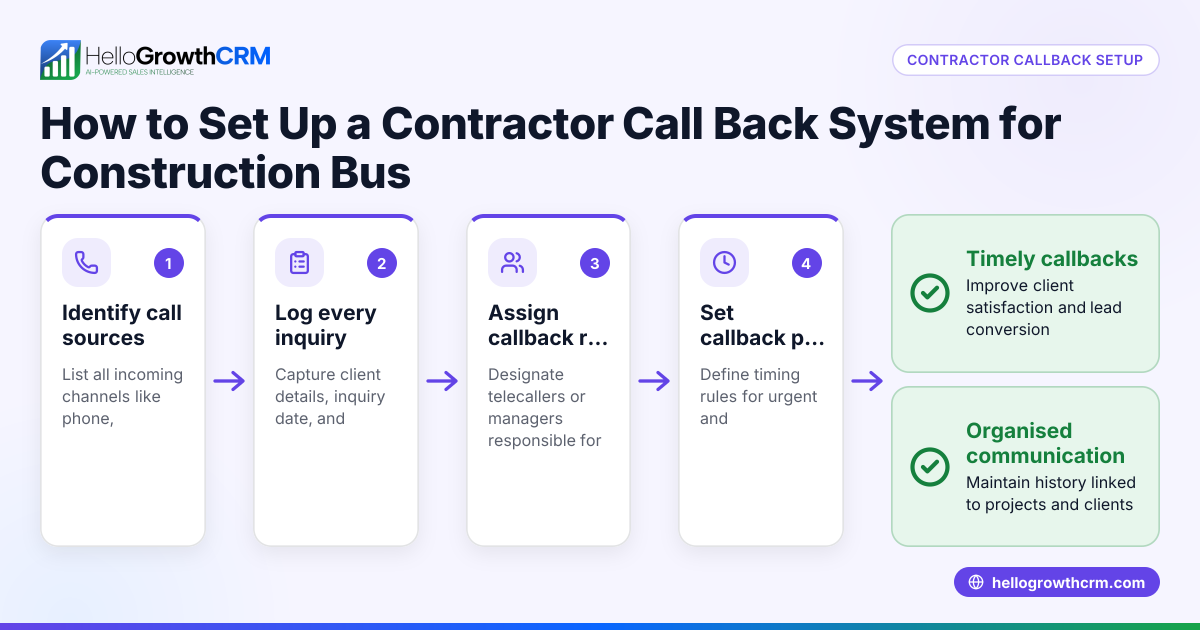
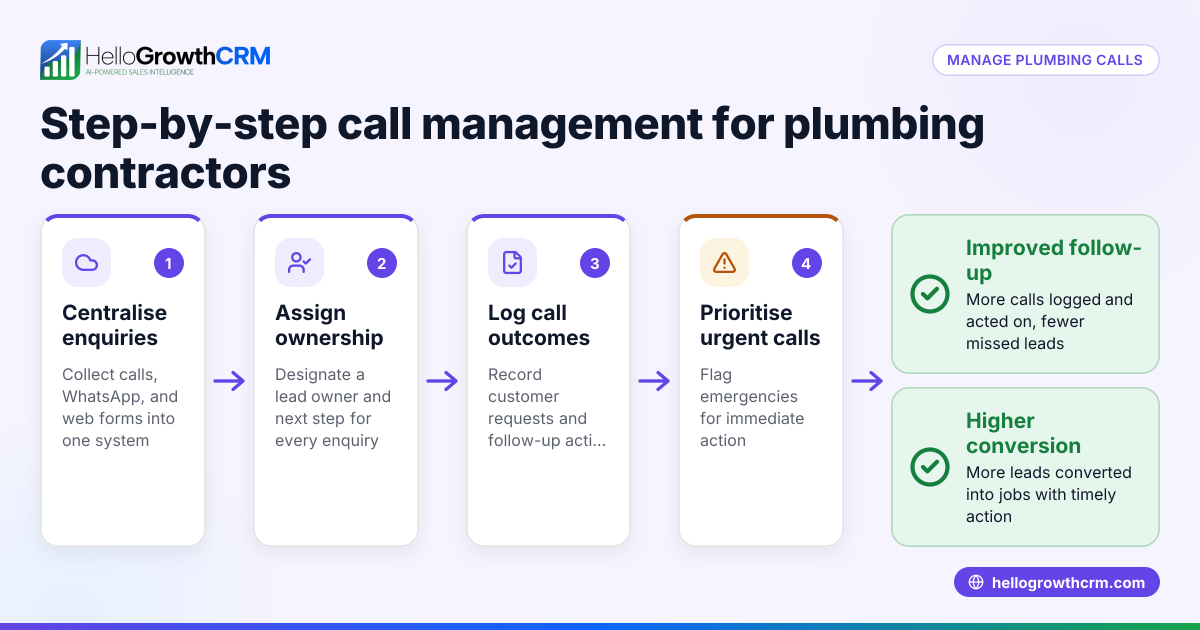
Effective call management means capturing every enquiry as a lead, assigning responsibility, scheduling follow-ups, and logging the results of each call. This ensures no lead slips through and improves conversion rates.
Step-by-step
- Capture every call enquiry as a lead
- Note caller details, service required, and source (e.g., website, referral).
- Use a central system rather than notebooks or WhatsApp chats.
- Check that each lead has an owner responsible for follow-up.
- Assign next steps and schedule callbacks
- Decide who will handle the enquiry (salesperson or plumber).
- Set a clear next action and a deadline for follow-up.
- Verify that the follow-up is tracked and reminders are set.
- Use a call logging system to record outcomes
- After each call, log the result: interested, needs quote, call back later, not interested.
- Check that call history is linked to the customer record.
- Review and clean up the call and lead pipeline weekly
- Identify leads with overdue follow-ups.
- Reassign leads if owners are unavailable.
- Remove duplicate or invalid leads.
- Train your team on consistent call handling
- Use call scripts for common enquiries.
- Emphasize polite, clear communication.
- Monitor call outcomes and coach for improvement.
- Use technology designed for contractors
- Choose a CRM with a built-in dialer and lead management.
- Check for features like WhatsApp integration and task boards.
Following these steps ensures plumbing contractors do not miss business opportunities due to poor call management.
Example (fictional figures)
A plumbing contractor in Pune receives an average of 40 calls per week. Without a call management system, they lose 25% of leads due to missed follow-ups.
- Total calls per week = 40
- Leads lost due to poor follow-up = 40 × 25% = 10 leads
- Average job value = ₹8,000
- Weekly revenue lost = 10 × ₹8,000 = ₹80,000
- Monthly revenue lost = ₹80,000 × 4 = ₹3,20,000
By implementing call management:
- Leads lost reduce to 5%
- Leads lost per week = 40 × 5% = 2 leads
- Revenue lost per week = 2 × ₹8,000 = ₹16,000
- Monthly revenue lost = ₹16,000 × 4 = ₹64,000
Savings per month = ₹3,20,000 - ₹64,000 = ₹2,56,000
This example shows how call management can significantly impact revenue by reducing missed leads.
Common mistakes
- Not capturing all calls as leads
- Prevent by using a system that automatically logs calls and enquiries.
- No clear ownership of leads
- Prevent by assigning each lead to a specific team member.
- Ignoring follow-up scheduling
- Prevent by setting reminders and deadlines for callbacks.
- Scattered information across WhatsApp and notebooks
- Prevent by centralizing data in one CRM system.
- Failing to review and clean up the pipeline regularly
- Prevent by weekly pipeline reviews to keep data current.
- Lack of team training on call handling
- Prevent by providing scripts and coaching for consistent customer interaction.
Doing this in HelloGrowthCRM
HelloGrowthCRM offers plumbing contractors a practical way to manage calls and leads. Its built-in dialer lets telecallers work from inside the CRM, calling prospects and logging each call outcome directly on the lead record. Every enquiry from forms, calls, or WhatsApp is captured as a lead with an assigned owner and a next step, avoiding lost notes in notebooks or chats. For contractors without a dedicated sales manager, the Managed RevOps service ensures someone works the follow-up queue weekly, keeping leads moving. Learn more about the built-in CRM dialer and how HelloGrowthCRM supports Contractors and construction in India on HelloGrowthCRM for India.
Frequently asked questions
How can plumbing contractors handle calls outside business hours? Plumbing contractors can use call forwarding or voicemail to capture enquiries after hours. Logging these as leads in a CRM ensures follow-up the next day. Automated messages can inform customers about expected callback times. NEEDS EXPERT REVIEW.
What should be included in call logs for plumbing enquiries? Call logs should capture caller name, contact details, service requested, call outcome, next steps, and scheduled callback dates. This helps track progress and maintain customer history.
Is WhatsApp effective for managing plumbing leads? WhatsApp is popular but can lead to scattered information if used alone. Integrating WhatsApp enquiries into a CRM that assigns leads and tracks follow-ups improves organisation and conversion.
How often should a plumbing contractor review their call pipeline? Weekly reviews are recommended to identify overdue follow-ups, reassign leads, and clean up duplicates. This keeps the sales process active and efficient.
Can a small plumbing business manage calls without a sales manager? Yes, but it requires discipline to follow up on leads consistently. Services like Managed RevOps in HelloGrowthCRM provide external support to manage follow-ups and pipeline hygiene.
Key takeaways
- Capture every call enquiry as a lead with assigned ownership.
- Schedule and track follow-ups to avoid missed opportunities.
- Use a central system instead of notebooks or WhatsApp alone.
- Review and clean your call pipeline weekly.
- Train your team on consistent call handling and logging.
- HelloGrowthCRM offers tools like a built-in dialer and Managed RevOps to support plumbing contractors.
Start managing your plumbing calls better today. Start on the Free Forever plan (200 leads, no credit card) and see how HelloGrowthCRM can help you keep every lead in sight.
Ready to put this into practice?
Set up your pipeline, WhatsApp follow-ups, and AI lead scoring in minutes — free, no credit card.
Try HelloGrowthCRM freeGet CRM tips in your inbox
Join thousands of sales professionals who get weekly insights on CRM strategy, AI automation, and pipeline optimization.

The HelloGrowthCRM team publishes guides on CRM strategy, AI sales tools, and revenue operations for small business sales teams.