HelloGrowthCRM software
Built for real small-business sales teams
HelloGrowthCRM helps reps qualify faster, follow up on time, and close more deals—with practical automation in one place.
- AI lead scoring and pipeline visibility
- Built-in dialer, WhatsApp, and email automation
- Sales forecasting and RevOps-ready reporting
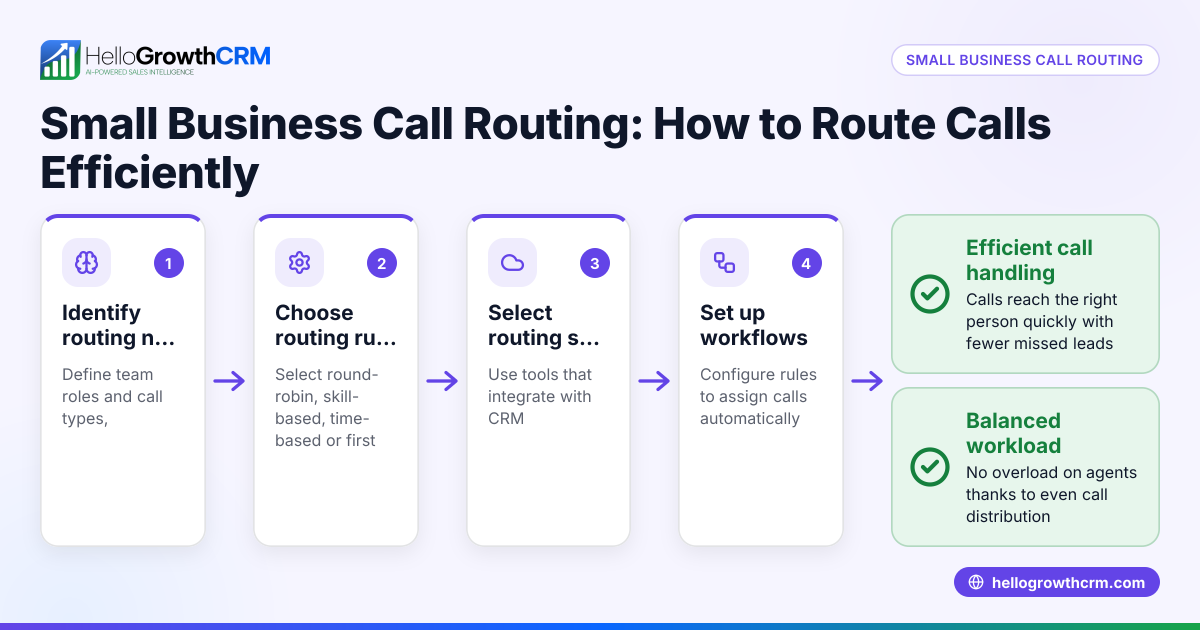
In the UAE, AI can manage lead routing inside your CRM if you train it to follow local channels, language, working patterns and compliance checks instead of simply assigning leads to the next available rep.
That matters because UAE businesses rarely receive inquiries through one tidy source. A dental clinic in Jumeirah may get WhatsApp messages after business hours, Instagram form leads during the day and referral calls from existing patients in Arabic and English. A facilities-management contractor in Al Quoz may get tender interest by email, urgent service requests by phone and quote requests from Google Business Profile. If all of those are pushed into one queue with one default owner, the CRM is organized but the response is still wrong.
Good routing in the UAE is less about flashy automation and more about deciding the first correct owner, the first correct channel and the first required check. AI helps by reading patterns in source, language, service type, location and urgency. It should not act as if Sharjah, DIFC, Jebel Ali Free Zone and Abu Dhabi all operate under identical conditions.
Lead source tells you what the first action should be in the UAE
In many UAE businesses, the source of the inquiry predicts the channel the prospect expects you to use next. WhatsApp replies tend to move faster than email-only follow-up. Dubizzle, Property Finder, Talabat, Noon, Instagram, exhibitions, trade shows and referrals all create different expectations around speed, detail and ownership.
A car-service workshop in Sharjah might treat a WhatsApp inquiry with a photo of vehicle damage as a same-shift triage item, while a website form asking about fleet maintenance belongs with a business development rep. A tutoring centre in Abu Dhabi may route a parent inquiry from Instagram to an enrolment adviser, but a referral from an existing family may go first to an admin team member who can verify the student’s current branch and schedule.
This is where AI is useful: not because it "knows sales," but because it can classify incoming text and metadata at speed. If the system can identify source, urgency words, service line and likely intent, it can place the record into the right queue and trigger the right next task. AI lead scoring and lead capture tools help structure this intake, but the routing logic should reflect how UAE buyers actually arrive and reply.
Arabic script, mixed languages and right-to-left rendering affect assignment quality
In the UAE, routing breaks quickly if the CRM treats language as a messaging issue rather than an ownership issue. Many businesses handle inquiries in Arabic, English, Hindi, Urdu, Tagalog or Malayalam. The first rep should often be chosen by the language of the inquiry, not only by territory or workload.
Arabic adds a practical test. It is not enough for Arabic to display correctly in an internal admin screen. If your public forms, auto-replies, booking pages and outbound messages do not render right-to-left properly, the lead record may enter the CRM with damaged text, reversed fields or unusable notes. Arabic-script names also need to survive export and re-import without corruption. If they do not, AI classification becomes unreliable because the system is reading broken data.
A corporate services firm in DIFC may receive a message in English but include shareholder names and supporting details in Arabic. That lead might still need a bilingual consultant because the next step involves document handling and entity setup questions. In other words, language is not only about courtesy. It changes who can safely take the deal forward.
The UAE calendar makes response windows uneven, so routing needs time awareness
The UAE working week and response rhythm are not a simple Monday-to-Friday pattern. Public-sector and private-sector schedules do not always look the same, and Ramadan changes both staffing and customer availability. Several holidays follow the Hijri calendar, so businesses often confirm operational plans closer to the date rather than locking a full annual pattern far in advance.
That means lead routing should consider when follow-up is most likely to work, not just who is free. During Ramadan, many clients become easier to reach later in the day or in the evening. Exhibition leads often arrive in bursts and need same-day qualification before interest cools. A naive automation rule that assigns every lead instantly to whichever rep has the lightest queue can produce slower contact if that rep is off-shift, travelling between emirates or unavailable for the lead’s preferred language window.
AI can help by looking at historic contact success by source, time and team, then suggesting or triggering the most suitable owner and follow-up slot. Meeting handoff matters too. If your funnel depends on quick consultation booking, scheduling and booking tools can shorten the gap between first inquiry and confirmed conversation, but only if the routing rules account for UAE availability patterns.
Privacy law and sector rules mean some leads need a human gate first
AI should not be allowed to send every new lead straight into outreach. The UAE Personal Data Protection Law sits under the UAE Data Office, and some businesses also operate in jurisdictions with their own data protection regimes, including DIFC through the DIFC Commissioner of Data Protection and ADGM through the ADGM Office of Data Protection. If you collect more personal information than you need at intake, or route it to the wrong team without a purpose, you create compliance risk before a salesperson even replies.
Emirates ID is a good example. It is a standard identifier for individuals in the UAE, but collecting it at lead stage needs a clear purpose. Many businesses do not need it for first contact. If your form asks for it by default and your AI uses it as part of routing, you may be gathering more than necessary. For a dental clinic, health-related inquiries may also require stricter handling in practice, especially where a regulator such as Dubai Health Authority is relevant to the operating environment.
Messaging rules matter as well. Promotional traffic to UAE numbers sits inside the framework overseen by the TDRA, and promotional and service messages are not the same thing. So AI should first decide whether the contact can receive marketing, whether the message is transactional or promotional, and whether a human review is needed. Routing is therefore partly a compliance control, not just a speed tool.
Free zone, mainland and licence scope can change who should own the lead
In the UAE, the same service inquiry can belong to different teams depending on the entity that is licensed to perform it. Multi-emirate businesses often hold more than one licence, and free-zone status can affect how the work is sold, fulfilled or invoiced. A vendor claiming that routing can be solved by postcode or product line alone is skipping the real operating structure.
Consider a corporate services group with one entity in DIFC and another on the mainland. An inquiry about company formation, visa support and office arrangements may need to be routed first by licence scope and jurisdiction knowledge before it is routed by salesperson seniority. Likewise, a facilities-management company may have one team licensed for certain work in one emirate and another team for different service categories elsewhere.
Routing rules should therefore check trade-licence logic, free-zone or mainland status where relevant, and service eligibility. If you run field teams across emirates, territory and ownership tools can support this, but the territory map has to mirror the legal and operational footprint of the business, not just geography.
Deposits, payment method and tax treatment can alter the workflow from day one
Some UAE leads should be routed according to how the deal will be paid and documented, because payment handling affects the work that follows. The Federal Tax Authority publishes the current rules and guidance on VAT, corporate tax and the treatment of advances. In practice, receipt of payment can matter before service delivery, so a deposit can trigger paperwork consequences when it arrives rather than when the job is done. Free-zone and mainland entities can also face different treatment, which is why a generic software answer is not enough.
Payment rails in the UAE are also varied. Bank transfer, credit card, cheque, Apple Pay, Google Pay, cash and Careem Pay may all appear in one business, and post-dated cheques still exist in some sectors. If a lead is likely to convert via staged payments or cheque-backed terms, the sales owner may need support from finance or operations much earlier than in a card-paid consumer sale.
The arithmetic below is illustrative; the figures are made up to show the shape of the decision. A facilities-management contractor receives two new leads. Lead A is a one-off repair at AED 2,400, likely to be paid by card after completion. Lead B is an annual service contract worth AED 48,000 with an upfront deposit of AED 12,000 and the balance scheduled by cheque. If AI routes both deals to the same fast-response inside-sales rep, Lead A may be fine, but Lead B may stall because the wrong owner does not gather the information needed for contract terms, payment schedule and tax treatment at the start. In many firms, Lead B belongs with an account manager or commercial desk from the first touch. This calculation leaves out sector-specific approvals, the current FTA guidance and the exact legal treatment for the entity involved.
If your CRM supports quotes, deals and payment-linked records, routing can attach the lead to the team best placed to get the paperwork right, not only to the team most likely to answer first. The current VAT and corporate tax rules, registration points and filing obligations should always be checked on the FTA’s official publications and, where needed, with a qualified adviser.
WhatsApp-first follow-up needs channel rules inside routing, not after it
In the UAE, many prospects who ignore email will answer on WhatsApp within minutes. That does not mean every lead should receive an automated WhatsApp message the moment it lands. It means your routing logic should decide which channel is appropriate, who owns that channel conversation and whether the message type is allowed.
For example, a restaurant supplier receiving a trade-show lead may want a same-day WhatsApp introduction from the assigned account executive, while a cold marketing list should not be treated the same way. Platform rules for business messaging change, and any software claim about template approval or message cost should be verified directly rather than accepted as a permanent fact. The safer design is to make channel choice part of routing policy.
HelloGrowthCRM can support this setup through WhatsApp and SMS workflows, lead capture, deal pipelines and workflow-based lead routing and validation rules. The useful part is not "AI sends messages" by itself; it is that the CRM can assign ownership, create tasks, update records and choose the next action based on the lead’s source, language, territory and status.
Test these UAE-specific checks before you let AI assign leads on its own
Before switching from assisted routing to automatic routing, test the process against the conditions your UAE team actually faces:
- Can the system distinguish WhatsApp, phone, website, marketplace and exhibition leads at intake without manual cleanup?
- Does Arabic render correctly on forms, messages and exports, and do Arabic-script names remain intact after import and re-import?
- Can routing choose by language, not only by queue size or territory?
- Do Ramadan hours, evening contact windows and Hijri-based holiday disruptions affect assignment logic or task timing?
- Are UAE PDPL, TDRA messaging rules and any DIFC or ADGM data rules reflected in validation checks before outreach?
- Can the workflow identify when a lead belongs to a free-zone entity, mainland entity or specific licence holder?
- Does likely payment method or deposit structure send the lead to the team that can handle the paperwork from the start?
If several of those answers are no, AI should assist your team rather than act alone. Start with recommendation mode, review the misses, then automate only the rules that consistently hold up.
If you want a quicker starting point, HelloGrowthCRM offers the core pieces needed to build this carefully: organized lead intake, AI-assisted qualification, pipelines, tasks, messaging and workflow automation. You can explore the setup on the UAE page and adapt it to how leads actually move through your business.
Ready to put this into practice?
Set up your pipeline, WhatsApp follow-ups, and AI lead scoring in minutes — free, no credit card.
Try HelloGrowthCRM freeGet CRM tips in your inbox
Join thousands of sales professionals who get weekly insights on CRM strategy, AI automation, and pipeline optimization.

The HelloGrowthCRM team publishes guides on CRM strategy, AI sales tools, and revenue operations for small business sales teams.