HelloGrowthCRM software
Built for real small-business sales teams
HelloGrowthCRM helps reps qualify faster, follow up on time, and close more deals—with practical automation in one place.
- AI lead scoring and pipeline visibility
- Built-in dialer, WhatsApp, and email automation
- Sales forecasting and RevOps-ready reporting
In Singapore, the right CRM alternative is the one that matches how your business collects leads, records consent, takes payment and hands work from enquiry to fulfilment without creating PDPA or GST problems later.
That matters because many Singapore businesses do not run on one neat sales channel. A tuition centre may get enquiries from Google Business Profile, WhatsApp and referrals. An air-conditioning firm in Jurong may quote after a site visit, collect a deposit by PayNow, then send a technician on a different day. A dental or aesthetic practice may need appointment booking, reminders and communication controls shaped by Ministry of Health rules as well as privacy law. If you compare CRM alternatives only on price or a generic feature grid, you can miss the parts that create real admin load.
A better shortlist starts with local operating facts: Singapore uses one time zone but many businesses sell across ASEAN; English is the working language but customer-facing messages in Mandarin or Malay can improve response in some segments; public holidays shift across communities and calendars; and business users often depend on Corppass and SingPass for government interactions outside the CRM. Your system does not need to do everything, but it does need to leave a clear trail of what happened, when, and who did it.
PDPA and Do Not Call checks should shape your shortlist early
Any CRM alternative used in Singapore should be tested against the Personal Data Protection Act and the Personal Data Protection Commission's guidance, not just against sales convenience. If your team sends promotional SMS or WhatsApp messages to Singapore numbers, the Do Not Call provisions matter. The legal duty to check the relevant Do Not Call Registry sits with the sender, not with the software vendor. A platform that makes it easy to blast messages without recording consent evidence can create risk faster, not less.
Look closely at how the system stores the basis for contact. Can staff distinguish a transactional reminder from a marketing message? Can they record clear and unambiguous consent and retrieve that history later? Can they stop outreach when consent is withdrawn? Those are more useful questions than whether the campaign screen looks polished.
Forms deserve the same scrutiny. PDPC guidance restricts routine collection of NRIC numbers, so a CRM alternative that encourages bulky lead forms may push staff toward asking for data they do not need. For most enquiries, a name, contact method, service interest and preferred time are enough. If your current process asks for NRIC by default, that is a process problem to fix during migration, not a custom field to recreate.
If you work in a regulated segment such as dental, medical or aesthetic services, review your communication flow against Ministry of Health rules and relevant professional guidance before you automate anything. A CRM can store records and trigger tasks, but it cannot decide whether a message is compliant advertising.
PayNow, FAST and SGQR expose weak payment tracking in many CRMs
Singapore customers often pay by PayNow, FAST transfer, bank transfer, SGQR, NETS or card depending on the business. That mix affects CRM choice because not every payment appears in the same place. Card collections may show up inside a processor dashboard, but PayNow and direct bank transfers often do not. Staff then have to recognise the incoming payment and match it to the right quote, invoice or booking manually.
This is where many generic CRM alternatives feel fine in a demo and frustrating in daily use. If the system treats payment as an afterthought, your team ends up tracking money in one tool, conversations in another and job fulfilment in a third. In Singapore, where instant bank-based transfers are common, that split causes avoidable ambiguity over whether a job should be scheduled or stock released.
For service businesses, ask how the system handles a deposit received before the work is done. Under Singapore's GST rules, timing can matter because a payment received for a taxable supply can trigger the tax point at the earlier of invoice or payment. IRAS publishes the current rules for GST and the current registration criteria, so check the official IRAS guidance rather than relying on a sales page summary. The practical lesson for CRM selection is simple: the record should show when the deposit arrived, what it relates to, and whether the commercial document and job status were updated on that basis.
Lead sources in Singapore affect routing more than feature checklists do
The best CRM alternative for a Singapore business depends heavily on where enquiries begin. Google Business Profile often brings high-intent local searches. Carousell can produce price-sensitive volume. WhatsApp enquiries usually expect a fast reply. LinkedIn matters more for B2B services such as logistics or commercial contracting. GeBIZ creates a very different workflow for firms selling to the public sector, where pre-qualification, documents and follow-up timing are unlike consumer sales.
A CRM should therefore route leads by source, area, service line or urgency. A heartland tuition centre in Tampines may want evening callback handling and Mandarin-capable follow-up for some parent segments. A B2B logistics broker near Changi may need separate ownership rules for inbound web leads, referral introductions and tender-related contacts. A field service company in Jurong may need postcode or territory assignment so the right technician or estimator gets the job.
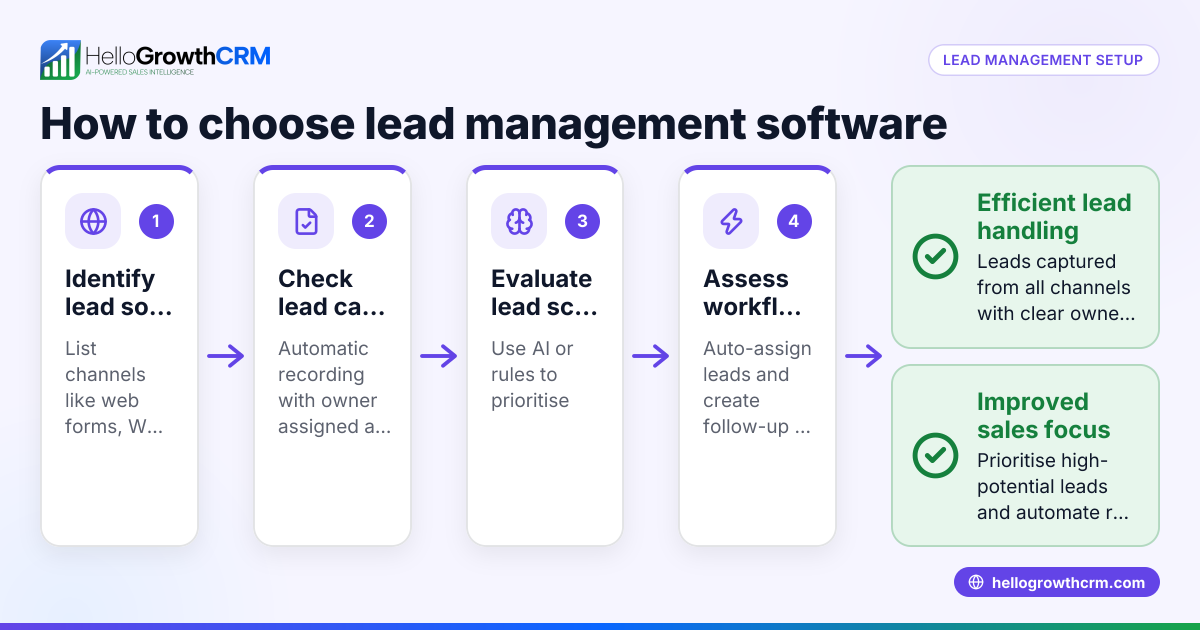
When you compare alternatives, use one check list and keep it practical:
- Can you capture the original lead source without staff typing it by hand every time?
- Can the system assign ownership by area, service type or language need?
- Can it separate new enquiries from quoted work, booked work and repeat customers?
- Can it store consent notes and message history on the same record?
- Can it handle leads from WhatsApp, web forms, phone calls and referrals without duplicate records multiplying?
If a vendor cannot show that flow on your real channels, the rest of the comparison matters less.
Booking patterns in Orchard, Novena and the heartlands are not the same
Singapore is compact, but demand patterns vary by location and business type. An aesthetic clinic in Orchard may see stronger demand around lunch-hour and post-work slots from office workers and shoppers. A dental practice in Novena may balance treatment time, practitioner availability and reminder timing differently. A home-service firm may group site visits by district to reduce travel dead time. A CRM alternative that only offers a basic calendar can make these operational patterns harder to manage.
Public holidays also affect scheduling in a specifically Singaporean way. The holiday calendar spans multiple communities, and some dates move because they follow lunar or Islamic calendars. If your business sends booking links or timed reminders, you want a system that supports sensible availability rules and does not force staff to patch exceptions manually every few weeks.
Regional sales add another wrinkle. Singapore itself is on one time zone, but clients in the wider ASEAN region may not be. If your sales team books demos with prospects elsewhere in the region, the system should make time selection clear enough to avoid no-shows caused by offset confusion. That is a more useful test than whether the meeting page is attractive.
GST timing and document trails matter when deposits arrive before delivery
CRM alternatives are often marketed as front-office tools, but in Singapore the line between sales activity and tax documentation is not always neat. If you issue quotes, take deposits and convert them into invoices, the system should preserve the sequence clearly. For GST-registered businesses, IRAS sets out when GST is accounted for and what supporting documents matter. If you are not yet registered, IRAS also publishes the current registration rules and turnover tests. Those are not details to leave until after implementation.
The arithmetic below is illustrative; the figures are made up to show the shape of the decision. Imagine an air-conditioning service firm quotes S$1,800 for a multi-unit servicing package. The customer accepts and sends a S$500 deposit by PayNow on Monday. The balance of S$1,300 is paid after completion on Friday. A useful CRM record would show the accepted quote, the deposit date, the remaining amount, the scheduled visit, the completion note and the final invoice linked to the same job.
What this leaves out is the actual GST treatment for that business, whether the supply is taxable in the ordinary way, whether the business is registered, and what wording must appear on the invoice or receipt. Those points must be checked against current IRAS guidance and, where needed, with a tax adviser. The lesson for choosing a CRM is operational: if your team cannot see the order of payment, invoicing and fulfilment in one place, month-end review becomes slower and more error-prone.
Multilingual follow-up is useful, but English should stay your system language
In Singapore, many businesses benefit from customer-facing messages in more than one language. English is the default working language in most offices, yet some customer segments respond better to Mandarin or Malay for reminders, promotions or service explanations. That does not mean your CRM should be redesigned around multiple internal data structures. In practice, the cleaner setup is often to keep internal stages, tasks and reason codes in English while allowing templates or message variants by segment.
This matters because reporting quality depends on consistency. If one staff member logs a lead as “quoted” and another uses an equivalent label in another language, your pipeline report becomes less reliable. But if both use the same internal stage and choose a customer-facing template that fits the recipient, you keep both operational clarity and local relevance.
For firms handling inbound enquiries by phone or message, language assignment can also affect conversion. A CRM alternative that lets you route or tag records by language need may save awkward handoffs. That is especially useful in businesses with quick-response expectations, where the first reply often determines whether the customer continues the conversation.
ACRA, MAS and MOH do not all matter to every business, but your records still should
Not every Singapore company is regulated in the same way. A standard retail or services firm may mainly care about ACRA for company administration, IRAS for tax and PDPC for data protection. A financial business may face MAS requirements. Healthcare-related practices may need to align communication and recordkeeping with Ministry of Health expectations and professional obligations. The CRM alternative you choose does not need to be a compliance system for every regulator, but it should support traceable records.
That usually means keeping the interaction history, ownership changes, notes and document versions attached to the contact or deal. If a complaint appears months later, you want to know what was promised, who sent which message and when the status changed. A tool that encourages off-system communication with no notes may look lightweight, but it weakens accountability.
This is also where data retention and vendor posture come into the conversation. If you are comparing systems for a business that handles personal data at scale, review the vendor's security materials and processor position carefully. HelloGrowth publishes a security overview, which is the sort of documentation a Singapore buyer should expect to review from any serious vendor before moving customer records.
A realistic trial should mirror one Singapore workflow from lead to cash
The most useful way to test CRM alternatives is not a broad feature tour. Pick one workflow that actually reflects your Singapore operation and run it end to end. For a tuition centre, that might be: Google enquiry, WhatsApp follow-up, trial class booking, parent reminder, enrolment decision and fee collection note. For a field service firm, it might be: phone enquiry, site visit booking, quote, PayNow deposit, job assignment and final invoice. For a clinic, it might be: web enquiry, consented reminder, appointment booking and post-visit follow-up within applicable communication rules.
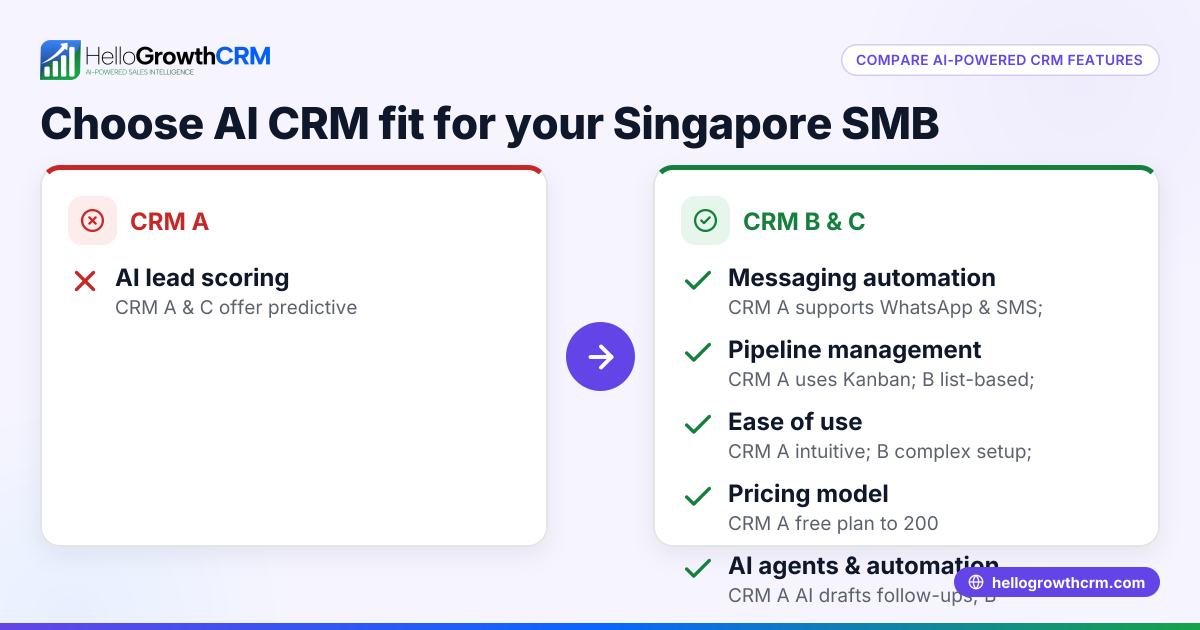
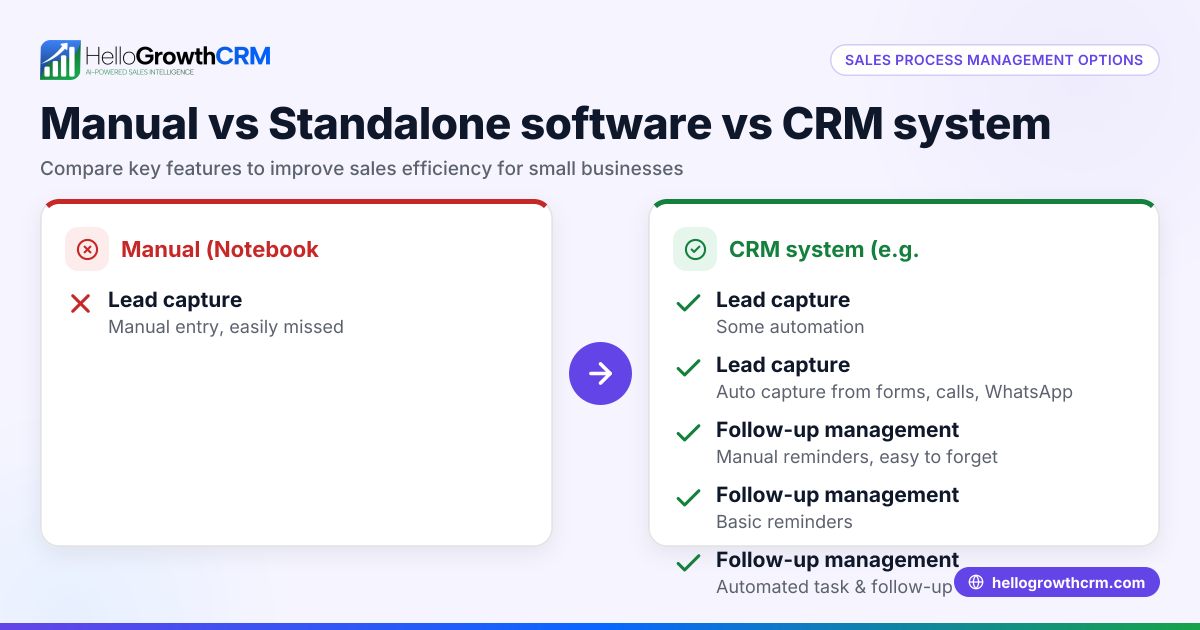
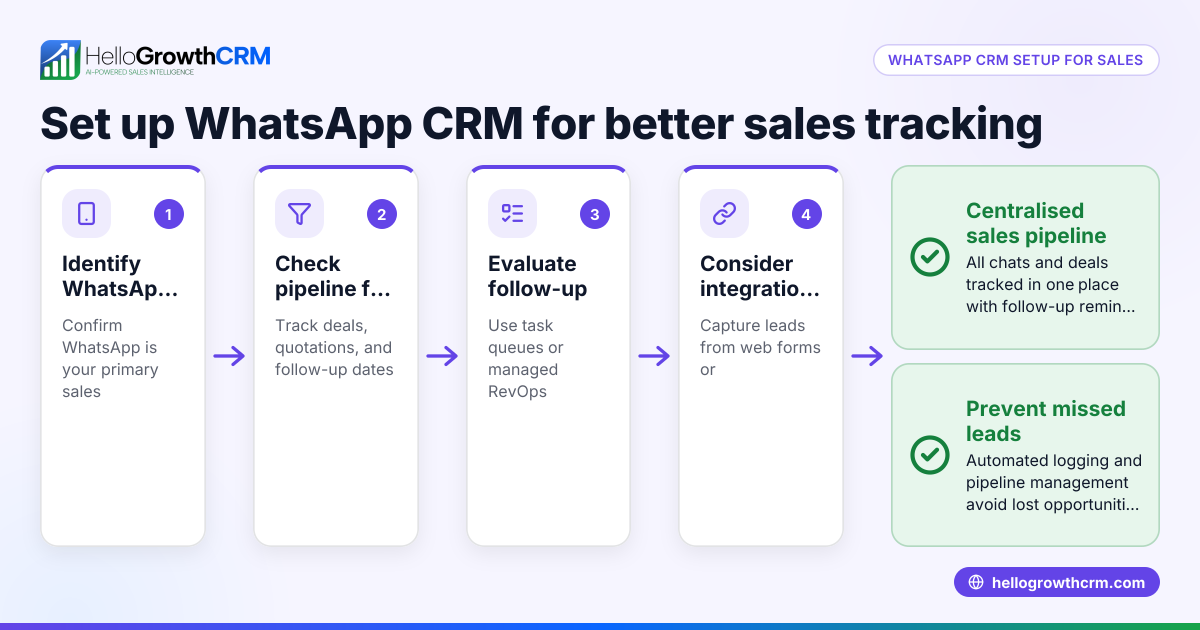
During that trial, look for friction around duplicate records, message history, task handoff and payment status. If you need a benchmark, compare how a vendor positions lead capture and pipeline management on its comparison pages and whether it gives you enough structure to test without a long setup. HelloGrowth, for example, offers a free CRM plan and covers lead capture and pipeline entry in its lead tools. If messaging is central to your sales motion, its WhatsApp and SMS workflows are the relevant part to test. Keep the trial focused on your own process, not the demo script.
A good CRM alternative in Singapore should make local realities easier to manage: PDPA-aware contact handling, clear evidence of consent, practical routing from channels such as Google Business Profile or WhatsApp, usable booking controls, and a clean trail from quote to payment. If it does that, your team will feel the benefit long after the feature checklist is forgotten.
Ready to put this into practice?
Set up your pipeline, WhatsApp follow-ups, and AI lead scoring in minutes — free, no credit card.
Try HelloGrowthCRM freeGet CRM tips in your inbox
Join thousands of sales professionals who get weekly insights on CRM strategy, AI automation, and pipeline optimization.

The HelloGrowthCRM team publishes guides on CRM strategy, AI sales tools, and revenue operations for small business sales teams.