HelloGrowthCRM software
Built for real small-business sales teams
HelloGrowthCRM helps reps qualify faster, follow up on time, and close more deals—with practical automation in one place.
- AI lead scoring and pipeline visibility
- Built-in dialer, WhatsApp, and email automation
- Sales forecasting and RevOps-ready reporting
Retail business owners and accountants often face the choice between managing customer data and sales using spreadsheets or adopting a CRM system tailored to retail needs. This question arises when spreadsheets become cumbersome, error-prone, or inefficient for tracking leads, sales, and customer interactions. Many UK retail shops start with spreadsheets due to low cost and familiarity but find limitations as their business grows.
Why this comes up / what goes wrong
A small to mid-sized retail business in the UK might initially track customer contacts, sales, and follow-ups using Excel or Google Sheets. This approach works when sales volumes are low and the owner or a single employee manages everything. However, as the team grows or the number of leads increases, spreadsheets can lead to:
- Lost or duplicated leads due to manual entry errors
- Slow follow-up because there is no automatic task or reminder system
- Poor visibility of sales pipeline and forecasting
- Difficulty sharing updates or customer history among team members
- Inefficient communication when sales happen over WhatsApp, email, and phone without central logging
These issues slow growth and cause lost sales.
Step-by-step
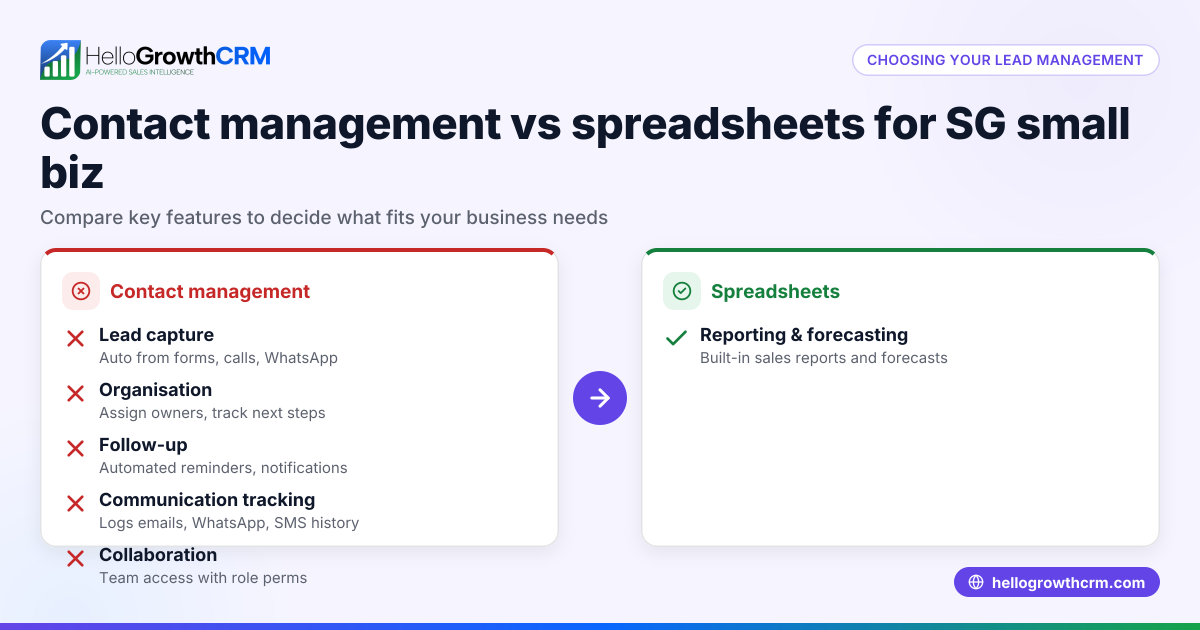
| Criteria | CRM for Retail | Spreadsheets |
|---|---|---|
| Lead and customer tracking | Centralised database with status updates and history | Manual entry; prone to errors and duplicates |
| Automation | Automated follow-up reminders, task boards, sequences | No automation; manual reminders needed |
| Communication | Logs WhatsApp, SMS, email conversations on lead records | Separate apps; no central log |
| Team collaboration | Real-time updates accessible to all team members | File sharing needed; version conflicts possible |
| Sales pipeline visibility | Visual pipeline boards and forecasting reports | Manual updates; no visual pipeline |
| Integration | Integrates with web forms, WhatsApp, and calling tools | No integration; manual import/export |
| Cost and complexity | Subscription cost; learning curve but scalable | Low cost; familiar but limited capability |
Who should pick which?
- Choose CRM for Retail if your business has multiple salespeople, increasing leads, or needs faster follow-up and better team coordination.
- Choose Spreadsheets if your business is very small, with few leads and simple sales processes, and you want to avoid subscription costs.
For growing retail shops, CRM is the more sustainable choice. Learn more about retail-specific sales tools at Retail shops.
Example (fictional figures)
A kitchen-fitting retail shop in Leeds, "Leeds Kitchens Ltd", handles 500 leads a month with a small sales team. They track leads and sales in spreadsheets but often miss follow-ups, causing lost sales opportunities.
- Average sale value: £1,200
- Monthly leads: 500
- Estimated lost leads due to slow follow-up: 50 leads (assumed for example)
- Potential lost revenue: 50 leads × £1,200 = £60,000
By adopting a CRM, Leeds Kitchens Ltd reduces lost leads to 10 leads monthly.
- Leads retained: 500 - 10 = 490 leads
- Leads saved: 50 - 10 = 40 leads
- Revenue saved: 40 × £1,200 = £48,000
This example shows how CRM can improve revenue by enabling timely follow-up and better pipeline management.
Common mistakes
- Underestimating data complexity: Trying to track growing customer info in spreadsheets leads to errors. Prevent by switching to CRM early.
- Ignoring team collaboration needs: Spreadsheets do not update in real time for multiple users. Use a CRM that supports team access.
- Failing to automate follow-ups: Manual reminders are often missed. Use CRM automation features.
- Not logging communications centrally: Losing conversation history causes confusion. Choose a CRM that logs WhatsApp and SMS messages.
- Overcomplicating spreadsheets: Adding complex formulas and tabs can confuse users. Keep it simple or move to CRM.
Learn more about comparing CRM options at compare CRMs.
Doing this in HelloGrowthCRM
HelloGrowthCRM supports UK retail teams with WhatsApp and SMS messaging workflows that log conversations on lead records, ensuring all communication is tracked. Its AI agents (in Beta) draft follow-up messages after calls for reps to review and send, saving time. For founders without sales managers, Managed RevOps service handles weekly follow-up queues, pipeline hygiene, and reporting to keep sales moving. Learn more about HelloGrowthCRM for the United Kingdom at HelloGrowthCRM for the United Kingdom.
Frequently asked questions
Can I switch from spreadsheets to a CRM easily? Yes, many CRMs offer import tools to bring spreadsheet data into the system. It requires some setup but is manageable with step-by-step guidance.
Is a CRM expensive for a small retail business? CRMs typically have subscription fees, but many offer plans suited for small teams. Compared to the cost of lost sales from poor follow-up, a CRM can be cost-effective. Consider trying free or entry-level plans.
Do CRMs work well with WhatsApp communication? Some CRMs, like HelloGrowthCRM, are WhatsApp-native and log WhatsApp messages directly on lead records, helping teams manage conversations efficiently.
Can I still use spreadsheets alongside a CRM? Yes, some businesses use spreadsheets for reporting or data analysis but rely on CRM for daily sales and customer management.
What are the risks of sticking with spreadsheets too long? Risks include lost leads, slow follow-up, poor team coordination, and limited sales insight, which can restrict growth.
Learn more about retail-specific sales tools at Retail shops and compare CRM options at compare CRMs.
Key takeaways
- Spreadsheets can work for very small retail businesses but have significant limitations as sales grow.
- CRM systems centralise customer data, automate follow-up, and improve team collaboration.
- Using a CRM reduces lost leads and improves sales forecasting and pipeline visibility.
- HelloGrowthCRM supports retail teams with WhatsApp and SMS integration, AI-assisted follow-ups, and Managed RevOps support.
- Switching early to a CRM avoids common mistakes of data loss and slow sales processes.
Start managing your retail leads more effectively today. Start on the Free Forever plan (200 leads, no credit card).
Ready to put this into practice?
Set up your pipeline, WhatsApp follow-ups, and AI lead scoring in minutes — free, no credit card.
Try HelloGrowthCRM freeGet CRM tips in your inbox
Join thousands of sales professionals who get weekly insights on CRM strategy, AI automation, and pipeline optimization.

The HelloGrowthCRM team publishes guides on CRM strategy, AI sales tools, and revenue operations for small business sales teams.