HelloGrowthCRM software
Built for real small-business sales teams
HelloGrowthCRM helps reps qualify faster, follow up on time, and close more deals—with practical automation in one place.
- AI lead scoring and pipeline visibility
- Built-in dialer, WhatsApp, and email automation
- Sales forecasting and RevOps-ready reporting
Startups often face the decision between using spreadsheets or a CRM system to manage their sales and customer relationships. This choice matters because it affects how efficiently leads are tracked, how well the team collaborates, and how quickly sales grow.
Why this comes up / what goes wrong
A startup founder or accountant in the United States might begin by tracking leads, contacts, and sales activities in spreadsheets due to their low cost and familiarity. However, as lead volume increases or the sales process becomes more complex, spreadsheets can become cumbersome, error-prone, and slow. Teams can lose leads due to missed follow-ups, data is duplicated or lost, and it becomes harder to forecast sales or measure performance. This leads to lost revenue and frustration.
Step-by-step
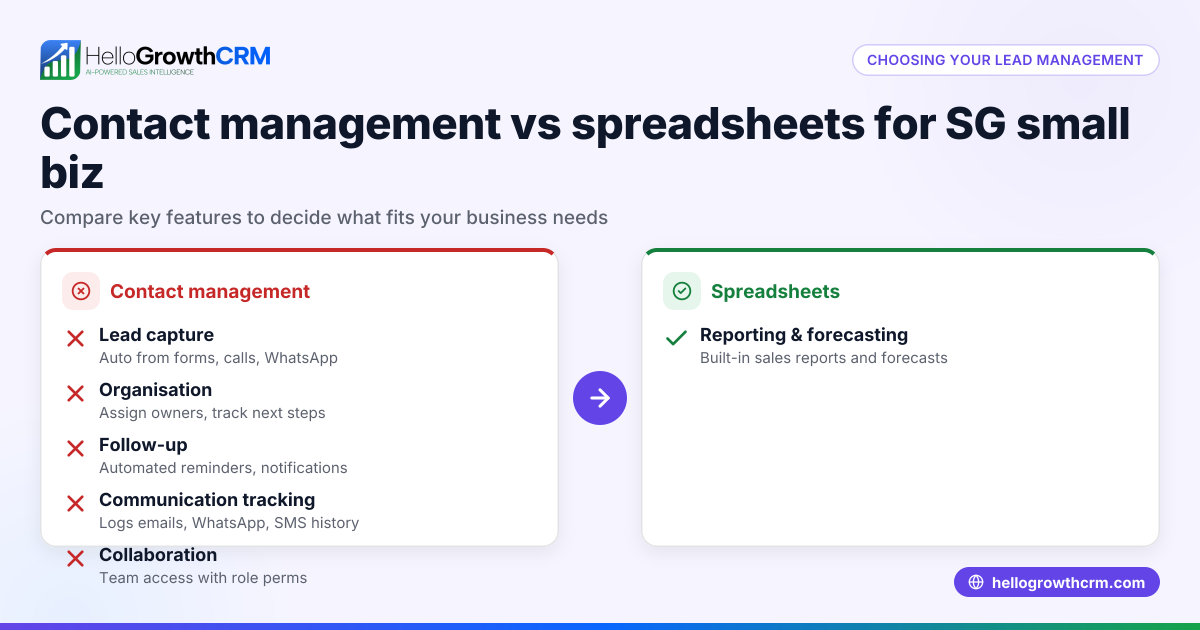
| Criteria | Spreadsheets | CRM for Startups | Who Should Choose? |
|---|---|---|---|
| Lead Capture | Manual entry or import from forms | Automated capture from web forms and integrations | Startups with very few leads might manage with spreadsheets; growing startups benefit from CRM automation |
| Collaboration | Limited, file sharing needed | Centralized, real-time updates and communication | Teams needing shared visibility and faster responses should choose CRM |
| Follow-up Management | Manual reminders, prone to oversight | Automated task boards and sequences for email, WhatsApp, SMS | Startups losing leads due to slow follow-up need CRM |
| Scalability | Becomes complex and error-prone as data grows | Designed to handle growing data and users efficiently | Startups planning fast growth should pick CRM |
| Reporting and Forecasting | Basic or manual calculations | Built-in sales forecasting and reporting dashboards | Startups needing data-driven decisions need CRM |
| Integration | Limited to manual data imports | Connects to web forms, email, WhatsApp, SMS, and other tools | Startups wanting to automate workflows benefit from CRM |
| Cost | Low upfront cost, time costs grow | Subscription cost, but saves time and reduces errors | Very early-stage startups with tight budgets might start with spreadsheets, but CRM pays off quickly |
In summary, startups with simple, low-volume sales and minimal team collaboration may start with spreadsheets. However, startups aiming for growth, team collaboration, and automation should choose a CRM designed for their needs. For more detailed CRM options, see compare CRMs.
Example (fictional figures)
Consider a two-location dental startup in Columbus, Ohio, that generates 300 leads monthly. They currently track leads in spreadsheets but find that slow follow-up causes some lost sales opportunities. They want to improve follow-up speed and sales forecasting.
- Leads per month = 300
- Estimated lost leads due to follow-up delays = 10% × 300 = 30 leads NEEDS EXPERT REVIEW
- Average revenue per lead = $1,000
- Estimated lost revenue per month = 30 × $1,000 = $30,000
If the startup invests in a CRM that improves follow-up and reduces lost leads to 2%, lost leads become:
- Lost leads with CRM = 2% × 300 = 6 leads NEEDS EXPERT REVIEW
- Lost revenue with CRM = 6 × $1,000 = $6,000
Revenue saved by CRM monthly = $30,000 - $6,000 = $24,000
This example shows how a CRM can help a startup reduce lost leads and increase revenue by improving follow-up and sales tracking.
Common mistakes
- Underestimating lead volume growth: Startups often think spreadsheets will suffice long-term. Prevent this by regularly reviewing lead volume and complexity.
- Ignoring team collaboration needs: Spreadsheets don’t support real-time updates well. Use a CRM if your team shares sales duties.
- Failing to automate follow-ups: Manual reminders lead to missed leads. Set up automated sequences in a CRM.
- Not tracking sales performance: Without reporting, it’s hard to improve. Use CRM dashboards for insights.
- Delaying CRM adoption until problems worsen: Early adoption saves time and revenue. Evaluate CRM options early; see Startups and technology companies for industry focus.
Doing this in HelloGrowthCRM
HelloGrowthCRM helps startups manage leads and sales efficiently with WhatsApp and SMS integration, where conversations with leads are logged on their records and follow-ups can be sent as messages. Its AI agents draft follow-up messages after calls, so reps only review and send, reducing workload. For startups without a sales manager, HelloGrowthCRM offers Managed RevOps, where a specialist works the follow-up queue weekly to keep pipelines clean and active. Learn more about how HelloGrowthCRM supports US startups at HelloGrowthCRM for the United States.
Frequently asked questions
Is a CRM necessary for very early-stage startups? Not always. If your lead volume is very low and sales processes are simple, spreadsheets can suffice initially. However, as your business grows, a CRM will save time and reduce errors.
How does a CRM improve sales follow-up compared to spreadsheets? CRMs automate reminders, task boards, and communication sequences via email, WhatsApp, and SMS. This reduces missed follow-ups and speeds response times, unlike manual spreadsheet tracking.
Can I switch from spreadsheets to a CRM later? Yes, but migrating data can be time-consuming. Planning for CRM adoption early in your startup’s growth avoids lost leads and data issues.
What features should startups look for in a CRM? Look for automated lead capture, task management, multi-channel communication (email, WhatsApp, SMS), reporting, and AI assistance. These features support growth and team collaboration.
Are CRMs expensive for startups? CRMs have subscription costs but save time and increase sales efficiency. Many offer free or low-cost plans suitable for startups.
Key takeaways
- Spreadsheets may work for very small, simple startups but become inefficient as sales grow.
- CRMs automate lead capture, follow-up, and reporting, improving sales and team collaboration.
- Startups with growing lead volume and multiple salespeople benefit most from a CRM.
- Early CRM adoption prevents lost leads and data management headaches.
- HelloGrowthCRM offers features like WhatsApp and SMS integration, AI agents for follow-ups, and Managed RevOps to support startups.
Start your startup’s sales growth by trying HelloGrowthCRM on the Free Forever plan (200 leads, no credit card).
Ready to put this into practice?
Set up your pipeline, WhatsApp follow-ups, and AI lead scoring in minutes — free, no credit card.
Try HelloGrowthCRM freeGet CRM tips in your inbox
Join thousands of sales professionals who get weekly insights on CRM strategy, AI automation, and pipeline optimization.

The HelloGrowthCRM team publishes guides on CRM strategy, AI sales tools, and revenue operations for small business sales teams.