HelloGrowthCRM software
Built for real small-business sales teams
HelloGrowthCRM helps reps qualify faster, follow up on time, and close more deals—with practical automation in one place.
- AI lead scoring and pipeline visibility
- Built-in dialer, WhatsApp, and email automation
- Sales forecasting and RevOps-ready reporting
CRM pricing depends mainly on how many users need access, which features you require, and how often you pay. Most CRM providers charge per user each month, with plans that unlock more capabilities like WhatsApp messaging, AI assistance, or automation as you move up tiers. Understanding these factors helps you pick the right CRM for your UK small business budget and needs.
Why this comes up / what goes wrong
Small business owners often start with informal sales processes using WhatsApp, email, or spreadsheets. When leads grow, they search for a CRM to centralise management and automate follow-ups. However, CRM pricing can be confusing. Some vendors charge per user, others by contacts or leads stored. Hidden costs such as messaging limits or onboarding fees catch buyers off guard. Without clear understanding, you risk paying for features you don’t use or choosing a system your team won’t adopt.
Step-by-step
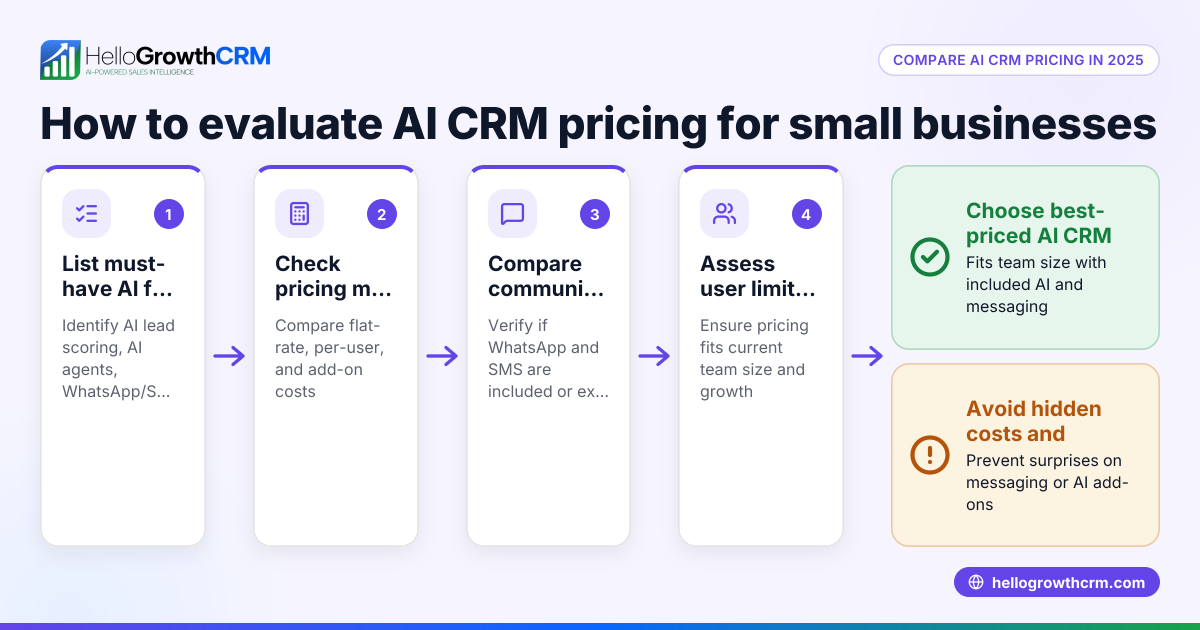
- Identify your current and future team size: Count how many users need CRM access now and estimate growth over 12 months. Pricing usually scales per user.
- List must-have features: Decide if you need WhatsApp or SMS messaging, AI agents, pipeline boards, or integrations. Some features appear only in higher tiers.
- Check billing cycles: Monthly billing offers flexibility; annual plans often reduce costs.
- Understand pricing models: Some CRMs charge per user, others by contacts or leads stored. Check limits on messaging, automation, or storage.
- Ask about free trials or free plans: These let you test core features without cost.
- Consider ease of use and team adoption: A cheaper CRM that your team avoids wastes money.
- Review onboarding and support fees: Some vendors charge extra for training or dedicated support.
- Use comparison tools and UK-specific pricing resources: Visit pages like compare CRMs and CRM pricing in the United Kingdom to see side-by-side pricing and features.
Example (fictional figures)
Imagine a Glasgow-based solar panel installer with 5 sales reps evaluating CRM costs for 2024.
- The CRM charges £30 per user per month on monthly billing.
- WhatsApp and SMS messaging is included only in the "Starter" tier.
- They plan to add 1 more rep in 6 months.
Calculation:
Current users: 5
Monthly cost now = 5 users × £30 = £150
After 6 months, users = 6
Monthly cost after 6 months = 6 × £30 = £180
Annual cost estimate = (6 months × £150) + (6 months × £180) = £900 + £1,080 = £1,980
This calculation helps budget for the year and compare against other CRM options or negotiate pricing.
Common mistakes
- Choosing based on lowest price alone: Focus also on features and usability to avoid wasted spend.
- Ignoring user limits or feature caps: Check if messaging or automation limits apply.
- Not planning for growth: Underestimating users can cause surprise cost hikes.
- Skipping free trials or demos: Testing helps confirm if the CRM fits your workflow.
- Overlooking onboarding costs: Factor in training or setup fees.
- Failing to compare UK-specific pricing: Some CRMs have different rates or features for UK businesses. Use resources like CRM pricing in the United Kingdom for accurate info.
Doing this in HelloGrowthCRM
HelloGrowthCRM offers a Free Forever plan for up to two users to manage pipelines at no cost until calling or WhatsApp automation is needed. On paid plans, WhatsApp and SMS conversations with leads are logged on the lead record, and follow-ups can be sent as messages. AI agents, available in Beta on the Growth plan, draft follow-up messages after calls for reps to review and send. This helps small teams start simply and scale with automation and messaging integrated in one system. Learn more about HelloGrowthCRM for the United Kingdom.
Frequently asked questions
What are common CRM pricing models? Most CRMs charge per user per month, with tiered plans offering more features. Some also charge based on the number of contacts or leads stored. Billing may be monthly or annual, with discounts for annual payments.
How can I compare CRM pricing effectively? Make a list of required features and number of users, then use comparison tools like compare CRMs to see pricing side by side. Consider free trials to test usability.
Are there free CRM options for small teams? Yes, many CRMs offer free plans with limited users and features. For example, HelloGrowthCRM has a Free Forever plan for two users to manage pipelines without cost.
What questions should I ask vendors about pricing? Ask about user limits, feature availability, messaging or automation caps, onboarding fees, support levels, and billing cycles. Confirm UK-specific pricing and any taxes or fees.
How do I budget for CRM growth? Estimate your team growth over 12 months and calculate costs for current and future users. Include potential feature upgrades and messaging usage.
Key takeaways
- CRM pricing varies by users, features, and billing model.
- List your team size and must-have features before comparing.
- Use free plans and trials to test usability and fit.
- Watch for hidden costs like onboarding or messaging limits.
- Plan for growth to avoid surprise price increases.
- Use UK-focused resources like CRM pricing in the United Kingdom and compare CRMs.
Choosing the right CRM involves balancing cost with features and team adoption. For a clear start, explore HelloGrowthCRM’s Free Forever plan or paid options with WhatsApp and AI features. See UK pricing and start your trial at See UK pricing.
Ready to put this into practice?
Set up your pipeline, WhatsApp follow-ups, and AI lead scoring in minutes — free, no credit card.
Try HelloGrowthCRM freeGet CRM tips in your inbox
Join thousands of sales professionals who get weekly insights on CRM strategy, AI automation, and pipeline optimization.

The HelloGrowthCRM team publishes guides on CRM strategy, AI sales tools, and revenue operations for small business sales teams.