HelloGrowthCRM software
Built for real small-business sales teams
HelloGrowthCRM helps reps qualify faster, follow up on time, and close more deals—with practical automation in one place.
- AI lead scoring and pipeline visibility
- Built-in dialer, WhatsApp, and email automation
- Sales forecasting and RevOps-ready reporting
A customer advisory board (CAB) is a curated group of customers who meet regularly to provide feedback, insights, and advice to a business. Small and mid-sized businesses use CABs to gain direct input from key customers, shape product development, improve service, and strengthen loyalty. This article covers why customer advisory boards are useful, how to create one step-by-step, a detailed example, common mistakes, and how HelloGrowthCRM can help manage customer relationships.
Why this comes up / what goes wrong
Many small-business owners struggle to get honest, actionable feedback from customers. Traditional surveys and reviews can be limited or biased. Without clear customer input, businesses may develop products or services that miss the mark, lose customers to competitors, or fail to spot emerging needs. A customer advisory board solves this by creating a structured forum for ongoing dialogue with trusted customers. It helps business owners avoid guesswork and build products and services that truly fit their market.
Step-by-step
- Identify your goals. Decide what you want from the advisory board—product feedback, market insights, service improvement, or strategic advice. Clear goals guide member selection and meeting topics.
- Select the right customers. Choose 8 to 12 customers who represent your target market segments, have experience with your products or services, and are willing to provide honest feedback. Diversity in size, industry, or use case can enrich discussions.
- Invite and onboard members. Send personalized invitations explaining the board’s purpose, time commitment, and benefits of participation. Provide onboarding materials so members understand their role.
- Plan meeting frequency and format. Decide how often to meet (quarterly or biannually is common) and whether meetings will be in-person, virtual, or hybrid. Prepare agendas focused on your goals.
- Facilitate productive meetings. Use structured agendas, encourage open discussion, and document feedback. Assign someone to moderate and keep meetings on track.
- Follow up and act on feedback. Share meeting summaries with members, outline how their input will be used, and implement changes where possible. This builds trust and shows members their time is valued.
- Evaluate and refresh the board regularly. Assess if the board meets your goals and consider rotating members every 1-2 years to keep perspectives fresh.
Check that your advisory board members are engaged and that meetings lead to actionable insights. Also, track customer health score to monitor overall satisfaction and loyalty, which complements CAB feedback. Learn more about customer health score here.
Example (fictional figures)
GreenLeaf Landscaping, a Charlotte, North Carolina business, launched a customer advisory board on 03/01/2026 to improve its seasonal service offerings.
- Goal: Get feedback on new lawn care packages and pricing.
- Members: 10 customers representing residential and commercial clients.
- Meeting frequency: Quarterly virtual meetings.
Costs:
- Meeting platform subscription: $50/month × 3 months = $150
- Staff time to organize and moderate: 15 hours × $30/hour = $450
Total quarterly cost: $150 + $450 = $600
Outcomes after first meeting:
- Added organic fertilizer option based on feedback.
- Adjusted pricing tiers to better match commercial client budgets.
This led to a 10% increase in repeat contracts within 6 months, improving revenue by about $12,000.
Common mistakes
- Selecting only loyal customers who never criticize. Prevent by inviting diverse voices willing to share honest opinions.
- Failing to set clear goals. Prevent by defining specific objectives before forming the board.
- Ignoring feedback after meetings. Prevent by documenting action items and reporting back on progress.
- Overloading members with too frequent meetings or too much work. Prevent by setting reasonable meeting schedules and respecting members’ time.
- Not refreshing the board membership. Prevent by rotating members every 1-2 years to maintain fresh perspectives.
Track your follow-ups and tasks efficiently to keep the advisory board process organized. HelloGrowthCRM’s activities and task boards help turn every follow-up into a task with a due date, so no feedback or action is lost. See more about task boards here.
Doing this in HelloGrowthCRM
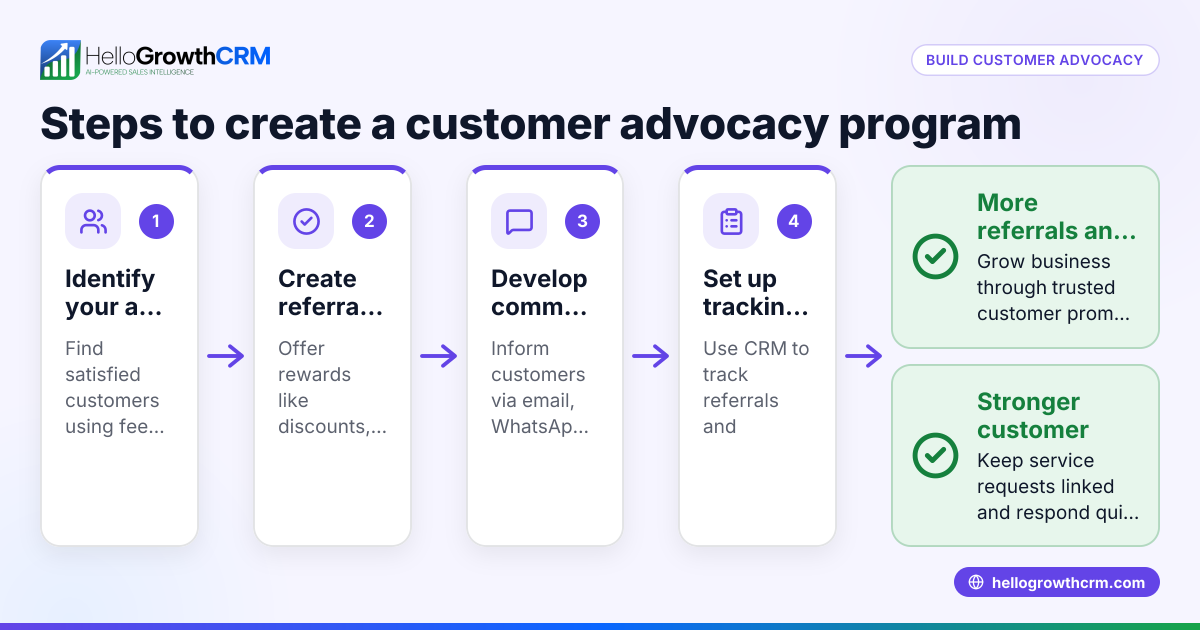
HelloGrowthCRM helps you manage customer advisory boards by organizing all interactions in one place. Use the activities and task boards to schedule and track follow-ups from advisory board meetings, ensuring every action item is assigned and completed on time. After the sale, customer service requests and feedback stay linked to the same customer record through the customer portal, referrals, tickets, and knowledge base features, making it easy to maintain a full history of customer input and responses. Learn about HelloGrowthCRM for the United States here.
Frequently asked questions
What is the difference between a customer advisory board and a focus group? A customer advisory board is a longer-term, ongoing group that meets regularly to advise on strategic issues, while a focus group is usually a one-time session to test a specific product or idea. CABs build deeper relationships and provide continuous insights.
How often should a customer advisory board meet? Most small businesses meet their advisory boards quarterly or biannually. This frequency balances gathering timely feedback without overburdening members.
How do I keep advisory board members engaged? Keep meetings focused and valuable, act on their feedback, communicate progress, and recognize their contributions. Providing exclusive previews or benefits can also help.
Can technology like HelloGrowthCRM improve managing a customer advisory board? Yes, tools like HelloGrowthCRM organize tasks, schedule follow-ups, and keep customer history in one place. This ensures no feedback is lost and helps track the impact of advisory board input.
Should I pay my advisory board members? Compensation varies by industry and business size. Some offer stipends, discounts, or exclusive perks to acknowledge members’ time and expertise.
How do I measure the success of a customer advisory board? Track if the board’s feedback leads to improved products, customer satisfaction, or increased sales. Monitoring customer health score alongside CAB insights can provide a fuller picture.
Key takeaways
- Customer advisory boards provide ongoing, structured feedback from key customers.
- Clear goals and diverse member selection are essential for success.
- Regular, well-facilitated meetings with follow-up build trust and actionable insights.
- Avoid common mistakes like ignoring feedback or overloading members.
- HelloGrowthCRM supports advisory board management with task boards and customer portals.
Start your customer advisory board today to strengthen your business’s connection with customers and improve your offerings.
Ready to organize your customer relationships and follow-ups efficiently? Start on the Free Forever plan (200 leads, no credit card).
Ready to put this into practice?
Set up your pipeline, WhatsApp follow-ups, and AI lead scoring in minutes — free, no credit card.
Try HelloGrowthCRM freeGet CRM tips in your inbox
Join thousands of sales professionals who get weekly insights on CRM strategy, AI automation, and pipeline optimization.

The HelloGrowthCRM team publishes guides on CRM strategy, AI sales tools, and revenue operations for small business sales teams.