HelloGrowthCRM software
Built for real small-business sales teams
HelloGrowthCRM helps reps qualify faster, follow up on time, and close more deals—with practical automation in one place.
- AI lead scoring and pipeline visibility
- Built-in dialer, WhatsApp, and email automation
- Sales forecasting and RevOps-ready reporting
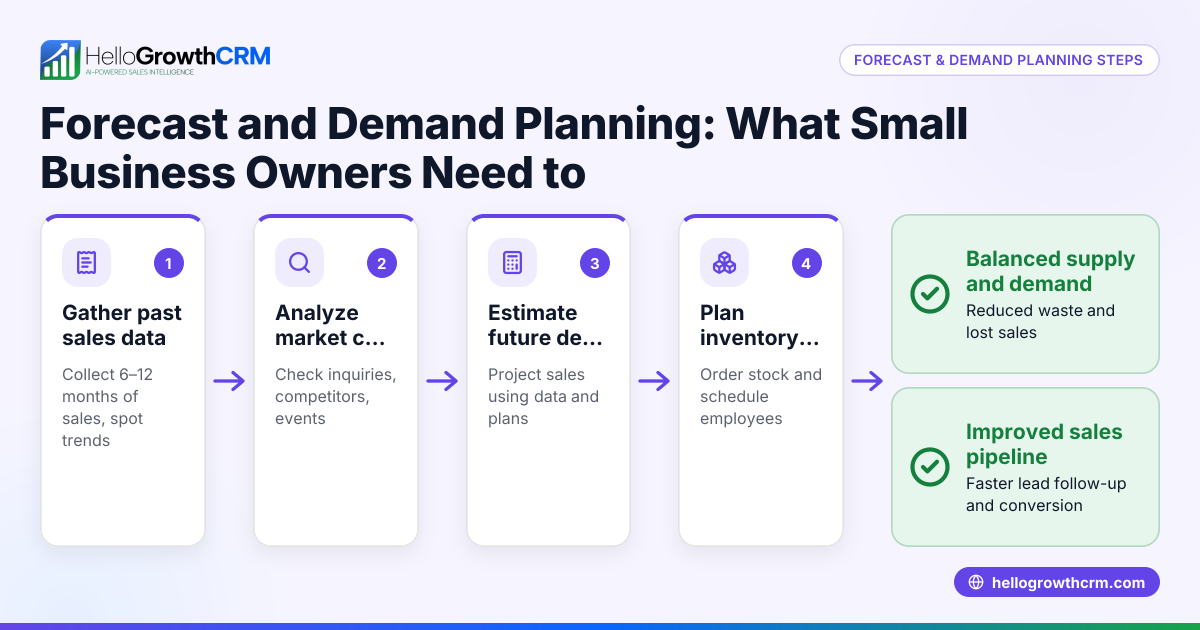
To prepare a sales forecast, follow these four steps: 1) Gather your historical sales data and market trends; 2) Define your sales pipeline stages and assign realistic probabilities; 3) Calculate expected sales by multiplying deal values by stage probabilities; 4) Regularly review and update your forecast based on actual sales progress. This article explains each step, common errors to avoid, a detailed example, and how HelloGrowthCRM can help manage your sales pipeline and forecasting.
Why this comes up / what goes wrong
Small-business owners often find sales forecasting challenging because they rely on informal methods such as guessing or using spreadsheets without a clear process. This can cause missed revenue targets, cash flow problems, and ineffective resource planning. Without a structured four-step approach, forecasts may be overly optimistic or pessimistic, making it difficult to plan inventory, staffing, or marketing activities effectively.
Step-by-step
- Gather historical sales data and market insights
- Collect sales figures from the past 6 to 12 months.
- Include factors like seasonality, market trends, and any upcoming events that could impact sales.
- Verify that the data is accurate and complete.
- Define your sales pipeline stages and assign probabilities
- List your sales process stages, such as Lead, Qualified, Quote Sent, Negotiation, and Closed Won.
- Assign a probability percentage to each stage based on your past conversion rates.
- Confirm these probabilities are realistic and reflect current business conditions.
- Calculate expected sales for each pipeline stage and period
- For every open deal, multiply the deal value by the stage probability to estimate expected revenue.
- Group deals by expected closing month or quarter.
- Add expected revenues to find total forecasted sales for each time period.
- Check for any stalled deals that require follow-up.
- Review and update your forecast regularly
- Update your forecast weekly or monthly to include new deals and closed sales.
- Compare forecasted sales to actual results to identify discrepancies.
- Adjust probabilities and pipeline stages as your sales process evolves.
Example (fictional figures)
A plumbing company in Austin, Texas, wants to forecast sales for Q3 2026.
- Historical average monthly sales: $80,000.
- Pipeline stages and probabilities:
- Lead (20%)
- Qualified (50%)
- Quote Sent (70%)
- Negotiation (90%)
- Closed Won (100%)
Current deals expected to close in July 2026:
| Deal | Stage | Value | Probability | Expected Revenue |
|---|---|---|---|---|
| A | Quote Sent | $30,000 | 70% | $30,000 × 70% = $21,000 |
| B | Negotiation | $50,000 | 90% | $50,000 × 90% = $45,000 |
| C | Qualified | $20,000 | 50% | $20,000 × 50% = $10,000 |
Total forecasted sales for July 2026:
$21,000 + $45,000 + $10,000 = $76,000
This forecast shows expected revenue of $76,000 for July, slightly below the historical average of $80,000, indicating a need to accelerate deals or generate new leads.
Common mistakes
- Ignoring historical data: Always start with accurate past sales figures to ground your forecast.
- Overestimating probabilities: Use realistic conversion rates based on your own data, not wishful thinking.
- Failing to update forecasts: Regular reviews keep your forecast aligned with actual sales progress.
- Not tracking stalled deals: Use pipeline tools to identify and follow up on deals that are stuck.
- Mixing sales and revenue figures: Keep deal values consistent and separate from other income.
Using tools like HelloGrowthCRM helps avoid these errors by tracking deal stages with follow-up reminders and providing AI insights into pipeline health. See more on AI CRM and sales forecasting.
Doing this in HelloGrowthCRM
HelloGrowthCRM provides a deals pipeline management layer that tracks open opportunities from first contact through close, including stage movement, probability, and expected value. For example, a quotation sent last week appears as a deal at the 'quote sent' stage with a follow-up date, so no opportunity is forgotten. The AI-assisted pipeline forecast and insights highlight which stages deals are stalling in without requiring spreadsheets. Additionally, territory and field operations tools let sales managers monitor daily visits and activities from the field. Learn more about HelloGrowthCRM for the United States at hellogrowthcrm.com/usa.
Frequently asked questions
What is the best time frame for a sales forecast? Most small businesses forecast monthly or quarterly to balance detail and planning needs. Shorter periods provide more detail but require frequent updates.
How do I assign probabilities to pipeline stages? Assign probabilities based on historical conversion rates between stages. Adjust these as your sales process or market conditions change.
Can I use Excel for sales forecasting? Excel can work but often becomes complex and error-prone. A CRM like HelloGrowthCRM simplifies tracking deals, probabilities, and follow-ups with less manual work.
How often should I update my sales forecast? Updating weekly or monthly helps catch changes early and keeps your plan realistic.
What if my forecast is consistently inaccurate? Check your data accuracy, probability assumptions, and sales process. AI insights from tools like HelloGrowthCRM can help identify pipeline bottlenecks.
Key takeaways
- Start with accurate historical sales data and market trends.
- Define pipeline stages with realistic conversion probabilities.
- Calculate expected revenue by multiplying deal values by stage probabilities.
- Review and update your forecast regularly based on actual sales.
- Avoid common mistakes by using structured processes and tools.
- HelloGrowthCRM helps manage deals, forecast sales, and track field operations efficiently.
Preparing a sales forecast is straightforward with clear steps and the right tools. To begin today, try HelloGrowthCRM’s Free Forever plan with 200 leads and no credit card required at free CRM for small business.
Ready to put this into practice?
Set up your pipeline, WhatsApp follow-ups, and AI lead scoring in minutes — free, no credit card.
Try HelloGrowthCRM freeGet CRM tips in your inbox
Join thousands of sales professionals who get weekly insights on CRM strategy, AI automation, and pipeline optimization.

The HelloGrowthCRM team publishes guides on CRM strategy, AI sales tools, and revenue operations for small business sales teams.