HelloGrowthCRM software
Built for real small-business sales teams
HelloGrowthCRM helps reps qualify faster, follow up on time, and close more deals—with practical automation in one place.
- AI lead scoring and pipeline visibility
- Built-in dialer, WhatsApp, and email automation
- Sales forecasting and RevOps-ready reporting
A high level CRM is a customer relationship management system that offers advanced features to help small businesses manage leads, sales pipelines, and customer communication more effectively. This article explains why small business owners search for high level CRMs, outlines the key steps to evaluate them, highlights common pitfalls, and shows how HelloGrowthCRM supports growing teams with AI and WhatsApp-native capabilities.
Why this comes up / what goes wrong
Many Australian small business owners start with simple tools like spreadsheets, emails, or text messages to track leads and sales. As the business grows, these methods lead to lost opportunities, slow follow-up, and inconsistent communication. Searching for a "high level CRM" often means looking for a system that can handle more complex workflows, automate repetitive tasks, and integrate communication channels like WhatsApp and SMS. The challenge is finding a CRM that your team actually uses, fits your budget, and scales with your business without unnecessary complexity.
Step-by-step
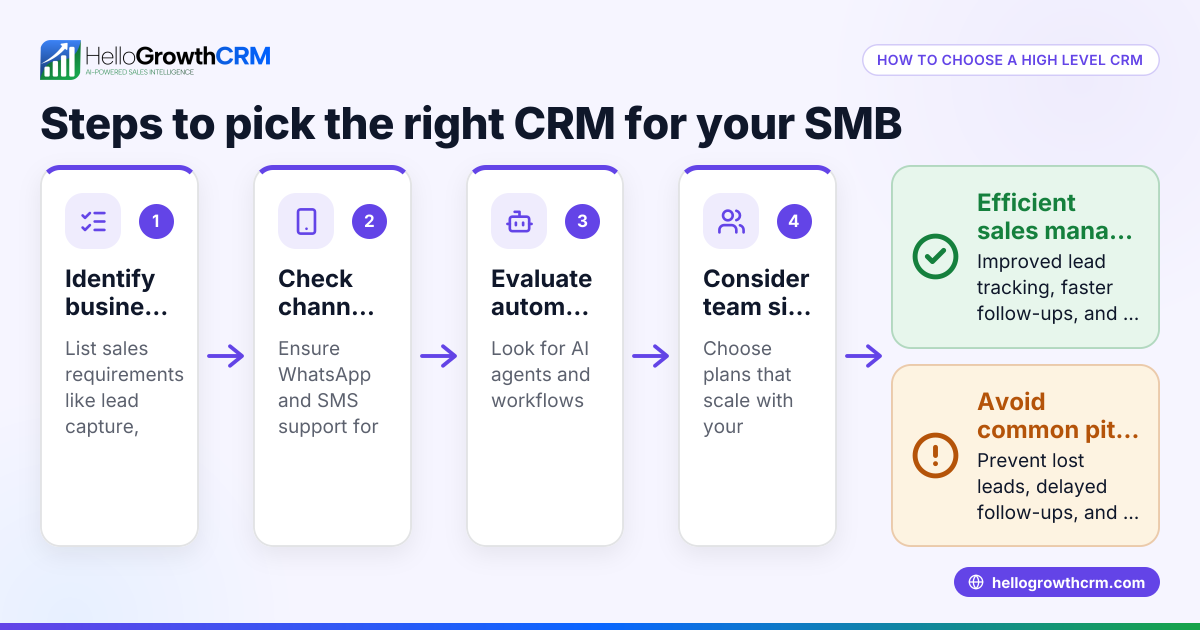
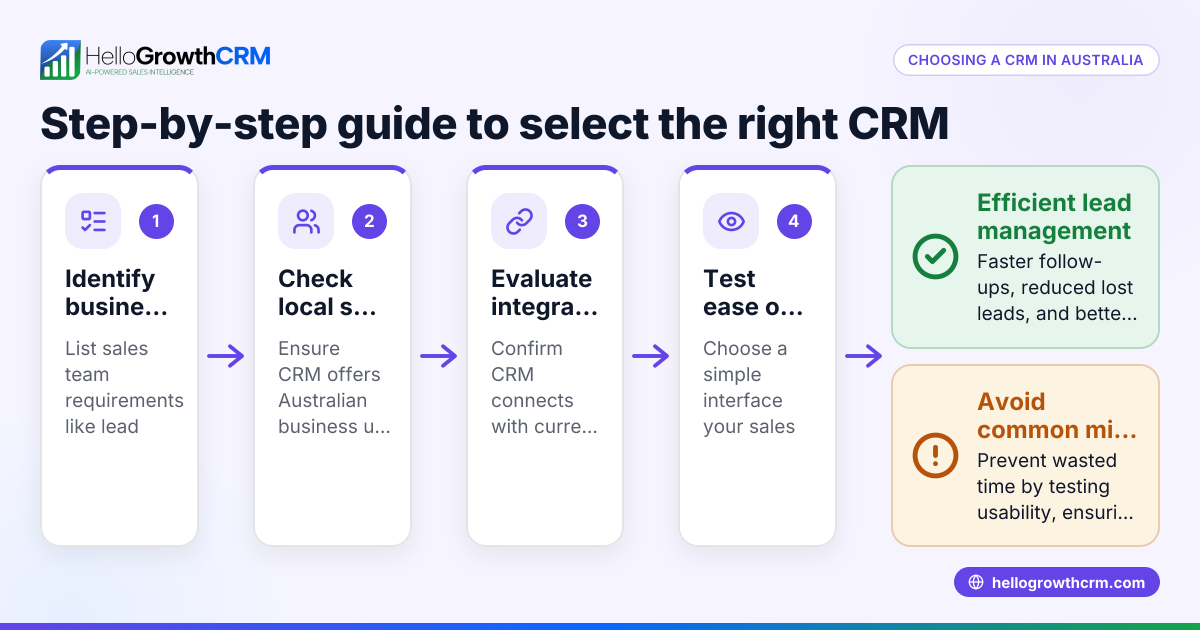
- Identify your business needs: List the key sales and marketing tasks you want to improve, such as lead capture, follow-up speed, pipeline visibility, or messaging automation.
- Check communication channels: Ensure the CRM supports the channels your customers use most, like WhatsApp and SMS, so your team can engage leads where they respond best (/product/whatsapp-sms-crm).
- Evaluate automation features: Look for AI agents or workflow automation that can draft follow-up messages or update records to reduce manual work (/product/ai-crm).
- Assess ease of use: The CRM should be intuitive so your sales team adopts it fully; complex systems often fail due to low usage.
- Consider pricing and scalability: Review plans carefully, especially limits on users, leads, and features. A Free Forever plan can be useful for small teams starting out (/free-crm).
- Request demos and trials: Test the CRM with your actual leads and tasks to see if it fits your workflow.
- Review integrations: Check if the CRM connects to your existing web forms, email, or other software.
Example (fictional figures)
A Brisbane-based solar installer with 10 sales reps wants to improve lead follow-up and pipeline management. They currently lose leads due to slow responses, which affects their revenue.
- Current leads per month: 150
- Average sale value: A$12,000
- Sales conversion rate: 25%
- Estimated lost leads due to slow follow-up: 20 (estimated for example purposes)
- Potential lost revenue: 20 × A$12,000 = A$240,000
If a high level CRM improves follow-up speed and reduces lost leads to 5 leads per month:
- New lost leads: 5
- Recovered leads: 20 - 5 = 15 leads
- Additional revenue: 15 × A$12,000 = A$180,000
This illustrates how investing in a CRM that automates follow-up and tracks leads can significantly increase revenue.
Common mistakes
- Choosing a CRM that is too complex: Avoid systems with features you don’t need; this can overwhelm your team and reduce adoption. Focus on your core needs.
- Ignoring communication channels: Don’t pick a CRM that can’t handle WhatsApp or SMS if that’s how your customers prefer to communicate. Check options like the WhatsApp and SMS CRM (/product/whatsapp-sms-crm).
- Overlooking automation: Manual follow-up wastes time and risks errors. Look for AI agents that draft messages or update records automatically (/product/ai-crm).
- Not testing with your team: A CRM that works in theory may fail in practice if the team finds it hard to use. Use free trials or a Free Forever plan to test before buying (/free-crm).
- Ignoring scalability and pricing: Starting small is fine, but ensure the CRM can grow with your business and won’t become too expensive or restrictive.
- Neglecting mobile access: Many sales teams work remotely or on-site. Confirm the CRM supports mobile-friendly features and messaging apps your team uses.
Doing this in HelloGrowthCRM
HelloGrowthCRM offers a WhatsApp-native CRM with features designed for small and mid-sized Australian businesses. WhatsApp conversations with leads are logged on the lead record, and follow-ups can be sent as messages, keeping communication seamless. AI agents draft follow-up messages after calls so sales reps only need to review and send them, reducing manual work. For very small teams, the Free Forever plan lets two people run a pipeline at no cost, making it easy to start without financial risk. Learn more about HelloGrowthCRM for Australia (/au).
Frequently asked questions
What is a high level CRM? A high level CRM is a customer relationship management system with advanced features like multi-channel communication, automation, and AI-driven workflows that help businesses manage leads and sales more effectively.
Why should small businesses consider WhatsApp and SMS in their CRM? Many customers prefer messaging apps like WhatsApp and SMS because they are quick and convenient. A CRM that integrates these channels helps your team engage leads faster and keeps all conversations logged in one place (/product/whatsapp-sms-crm).
How can AI agents improve CRM usage? AI agents can automate routine tasks such as drafting follow-up messages or updating records, which reduces manual work for sales reps and improves consistency in communication (/product/ai-crm).
Is there a risk of overpaying for CRM features a small business doesn’t need? Yes. It’s important to match the CRM’s features with your actual business needs. Starting with a free or low-cost plan that allows you to scale up helps avoid paying for unused features (/free-crm).
Can I try this CRM before committing? Yes, a Free Forever plan suitable for small teams to manage up to 200 leads without a credit card helps you test the system before upgrading (/free-crm).
How important is ease of use when choosing a high level CRM? Ease of use is critical. A CRM that’s difficult to navigate or requires extensive training may see low adoption, reducing its effectiveness. Testing with your team during trials can help ensure it fits your workflow (/free-crm).
Key takeaways
- A high level CRM helps small businesses manage leads, communication, and sales pipelines with advanced features.
- Choose a CRM that supports your customers’ preferred channels like WhatsApp and SMS.
- Automation and AI agents reduce manual follow-up and improve sales efficiency.
- Test the CRM with your team using free plans or trials to ensure adoption.
- Consider scalability, pricing, and mobile access to avoid paying for unnecessary features.
- HelloGrowthCRM offers WhatsApp-native messaging, AI follow-up drafting, and a Free Forever plan to help small teams get started.
Start your CRM journey with the Free Forever plan (200 leads, no credit card) at HelloGrowthCRM.
Ready to put this into practice?
Set up your pipeline, WhatsApp follow-ups, and AI lead scoring in minutes — free, no credit card.
Try HelloGrowthCRM freeGet CRM tips in your inbox
Join thousands of sales professionals who get weekly insights on CRM strategy, AI automation, and pipeline optimization.

The HelloGrowthCRM team publishes guides on CRM strategy, AI sales tools, and revenue operations for small business sales teams.