HelloGrowthCRM software
Built for real small-business sales teams
HelloGrowthCRM helps reps qualify faster, follow up on time, and close more deals—with practical automation in one place.
- AI lead scoring and pipeline visibility
- Built-in dialer, WhatsApp, and email automation
- Sales forecasting and RevOps-ready reporting
Calculating cost per lead (CPL) helps you understand how much your business spends to attract each potential customer. It is a crucial metric for managing marketing budgets and improving sales efficiency.
Why this comes up / what goes wrong
Small UK businesses often struggle with tracking their marketing spend against the leads they generate. Many rely on informal methods like WhatsApp messages, emails, or spreadsheets, which can cause lost or duplicated leads and unclear costs. Without a clear CPL figure, businesses risk spending too much on ineffective channels or failing to follow up leads promptly, resulting in lost sales opportunities.
Step-by-step
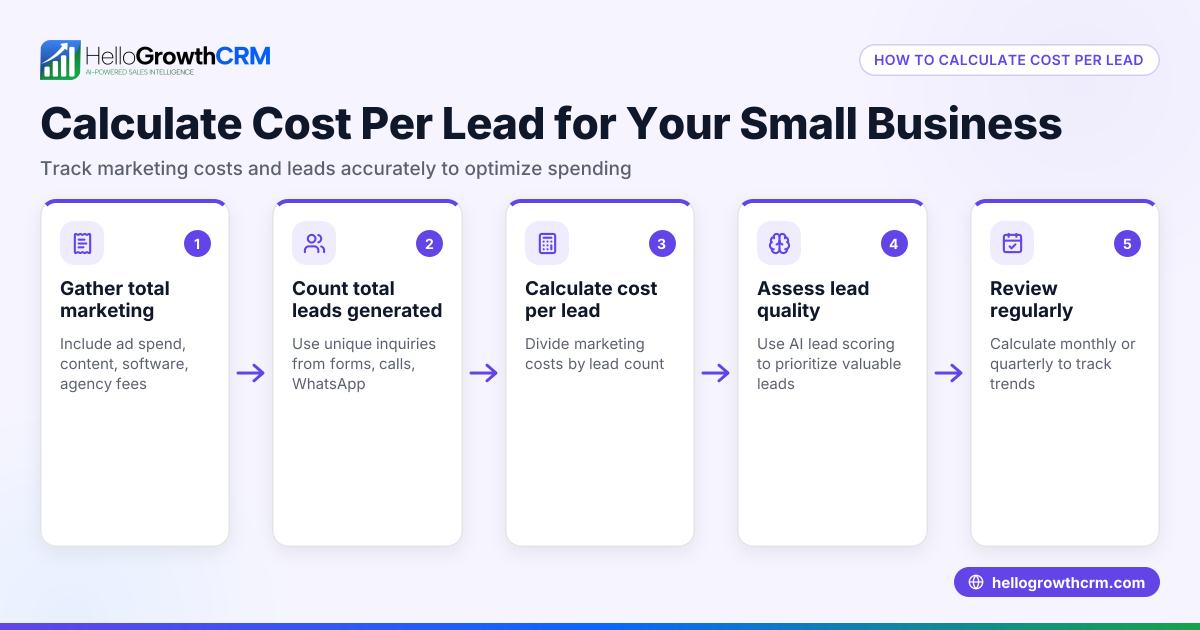
- Choose your time period: Decide the period you want to analyse, such as one month or a quarter. Make sure your marketing spend and lead data cover exactly this period.
- Calculate total marketing spend: Add up all costs directly related to marketing during this period. Include paid ads, design work, agency fees, event sponsorships, and any other marketing expenses. Check your invoices and receipts to be accurate.
- Count the number of leads generated: Collect the total number of leads acquired during the same period. Leads are potential customers who have shown interest by filling a form, calling, or messaging. Verify your lead records carefully to avoid counting duplicates or unqualified contacts.
- Calculate cost per lead: Use the formula:
\[ \text{Cost per lead} = \frac{\text{Total marketing spend}}{\text{Number of leads}} \]
Both values must be in the same currency (£) and for the same time period.
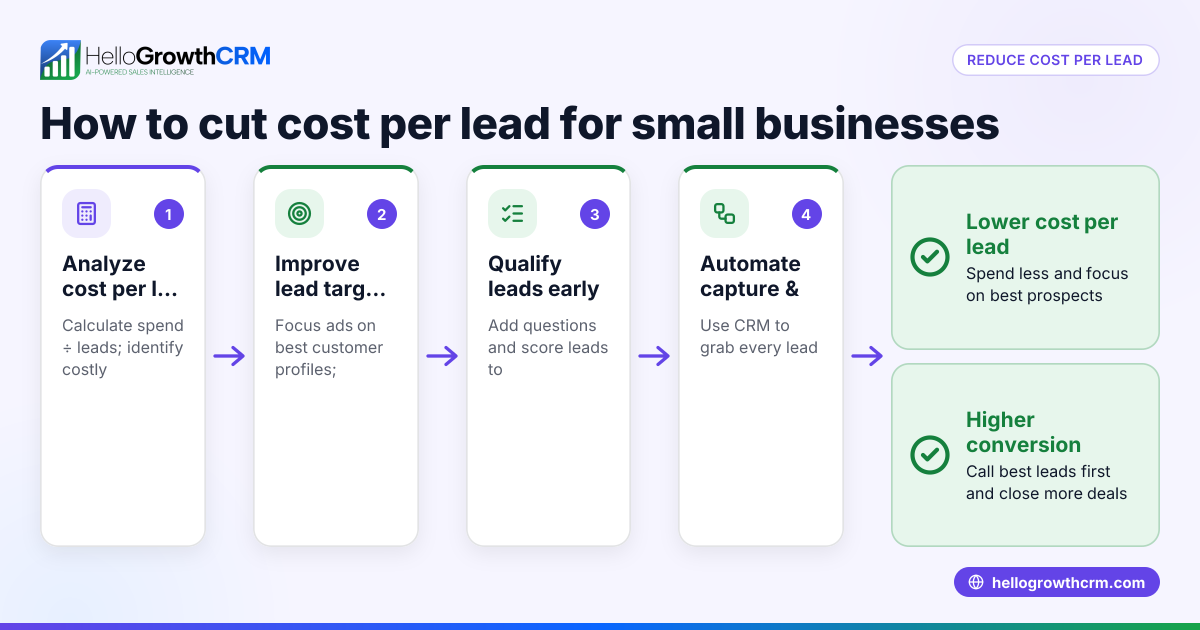
- Calculate CPL by channel (optional): If you use multiple marketing channels, calculate CPL separately for each to see which is most cost-effective.
- Review and adjust: Check your data for errors or gaps. Use the CPL insights to optimise your marketing budget and improve lead quality.
- Use a CRM to track leads: To avoid manual errors and lost leads, use a CRM system that captures every enquiry as a lead with an owner and next step. This helps organise leads and speeds up follow-up.
Example (fictional figures)
A recruitment consultancy in Bristol wants to calculate its CPL for January 2024.
- Marketing spend in January 2024:
- Google Ads: £3,000
- Facebook Ads: £1,500
- Design and print materials: £500
- Event sponsorship: £2,000
Total marketing spend = £3,000 + £1,500 + £500 + £2,000 = £7,000
- Leads generated in January 2024:
- From Google Ads: 70 leads
- From Facebook Ads: 30 leads
- From other sources: 10 leads
Total leads = 70 + 30 + 10 = 110 leads
Calculate cost per lead:
£7,000 ÷ 110 = £63.64 per lead
This means the consultancy spent on average £63.64 to acquire each lead in January 2024.
Common mistakes
- Mixing time periods: Using marketing spend from one period and leads from another results in inaccurate CPL. Always align your data periods.
- Ignoring indirect costs: Forgetting to include agency fees, design, or event costs underestimates your spend. Include all marketing-related expenses.
- Counting unqualified leads: Including contacts who are not genuine prospects inflates lead count and skews CPL. Define your lead criteria clearly.
- Manual tracking errors: Using spreadsheets or WhatsApp for leads can cause lost or duplicated entries. Use a CRM to keep accurate lead data.
- Not segmenting by channel: Calculating only overall CPL hides which marketing channels perform best. Break down CPL by source.
- Slow follow-up: Delayed contact with leads reduces conversion chances. Prioritise follow-up using AI lead scoring to call leads most likely to convert first.
Doing this in HelloGrowthCRM
HelloGrowthCRM captures every enquiry from forms, calls or WhatsApp as a lead with an owner and next step, preventing leads from getting lost in notebooks or chats. Its AI lead scoring helps telecallers focus on leads most likely to convert first. Automated workflows and lead routing assign new enquiries round-robin and create first-call tasks automatically, ensuring fast follow-up and better use of your marketing spend. Learn more about AI lead scoring and how HelloGrowthCRM supports UK businesses on HelloGrowthCRM for the United Kingdom.
Frequently asked questions
What counts as a lead for cost per lead calculation? A lead is a potential customer who has shown interest by providing contact details or engaging with your business, such as filling a form or calling. Clear criteria for what qualifies as a lead keep your CPL meaningful.
Should I include all marketing costs in the CPL calculation? Yes, include all direct and indirect marketing expenses like advertising, design, events, and agency fees within the chosen period to get an accurate figure.
How often should I calculate cost per lead? Calculate CPL regularly, such as monthly or quarterly, to track changes and adjust your marketing strategy accordingly.
Can I calculate CPL for each marketing channel separately? Yes, breaking down CPL by channel helps identify the most cost-effective sources and guides budget allocation.
How can a CRM help improve cost per lead? A CRM like HelloGrowthCRM organises leads, automates follow-up tasks, and uses AI lead scoring to prioritise calls, improving conversion rates and making your marketing spend more efficient.
Key takeaways
- Calculate cost per lead by dividing total marketing spend by the number of leads in the same period.
- Include all marketing-related expenses and ensure lead counts are accurate and qualified.
- Segment CPL by marketing channel to optimise budgets.
- Avoid manual tracking errors by using a CRM to capture and manage leads.
- Fast follow-up and AI lead scoring improve conversion and reduce wasted spend.
Understanding your cost per lead helps you manage marketing budgets and improve sales efficiency. To organise and prioritise your leads effectively, consider using HelloGrowthCRM. See UK pricing to get started.
Ready to put this into practice?
Set up your pipeline, WhatsApp follow-ups, and AI lead scoring in minutes — free, no credit card.
Try HelloGrowthCRM freeGet CRM tips in your inbox
Join thousands of sales professionals who get weekly insights on CRM strategy, AI automation, and pipeline optimization.

The HelloGrowthCRM team publishes guides on CRM strategy, AI sales tools, and revenue operations for small business sales teams.