HelloGrowthCRM software
Built for real small-business sales teams
HelloGrowthCRM helps reps qualify faster, follow up on time, and close more deals—with practical automation in one place.
- AI lead scoring and pipeline visibility
- Built-in dialer, WhatsApp, and email automation
- Sales forecasting and RevOps-ready reporting
Generating leads is essential for small businesses in Singapore to grow sales and stay competitive. Many owners struggle because they rely on informal methods like WhatsApp chats or spreadsheets that lose leads or delay follow-up. This guide gives clear, actionable steps to generate and manage leads effectively.
Why this comes up / what goes wrong
Small business owners in Singapore often find lead generation difficult because they lack a clear system. Leads come from multiple sources — social media, web forms, referrals, or walk-ins — but without organisation, enquiries get lost or delayed. Slow follow-up causes potential customers to turn to competitors. Without prioritising leads, sales teams waste time calling uninterested contacts instead of focusing on those most likely to buy.
Step-by-step
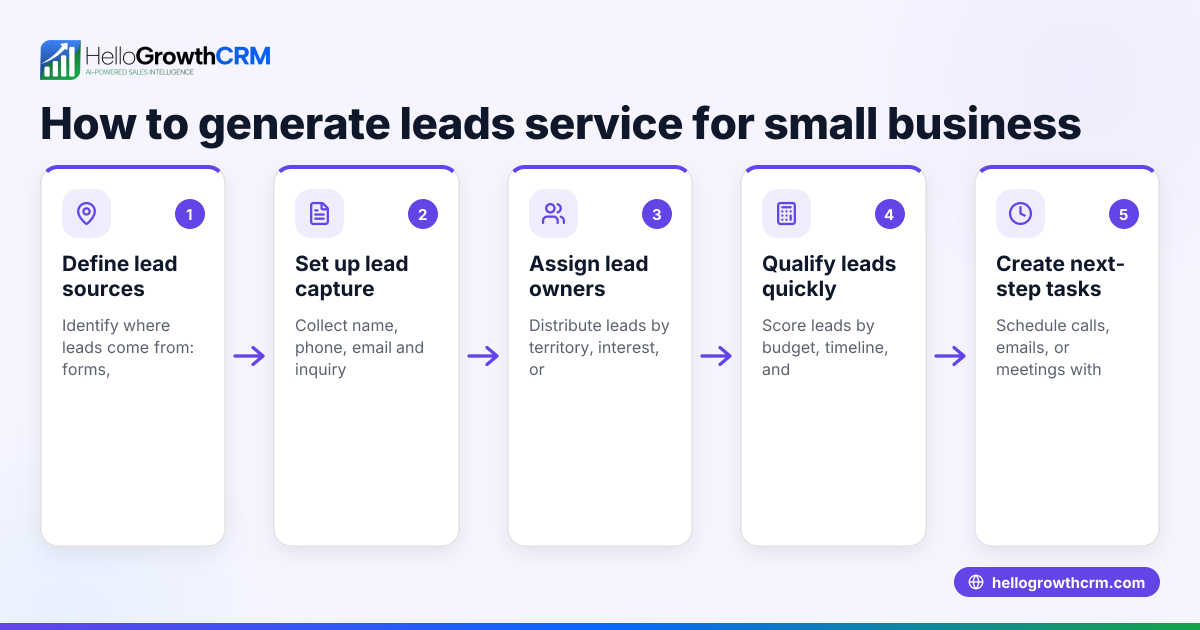
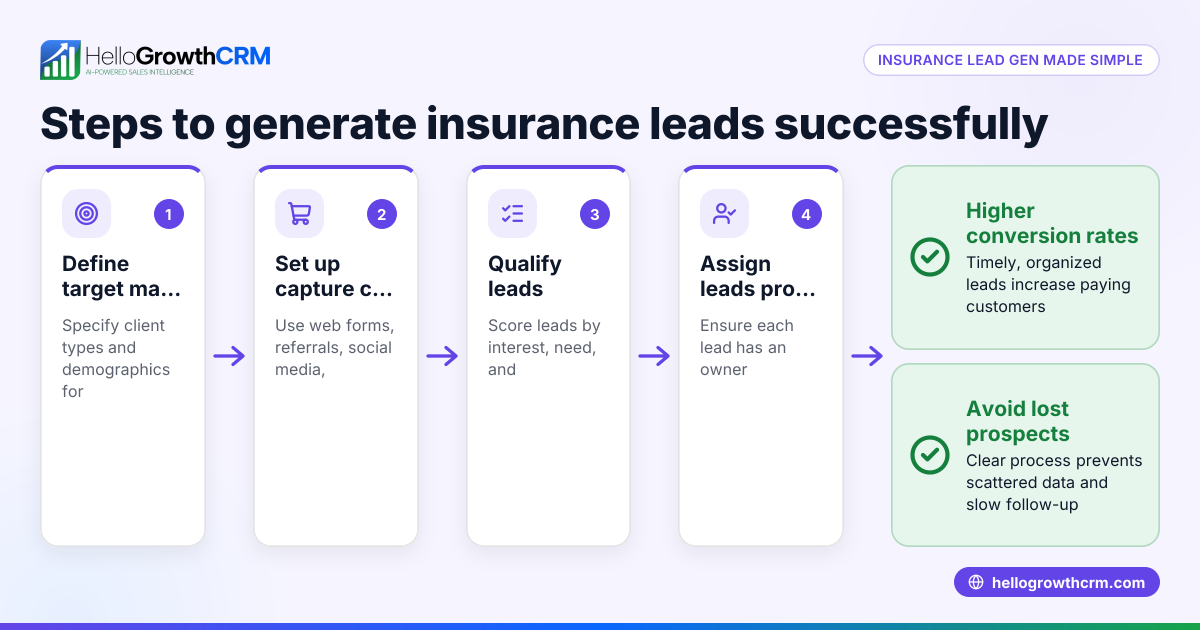
- Define your ideal customer: Identify who benefits most from your product or service. Consider location, industry, company size, or demographics. Check this profile regularly to stay focused.
- Create lead capture points: Set up ways for prospects to contact you easily. Use web forms on your website, WhatsApp business links, email sign-ups, and phone numbers. Ensure these are visible and simple to use.
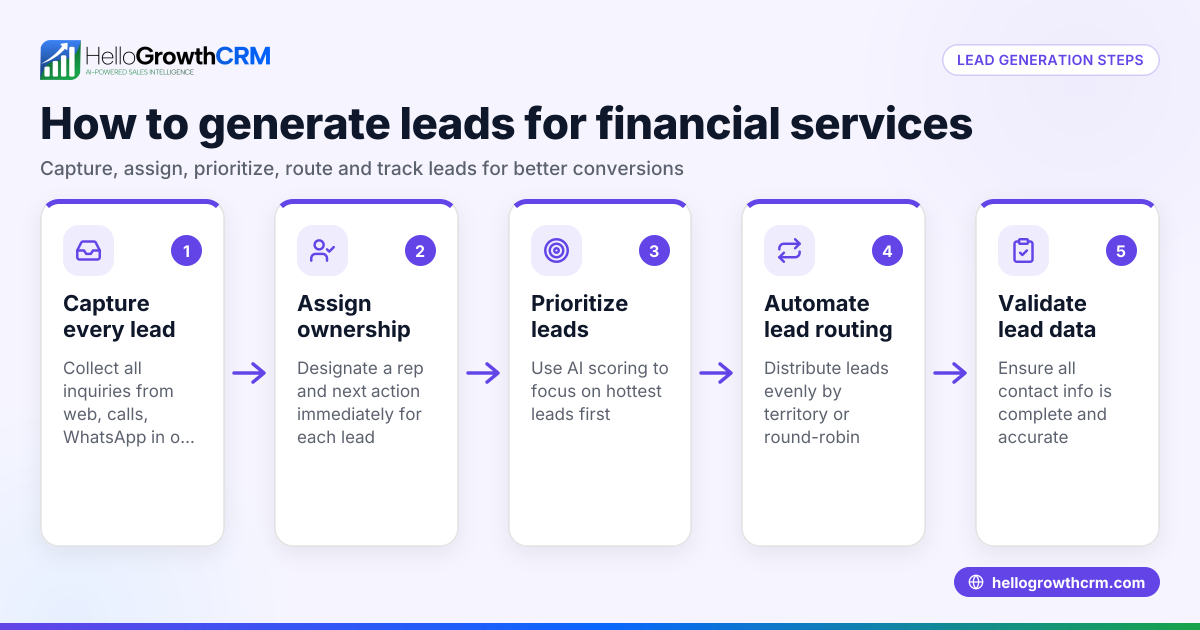
- Collect and centralise leads: Gather all enquiries from forms, calls, WhatsApp, and emails in one place. Avoid notebooks or scattered spreadsheets. Check that each lead has basic contact info and enquiry details recorded.
- Qualify leads quickly: Assess which leads are ready to buy or need nurturing. Use criteria like budget, timeline, and interest level. Prioritise leads likely to convert.
- Assign leads to team members: Distribute leads fairly among your salespeople or telecallers. Confirm each lead has an owner responsible for follow-up.
- Follow up promptly: Contact leads within 24 hours. Use phone calls, WhatsApp messages, or email sequences tailored to the lead’s interest. Track follow-up attempts and results.
- Use lead scoring to prioritise: Score leads based on engagement and fit. Call the highest-scoring leads first to improve conversion rates.
- Track progress and update lead status: Move leads through stages like New, Contacted, Proposal Sent, and Closed. Review your pipeline regularly.
- Analyse and adjust: Review which lead sources bring the best customers and optimise your capture points and follow-up accordingly.
Example (fictional figures)
A renovation contractor in Jurong wants to generate leads for home renovation projects starting in 2024.
- Step 1: Defines ideal customers as homeowners aged 30-55 in Jurong and nearby estates.
- Step 2: Adds a web form on their website and a WhatsApp business link on social media.
- Step 3: Collects 50 enquiries in January 2024 from these sources.
- Step 4: Qualifies leads by asking budget and renovation timeline.
- Step 5: Assigns leads evenly to two sales staff.
- Step 6: Sales staff call leads within 24 hours.
- Step 7: Uses simple lead scoring: budget over S$50,000 scores 3 points, timeline within 3 months scores 2 points, expressed strong interest scores 1 point.
- Step 8: Tracks leads moving from New to Contacted to Proposal Sent.
- Step 9: Reviews results monthly to focus on WhatsApp leads, which have higher conversion.
Calculations for January:
Total leads = 50
Leads with budget > S$50,000 = 20 leads × 3 points = 60 points
Leads with timeline < 3 months = 30 leads × 2 points = 60 points
Leads with strong interest = 15 leads × 1 point = 15 points
Total lead score = 60 + 60 + 15 = 135 points
Average lead score = 135 ÷ 50 = 2.7 points per lead
This scoring helps the team call the 20 highest scoring leads first.
Common mistakes
- Ignoring lead centralisation: Prevent by collecting all leads in one system rather than notebooks or scattered files.
- Slow follow-up: Prevent by setting a 24-hour call-back rule and tracking follow-up tasks.
- Not qualifying leads: Prevent by asking key questions early to focus effort on promising prospects.
- Unequal lead distribution: Prevent by assigning leads fairly to avoid overloading or neglecting team members.
- Not tracking lead status: Prevent by updating lead stages and reviewing pipeline weekly.
- Failing to analyse lead sources: Prevent by recording where leads come from and adjusting marketing spend accordingly.
Doing this in HelloGrowthCRM
HelloGrowthCRM captures every enquiry from a form, call or WhatsApp as a lead with an owner and a next step, instead of leaving them in notebooks. Its AI lead scoring helps telecallers call the leads most likely to convert first. Automated workflows and lead routing assign new enquiries round-robin and create first-call tasks automatically. Learn more about AI lead scoring and how HelloGrowthCRM supports lead management for small businesses in Singapore.
Frequently asked questions
How quickly should I follow up on new leads? Follow up within 24 hours to keep the lead warm and show professionalism. Delays can cause loss of interest.
What is lead scoring and how can it help? Lead scoring ranks leads by their likelihood to buy based on criteria like budget and interest. It helps sales teams prioritise calls and improve conversion rates. See AI lead scoring for automated scoring.
Can I generate leads without a website? Yes, you can use WhatsApp business links, social media, referrals, and phone calls as lead capture points. However, a website with forms can increase lead volume.
How do I assign leads fairly in a small sales team? Use round-robin assignment or territory rules to distribute leads evenly. HelloGrowthCRM offers automated lead routing to assist with this.
What if I get too many leads to handle? Qualify leads quickly to focus on those ready to buy. Consider adding more salespeople or using automation tools to manage volume.
Key takeaways
- Define your ideal customer clearly to target lead generation efforts.
- Create visible, easy lead capture points like web forms and WhatsApp links.
- Centralise all leads in one system with assigned owners and next steps.
- Qualify and score leads promptly to prioritise follow-up.
- Track lead status and analyse sources regularly to improve results.
- Avoid common mistakes by following a structured process.
Start generating leads efficiently today with HelloGrowthCRM. Start on the Free Forever plan (200 leads, no credit card) and organise your leads with AI scoring and automated workflows.
Ready to put this into practice?
Set up your pipeline, WhatsApp follow-ups, and AI lead scoring in minutes — free, no credit card.
Try HelloGrowthCRM freeGet CRM tips in your inbox
Join thousands of sales professionals who get weekly insights on CRM strategy, AI automation, and pipeline optimization.

The HelloGrowthCRM team publishes guides on CRM strategy, AI sales tools, and revenue operations for small business sales teams.