HelloGrowthCRM software
Built for real small-business sales teams
HelloGrowthCRM helps reps qualify faster, follow up on time, and close more deals—with practical automation in one place.
- AI lead scoring and pipeline visibility
- Built-in dialer, WhatsApp, and email automation
- Sales forecasting and RevOps-ready reporting
Improve sales pipeline velocity by accelerating how quickly deals move through each stage, from lead capture to closing. Focus on timely follow-ups, prioritising promising leads, clearing bottlenecks, and tracking progress with clear metrics. This article covers why slow pipeline velocity happens, step-by-step instructions, a realistic example with arithmetic, common mistakes, and how HelloGrowthCRM supports your efforts.
Why this comes up / what goes wrong
Many Indian small and mid-sized businesses rely on spreadsheets, WhatsApp chats, or manual notes to track sales. Leads get forgotten or delayed because no one has a clear, central view of the pipeline. Deals stall at certain stages like quotation or negotiation without timely follow-up. This slows revenue and wastes sales effort. Business owners and sales leaders want a practical way to speed up pipeline velocity without complex tools or reports.
Step-by-step
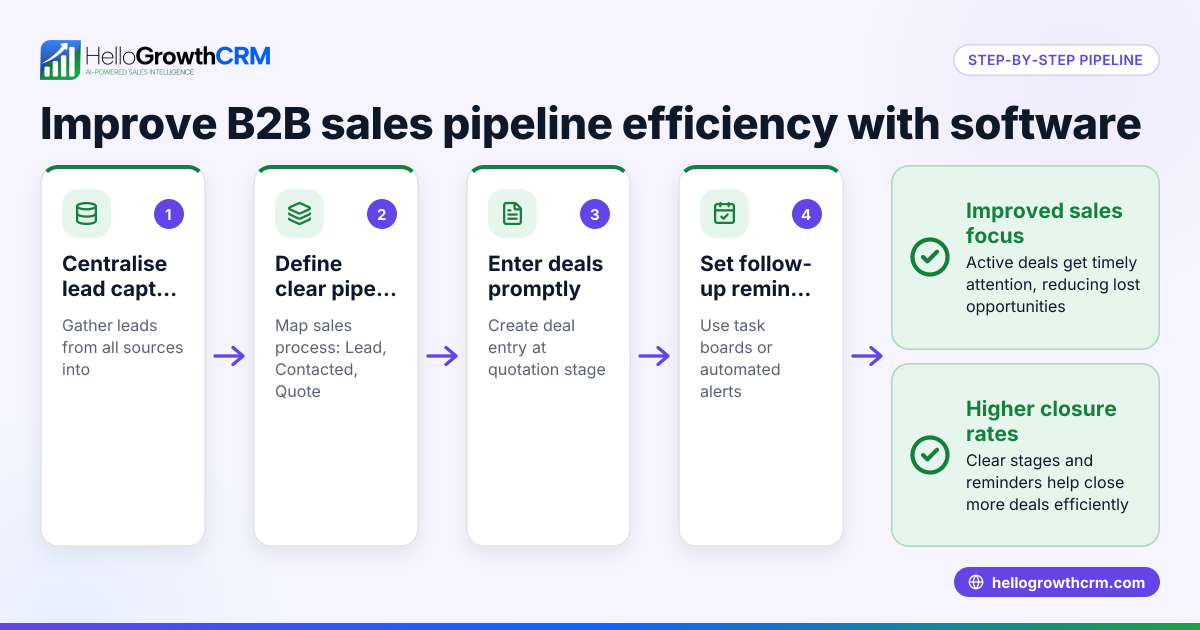
- Define your sales pipeline stages clearly. List each stage, for example: New Lead, Contacted, Quote Sent, Negotiation, Closed Won, Closed Lost. Check that every deal is assigned a current stage.
- Set follow-up dates for every deal after key actions. For example, after sending a quotation, schedule a follow-up call or message within 3-5 days. Check daily that no follow-ups are overdue.
- Prioritise leads using simple criteria. Focus on leads who have requested quotes or shown recent interest. This saves time by working on deals more likely to close faster.
- Identify bottlenecks by reviewing pipeline stages weekly. Find where deals stay longest. Investigate reasons like pricing objections or missing information and address them.
- Use a visual pipeline board (kanban style) to track deals. This helps your team see what needs attention and move deals forward.
- Calculate pipeline velocity weekly. Use the formula: (Number of deals × Average deal value) ÷ Average sales cycle length in days. This shows daily revenue flow and highlights improvement areas.
- Train your sales team to communicate promptly. Ensure calls, WhatsApp messages, and emails happen without delay.
- Automate routine reminders and alerts where possible. This reduces manual work and prevents deals slipping through cracks.
- Review and refine your sales process monthly. Adjust stages, scoring, or communication based on results and feedback.
These steps help keep deals moving and reduce delays.
Example (fictional figures)
A small Pune-based manufacturer tracks 20 deals monthly. They want to improve velocity by reducing average stage time from 10 days to 7 days.
- Average deal value: ₹1,50,000
- Deals per month: 20
- Current average sales cycle: 5 stages × 10 days = 50 days
- Target average sales cycle: 5 stages × 7 days = 35 days
Current velocity:
Number of deals × Average deal value = 20 × ₹1,50,000 = ₹30,00,000
Velocity = ₹30,00,000 ÷ 50 days = ₹60,000 per day
Target velocity:
Number of deals × Average deal value = 20 × ₹1,50,000 = ₹30,00,000
Velocity = ₹30,00,000 ÷ 35 days = ₹85,714 per day
Increase in daily revenue velocity:
₹85,714 − ₹60,000 = ₹25,714 per day
By reducing stage time by 3 days each, the business increases daily revenue velocity by ₹25,714, meaning faster cash flow and growth.
Common mistakes
- Not scheduling follow-ups immediately: Leads get forgotten. Prevent this by setting reminders right after each contact.
- Using only spreadsheets or WhatsApp: Leads get lost or data is inconsistent. Use pipeline management tools to centralise tracking.
- Ignoring stalled deals: Bottlenecks remain hidden. Regularly review pipeline stages to find and clear stuck deals.
- Spending time on low-priority leads: This wastes effort. Score leads and focus on those more likely to close soon.
- No clear ownership or accountability: Deals don’t move if no one owns them. Assign responsibilities and track activity.
- Not measuring pipeline velocity: Without metrics, it’s hard to improve. Calculate velocity weekly or monthly.
Avoid these by following the step-by-step process and using proper tools like HelloGrowthCRM.
Doing this in HelloGrowthCRM
HelloGrowthCRM helps Indian SMBs improve pipeline velocity with Deals (pipeline) that track open opportunities from first contact through close. For example, a quotation sent last week automatically appears as a deal at the 'quote sent' stage with a follow-up date, so no deal is forgotten. The Pipeline forecast and AI insights feature shows which stages deals are stalling in, without needing to build spreadsheets. For businesses with field sales, Territories, field operations and commissions let reps log visits from their phones while managers see the day's beat. Learn more about these features in the AI CRM and sales forecasting pages. HelloGrowthCRM is tailored for Indian sales teams and helps keep your pipeline moving.
Frequently asked questions
How do I calculate sales pipeline velocity? Calculate sales pipeline velocity by multiplying the number of deals by the average deal value, then dividing by the average length of the sales cycle in days. This gives the average revenue moving through your pipeline daily.
What causes slow sales pipeline velocity? Slow velocity often results from delayed follow-ups, unclear pipeline stages, lack of lead prioritisation, and deals stuck in negotiation or quote stages.
How often should I review my sales pipeline? Review your sales pipeline weekly to track deal progress and identify bottlenecks. Monthly reviews help refine your overall sales process and improve velocity.
Can technology help improve pipeline velocity? Yes, technology like HelloGrowthCRM provides visual pipeline boards, automated reminders, AI insights, and mobile tools to speed up deal movement and reduce manual errors. See HelloGrowthCRM for India for details.
What is a good sales pipeline velocity for small businesses? Good velocity varies by industry and deal size. The key is to improve your own velocity over time by reducing delays and increasing the number and value of deals closed.
Key takeaways
- Define clear pipeline stages and assign every deal to one.
- Schedule and track follow-ups to avoid lost deals.
- Prioritise leads based on potential to close soon.
- Identify bottlenecks and work to clear them regularly.
- Use visual pipeline boards and measure velocity weekly.
- Avoid manual tracking pitfalls by using tools like HelloGrowthCRM.
Start improving your sales pipeline velocity today with clear steps and the right tools. You can Start on the Free Forever plan (200 leads, no credit card) to see how HelloGrowthCRM helps keep your deals moving faster.
Ready to put this into practice?
Set up your pipeline, WhatsApp follow-ups, and AI lead scoring in minutes — free, no credit card.
Try HelloGrowthCRM freeGet CRM tips in your inbox
Join thousands of sales professionals who get weekly insights on CRM strategy, AI automation, and pipeline optimization.

The HelloGrowthCRM team publishes guides on CRM strategy, AI sales tools, and revenue operations for small business sales teams.