HelloGrowthCRM software
Built for real small-business sales teams
HelloGrowthCRM helps reps qualify faster, follow up on time, and close more deals—with practical automation in one place.
- AI lead scoring and pipeline visibility
- Built-in dialer, WhatsApp, and email automation
- Sales forecasting and RevOps-ready reporting
AI lead scoring uses machine learning to analyze and prioritize leads based on their likelihood to convert. US B2B sales teams leverage this ai-powered process to focus on high-value opportunities, improving pipeline efficiency and boosting revenue.
Key takeaways
- AI lead scoring helps US B2B sales teams prioritize leads showing the highest purchase intent.
- Automated with AI, lead scoring reduces manual qualification, saving time and increasing accuracy.
- Integrating AI software with your CRM enhances pipeline management and forecasting capabilities.
- Compliance with US regulations like CAN-SPAM and TCPA remains crucial when using AI automation for outreach.
- AI lead scoring supports better resource allocation across sales and marketing efforts.
What is AI lead scoring and how does it work?
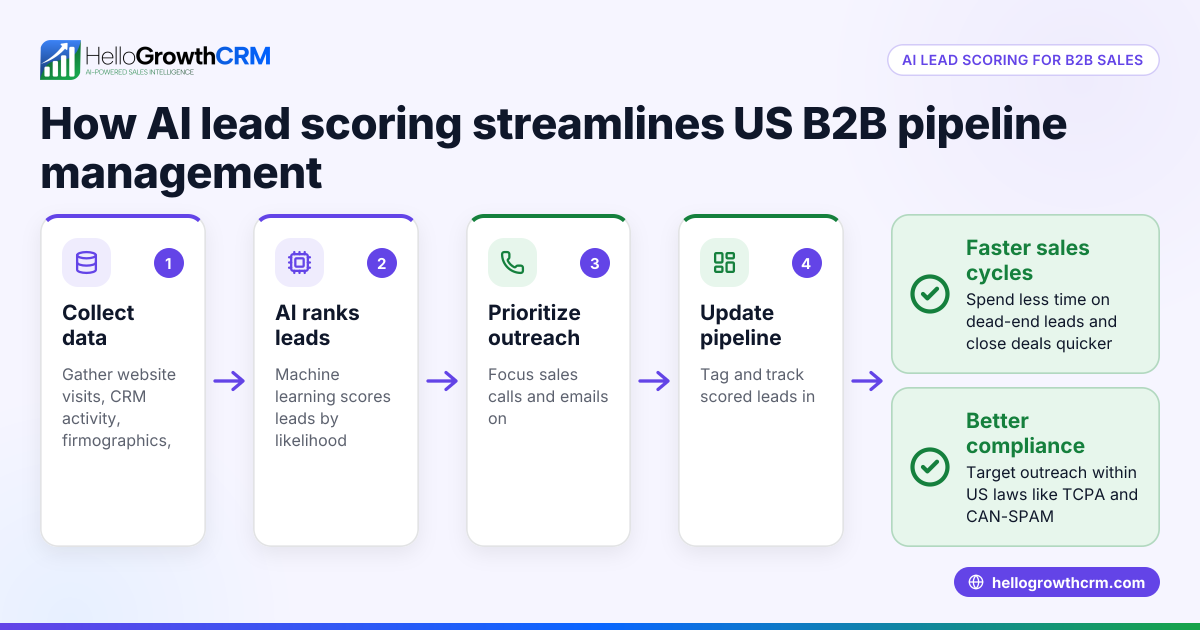
AI lead scoring is an ai-powered process that ranks leads by their likelihood to become paying customers using machine learning algorithms. It improves lead qualification by analyzing patterns in historical data and real-time engagement signals.
Unlike traditional fixed-score models, this ai tool uses data such as website visits, email interaction, and firmographic info to assign a dynamic score. The AI software learns continuously, updating lead rankings automatically as new data flows in. This integration with your CRM automates prioritization, helping sales reps focus on high-value prospects without manual effort.
Why should US B2B sales teams adopt AI lead scoring?
AI lead scoring decreases guesswork in qualifying leads, making pipeline management more data-driven. By focusing on high-priority prospects, sales reps can have more meaningful conversations with buyers, improving conversion rates. This results in a healthier sales pipeline and more predictable revenue forecasts.
In busy markets like Chicago or Houston, this efficiency matters. With many leads coming from inbound marketing or trade shows, AI automation prioritizes leads that fit your ideal customer profile. It also helps identify hidden opportunities in cold leads or accounts with low initial engagement but growing intent signals.
How does AI lead scoring integrate with existing sales processes?
AI software fits seamlessly into most CRM platforms, including systems commonly used in US businesses. The integration automates lead scoring updates and feeds into pipeline stages, triggering task creation or outreach. For example, once a lead reaches a high score threshold, a sales automation workflow can assign the lead to a rep or initiate an email sequence.
Integration also supports sales and marketing alignment. Marketing teams can adjust campaigns based on the quality of leads generated as reflected in AI lead scores, optimizing spend and messaging to better engage target accounts.
How to implement AI lead scoring in your US B2B company?
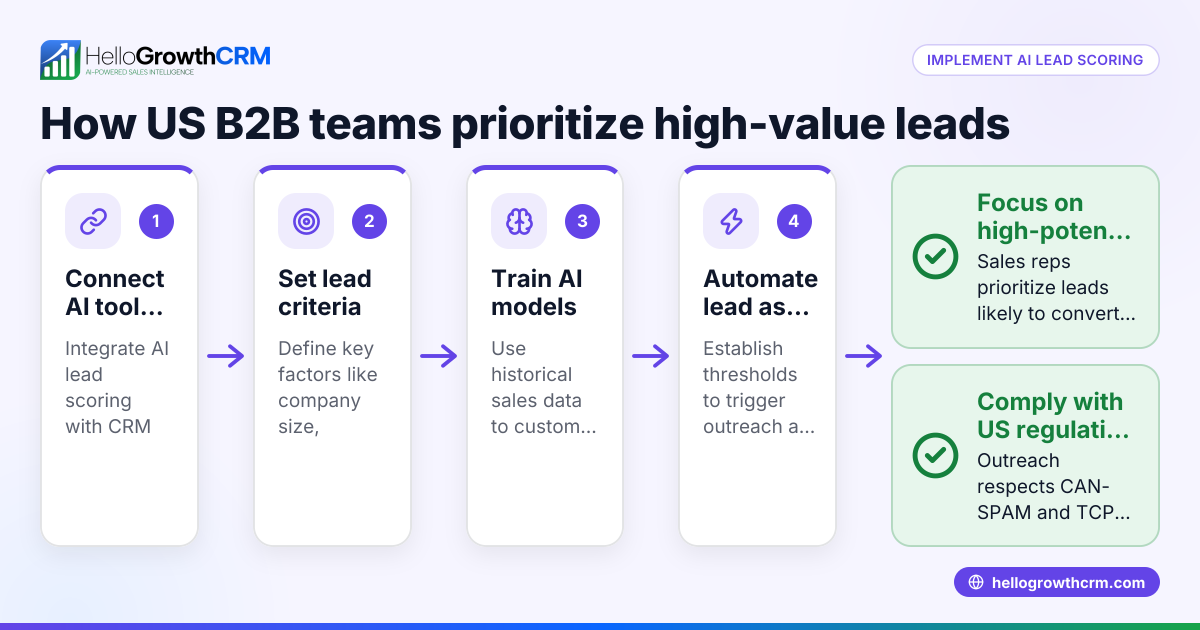
Implementing AI lead scoring follows these steps:
- Assess your data: Ensure you have quality data from CRM, marketing automation, and engagement channels like email or calls.
- Choose an AI lead scoring solution: Select an AI software that integrates with your CRM and sales stack. Look for features like automated lead capture, AI lead scoring models, and visibility into scoring criteria.
- Clean and enrich data: Remove duplicates, standardize fields, and append missing firmographic or behavioral data where possible.
- Train the AI model: Feed historical data on leads and deals to teach the AI what good versus poor leads look like.
- Define scoring criteria: Collaborate with sales and marketing to set thresholds and rules for automated actions based on scores.
- Integrate with workflows: Connect your AI lead scoring to sales automation tools, email campaigns, and pipeline management.
- Monitor and refine: Continuously evaluate lead scoring performance and adjust models as your business and buyer behavior evolve.
Using an AI CRM like HelloGrowthCRM makes this process smoother, with integrated managed RevOps support to help deploy and optimize AI lead scoring fast.
What legal considerations should US companies keep in mind?
When using AI automation for lead scoring and outreach, it’s essential to comply with US laws such as CAN-SPAM and the Telephone Consumer Protection Act (TCPA). These laws regulate email marketing and phone calls for sales outreach, including opt-out requirements and call times.
Ensure your AI-powered email automation respects unsubscribe requests immediately. AI tools should also be configured to avoid calling numbers listed on the National Do Not Call Registry. Maintaining compliance builds trust with leads and avoids costly penalties.
How does AI lead scoring improve sales forecasting?
Sales forecasting relies heavily on pipeline visibility and lead quality. AI lead scoring enhances this by providing a real-time weighted view of opportunities based on predictive data. This reduces reliance on subjective rep estimates.
AI software can analyze win rates by score band to forecast expected revenue from the current pipeline. It also highlights at-risk deals needing attention. This empowers RevOps managers in US companies to produce more accurate forecasts that drive better business decisions.
How can sales teams use AI-powered insights to close deals faster?
With AI lead scoring, sales reps get timely alerts on hot leads. Combining scores with engagement data from email and calls helps tailor messaging and timing. Using AI automation, reps can trigger personalized email sequences or schedule calls when prospects are most receptive.
AI tools also identify common objection patterns or churn risks, enabling proactive deal management. The result is a more efficient sales process where reps spend less time chasing cold leads and more time building relationships with qualified buyers.
What are common challenges and how to overcome them?
Common obstacles include poor data quality, resistance to change, and misunderstanding AI outputs. To overcome these:
- Invest in data hygiene by regularly cleaning and enriching lead records.
- Train sales and marketing teams on AI lead scoring concepts and benefits.
- Use AI CRM dashboards to clearly visualize scores and actionable insights.
- Collaborate across departments to align scoring criteria with real-world sales outcomes.
Ongoing managed RevOps support can help troubleshoot issues and improve adoption in US B2B teams.
Conclusion
AI lead scoring offers US B2B sales teams a powerful way to optimize pipeline efficiency by focusing efforts on the leads most likely to convert. This ai-powered approach automates manual qualification, integrates seamlessly with CRM workflows, and improves both forecasting and sales outcomes. If you want to see AI lead scoring in action, start a free trial or book a demo with HelloGrowthCRM today.
Frequently asked questions
What data does AI lead scoring use?
AI lead scoring collects data from various sources like CRM profiles, website visits, email opens and clicks, call outcomes, and firmographic details such as company size and industry. This rich dataset helps the AI algorithms accurately predict lead quality.
How quickly can my team see results from AI lead scoring?
Results vary but many US B2B teams notice improved lead prioritization and faster sales cycles within several weeks of implementation, especially when supported by managed RevOps to ensure proper setup.
Can AI lead scoring replace human judgment?
AI lead scoring complements but does not replace sales expertise. It processes large datasets to highlight priority leads, but experienced reps still apply human insight to build rapport and close deals.
Is AI lead scoring compliant with US data laws?
Yes, when properly configured AI lead scoring respects laws like CAN-SPAM and TCPA by managing opt-outs and call restrictions. Compliance is critical to avoid legal risks during AI-driven outreach.
How does AI lead scoring impact sales and marketing alignment?
AI lead scoring provides shared insight into lead quality, helping sales and marketing teams collaborate on campaign targeting and lead nurturing strategies. This drives better pipeline quality and ROI on marketing efforts.
What is the difference between AI lead scoring and traditional lead scoring?
Traditional lead scoring uses fixed criteria and manual updates, while AI lead scoring dynamically adjusts scores based on continuous learning from large datasets, improving accuracy and predictive power over time.
Read next
This article covers one part of a bigger topic. For the complete picture, read our guide to ai lead scoring.
Frequently Asked Questions
Ready to put this into practice?
Set up your pipeline, WhatsApp follow-ups, and AI lead scoring in minutes — free, no credit card.
Try HelloGrowthCRM freeGet CRM tips in your inbox
Join thousands of sales professionals who get weekly insights on CRM strategy, AI automation, and pipeline optimization.

The HelloGrowthCRM team publishes guides on CRM strategy, AI sales tools, and revenue operations for small business sales teams.