AI Lead Scoring: How Machine Learning Finds Your Best Leads First

Co-Founder, HelloGrowthCRM · March 20, 2026 · 13 min read
Quick Answer
AI lead scoring uses machine learning to rank inbound leads by conversion probability, trained on your historical closed-won and closed-lost data. In 2026, transformer-based models now parse unstructured lead data (email replies, call transcripts, chat messages) that classic ML could not reach — extending the score beyond clicks and form fills. The model re-scores leads in real time as they take actions, and reps who work AI-scored leads first typically convert 2–3× more without increasing effort or headcount.
HelloGrowthCRM software
Built for real small-business sales teams
HelloGrowthCRM helps reps qualify faster, follow up on time, and close more deals—with practical automation in one place.
- AI lead scoring and pipeline visibility
- Built-in dialer, WhatsApp, and email automation
- Sales forecasting and RevOps-ready reporting
What changed in AI lead scoring in 2026
AI lead scoring in 2026 is materially different from the rule-based and gradient-boosted approaches that dominated the field through 2023-2024. Four practical shifts have moved the ceiling on what a working lead-scoring system can do — and lowered the cost of running one enough that mid-size sales teams can now afford models that were enterprise-only two years ago.
First, transformer-based models now handle the unstructured signals classic ML could not reach. Where a gradient-boosted classifier scored a lead on a fixed feature set (company size, title, page visits, email opens), a transformer-augmented scoring layer reads the actual content of email replies, call transcripts, WhatsApp messages, and chat conversations.
It extracts intent — "the buyer mentioned budget approval is pending," "the buyer asked about SOC 2 compliance," "the buyer named a specific competitor" — and feeds those semantic features into the same probability model that used to only see click patterns. The uplift is largest on B2B leads where most of the signal lives in what people actually say, not what they clicked.
Second, real-time scoring latency has collapsed. As recently as 2024, a lead-scoring API call took 150-300 milliseconds — too slow to run inside a form-submission handler without visible delay. In 2026, most production scoring APIs return in under 20 milliseconds, which means a lead can be scored, routed, and assigned to the right rep before the browser has finished the redirect.
Faster routing is worth more than slightly better scoring — the first-response time of the rep matters more to conversion than a five-percent difference in probability rank.
Third, foundation-model inference costs dropped roughly an order of magnitude in 2025-2026. A per-lead LLM call that cost $0.01-0.02 in 2024 now costs $0.001-0.003 for equivalent quality. That collapse changes the economics: teams that couldn't justify LLM inference on every inbound lead can now afford to run semantic scoring on 100% of traffic instead of a top-quartile subset.
The result is a fuller training set for the downstream model and less bias toward whatever heuristic the team used to pick the "expensive" subset.
Fourth, and most important for revenue teams: outbound sequences in 2026 now trigger on AI-answer-engine signals. When a prospect asks Microsoft Copilot, ChatGPT, or Perplexity about your product category, some CRMs can pick up that behavior via server-side referrer patterns and citation logs, and elevate that prospect's score.
The signal is early — usually before the prospect fills a form or downloads anything — and the sales rep who reaches out at that moment sees a materially better response rate than one who waits for the form-fill trigger.
What has NOT changed: the fundamentals of feature engineering, model validation against a hold-out set, and threshold calibration by score band. The rest of this guide covers those fundamentals, then returns to how the 2026 additions above change specific implementation choices.
What Is Lead Scoring? Rule-Based vs Predictive vs AI
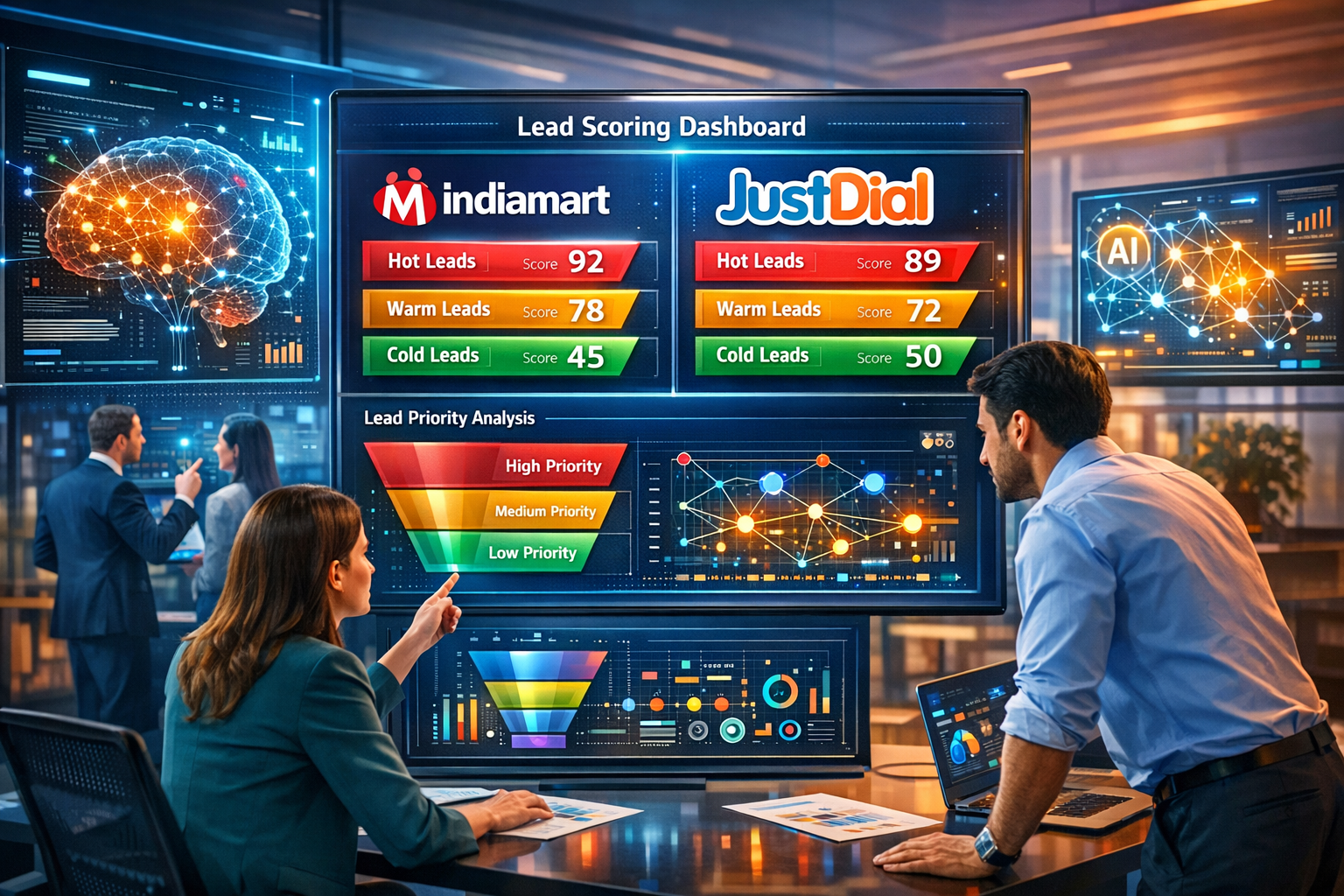
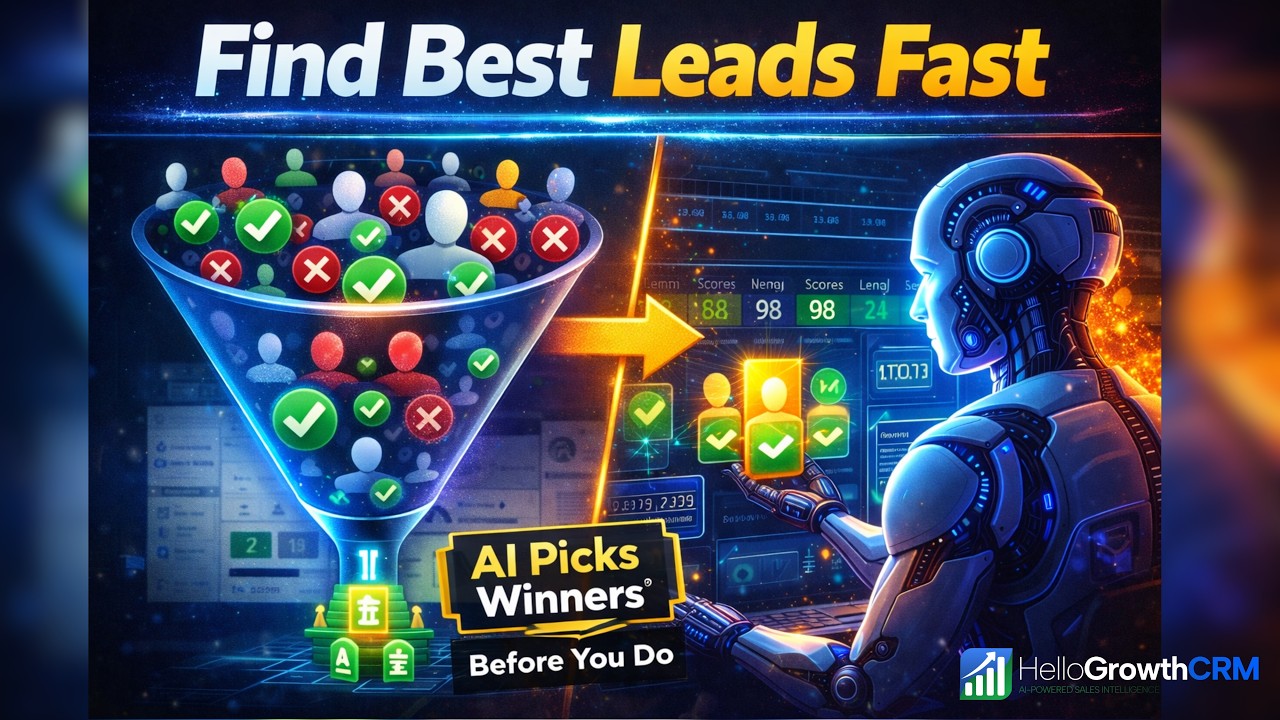
AI lead scoring uses machine learning to assign every inbound lead a conversion probability score, trained on your historical closed-won and closed-lost data. The model re-scores leads in real time as they take actions — email opens, page visits, form fills. The result: reps work the top 20% of leads first and convert 2–3x more of them without working harder.
Lead scoring is a system that ranks leads by likelihood to convert, so reps know who to call first. Rule-based scoring is manual: "If someone is a VP at a 100+ person company in the SaaS industry, give them 100 points. If they visited our pricing page, add 20 points.
If they opened an email, add 5 points." The rep then calls whoever has the highest score. Rule-based scoring is better than guesswork but requires constant manual tuning as your business and market change.
Predictive scoring uses machine learning on historical data to predict which leads are most likely to convert. It analyzes thousands of won and lost deals to identify patterns: "Leads in fintech convert 3x better than retail leads." "VPs close faster than managers." "Leads who visit the demo page 2+ times have a 40% conversion rate vs 5% who don't." These patterns emerge from data, not gut feel.
Predictive scoring improves over time as more deals close and the model learns.
AI lead scoring goes a step further by continuously learning from new signals in real-time. As market conditions change, as your product evolves, as your sales process improves, the AI model updates dynamically. It can also detect emerging signals — e.g., if a new industry suddenly has high conversion rates, the AI catches it immediately and reprioritizes.
AI lead scoring is the most accurate and requires minimal manual maintenance.
How AI Lead Scoring Works: Feature Engineering, Model Training, Real-Time Scoring
Under the hood, AI lead scoring works in three phases. Feature engineering: the system extracts "features" from data — company size, industry, job title, email domain, website behavior, email engagement, intent signals, etc. Each feature is analyzed to determine its predictive power.
Some features are highly predictive (CIO at a Fortune 500 company is more likely to convert than a freelancer), while others are noise.
Model training: the system uses historical data (your past won deals) as training data. It learns the pattern: "When these features are present, deals close." The model is tested against historical lost deals to ensure it correctly identifies low-probability leads.
Cross-validation (testing on data the model hasn't seen) ensures the model doesn't overfit to your specific past but generalizes to future leads.
Real-time scoring: once trained, the model scores new leads instantly as they enter the system. Lead "John Smith at Acme Corp with VP title" gets a score of 85/100 based on the pattern it learned. The score updates as new signals arrive — John visits your demo page, the score jumps to 92.
John replies to an email, the score becomes 96. Reps see the highest-scoring leads in their queue first, ensuring they work the most likely-to-close opportunities during their best selling hours.
Demographic Scoring Signals: Company Size, Industry, Title, Location
Demographic signals are stable characteristics of a lead — company size, industry, geography, job title, revenue. These signals are foundational because they determine baseline fit to your ideal customer profile (ICP). A SaaS company selling enterprise software prioritizes leads at 500+ person tech companies over 5-person manufacturing shops.
The feature engineer assigns higher weight to company size and industry because historical data shows strong correlation.
Job title matters enormously. A C-level (CEO, CIO, CFO) at a mid-size company closes 10x better than an individual contributor at the same company. A VP of Sales at a B2B SaaS is more likely to buy a sales tool than a VP of Operations at a retail chain.
Location signals matter too — your strongest market (e.g., US, India) might convert 5x better than weak markets, so geographic prioritization is reasonable.
Seniority level is a key demographic signal. More senior roles usually have budget authority and higher urgency. However, depending on your sales motion, sometimes a champion at a lower level (who is frustrated with a problem and pushing internally) closes faster than a senior executive who's only vaguely aware of the need. The AI model learns these patterns from your specific deal history.
Behavioral Scoring Signals: Website Visits, Email Opens, Demo Requests, Content Downloads
Behavioral signals reveal intent — what is the lead actually doing right now? Website visits (how many times did they visit in the last 30 days?) signal active interest. Multiple visits are far more predictive than a single visit. Visiting specific pages (pricing, demo, customer success stories) reveals which features they care about.
Time on page matters — someone who spends 5 minutes on your pricing page is 5x more likely to buy than someone who bounces in 5 seconds.
Email engagement is measurable intent. Did they open your email? Click a link? Reply? Each action increases the likelihood they're engaged. Leads who open 3+ emails but never click are different from leads who open and click — the latter are more engaged.
Demo request is one of the strongest behavioral signals because it requires explicit action. Someone requesting a demo is 50x more likely to close than a random lead.
Content downloads (whitepaper, case study, ROI calculator) signal problem awareness. Someone downloading your "5 Ways to Cut Sales Cycle in Half" whitepaper is telling you they care about sales efficiency. Webinar attendance is even stronger because they invested 30-45 minutes.
Pricing page visit is the ultimate intent signal — when someone views pricing, they're actively considering buying. The AI model learns that pricing page visits predict 30%+ conversion rate vs. 1% for non-visitors.
Fit Scoring vs Intent Scoring: ICP Fit + Buying Intent Combined
The most sophisticated AI lead scoring combines two scores: fit (does this lead match your ICP?) and intent (are they actively buying?). Fit scoring uses demographic and company signals: company size, industry, revenue, growth rate, technology stack, funding status.
A high-fit lead matches your ideal profile but might not be buying yet. An insurance broker at a 200-person brokerage in Austin, TX might be a perfect fit for your distribution software, but today they're not shopping.
Intent scoring uses behavioral signals: content downloads, website visits, email engagement, demo requests, keyword searches. High intent means they're actively looking. A lead with low fit but high intent (solo practitioner at a startup researching your tool) might close fast because they're ready to buy. A lead with high fit but low intent (perfect customer, but dormant) might need nurturing.
The best lead scoring combines both. A lead with 95/100 fit and 80/100 intent is the dream (great customer, actively buying). A lead with 95/100 fit but 20/100 intent should be nurtured (lots of potential, but not buying yet). A lead with 30/100 fit but 90/100 intent might close fast but might not be a good long-term customer.
The AI model learns your optimal balance based on historical close rates, ACV (average contract value), and customer lifetime value.
Implementing Lead Scoring in Your CRM: Step-by-Step Setup Guide
Implementing AI lead scoring doesn't require data science expertise if your CRM has it built-in. Step 1: ensure clean data. The model trains on historical data, so deduplicate contacts, standardize company names, and fill in missing fields (company size, industry, title) using enrichment. A dataset with 30% missing industry field will train poorly.
Step 2: define your ideal customer profile. What company size, industry, revenue, and job titles are your best customers? Document this. Step 3: feed the CRM your historical data (past 12-24 months of deals). The system trains on this data, learning which customer characteristics correlated with wins.
Step 4: validate the model. Test it against data it hasn't seen. If it correctly identifies that high-fit, high-intent leads close at 30% and low-score leads close at 2%, the model is working. Step 5: adjust thresholds. What score is "MQL" (marketing qualified lead)? What score triggers "ready for sales"? Your CRM should recommend thresholds based on historical conversion by score band.
Step 6: train your team. Explain the score (a number, not magic). Tell reps: "Leads scoring 80+ convert at 40%. Leads scoring 20-40 convert at 5%. Your job is to increase conversion, so focus on high-score leads during prime selling time, then nurture low-score leads in slow periods." Step 7: monitor and iterate.
After 90 days, evaluate: Did high-score leads actually convert better? If not, refine the model or data.
Lead Scoring Thresholds and Routing: MQL, SQL, SAL Definitions and Triggers
Lead scoring creates a pipeline that routes leads based on score. MQL (Marketing Qualified Lead) is typically a score of 40-60: they match your ICP (fit) and have shown some interest (intent). MQLs are ready to be handed to sales. An automated trigger sends MQLs to sales immediately — no delay.
SQL (Sales Qualified Lead) is a higher score, typically 65-80: they've engaged with sales (contacted rep, booked demo, requested pricing). At this stage, a rep owns the opportunity and actively pursues it. SAL (Sales Accepted Lead) is when the rep confirms the lead is genuinely qualified and accepts ownership. At this point, the opportunity becomes a deal with a stage (Qualified, Proposal, etc.).
The exact score thresholds depend on your business. An enterprise SaaS company selling $100k deals might set MQL at 70 (only high-confidence leads to avoid wasting sales time). An SMB software company selling $500/month might set MQL at 40 (cast a wider net because low ACV means higher volume needed).
The key is setting thresholds based on your data: what score band historically converts best for your sales team? Monitor conversion by score band monthly and adjust thresholds if patterns change.
A/B Testing Your Lead Scoring Model: Iteration and Improvement Cycle
Lead scoring models need continuous improvement. You might run an A/B test: use the current model to score 1,000 new leads, then use an experimental model (that weighs behavioral signals higher) to score another 1,000 leads. Compare conversion rates. If the experimental model produces higher conversion, switch it. If not, stick with the current one or try a different experiment.
Other A/B tests: Does demographic fit or behavioral intent matter more? Test a model that's 70% intent and 30% fit vs. one that's 50/50. Which wins? Does recency matter? Test a model that de-weights old signals (a visit from 60 days ago) vs. one that gives equal weight.
Implement the winning version. Does intent signal X (e.g., pricing page visit) actually predict better than we thought? Test by adjusting its weight and measuring.
Iteration cycles might run quarterly: measure current performance, identify improvement opportunity, test, implement winner. After a year of optimization, your lead scoring might be 20-30% more accurate (higher conversion on high-score leads, lower false positives on low-score leads).
This seems small but compounds over time. A 20% improvement in lead quality means a 20% productivity boost for your sales team.
Lead Scoring ROI: Case Studies and Metrics (Speed-to-Lead, Conversion Lift, Revenue Impact)
Companies that implement AI lead scoring report measurable ROI. A typical case study: a B2B SaaS team of 10 reps had 100 MQLs per month but no prioritization. Reps worked leads randomly, and conversion was 2%. After implementing lead scoring, reps prioritized the top 40 MQLs (score 80+).
Conversion on top-score leads improved to 8%. The bottom 60 leads (score 20-60) were automated through nurture sequences instead. Result: 3x higher conversion on sales time spent.
Speed-to-lead improves because the system routes high-score leads to reps instantly. A company that implemented scoring improved average time-to-first-call from 6 hours to 12 minutes. The reps' winning rate — percentage of opportunities that closed — improved from 18% to 28% because they were working higher-quality leads.
Average deal size actually increased because lead scoring tends to surface bigger companies over SMBs.
Revenue impact scales quickly. A team of 10 reps closing $2M annually might gain $500k-1M additional revenue in year one through better prioritization alone, without hiring more reps. The cost of a lead scoring system (usually $100-500/month depending on volume) is recovered in a single month of improved conversion.
That's why AI lead scoring is one of the highest-ROI tools a sales team can implement.
Frequently Asked Questions
Ready to put this into practice?
Set up your pipeline, WhatsApp follow-ups, and AI lead scoring in minutes — free, no credit card.
Try HelloGrowthCRM freeGet CRM tips in your inbox
Join thousands of sales professionals who get weekly insights on CRM strategy, AI automation, and pipeline optimization.
Harnish Shah is co-founder of Soor LLC and oversees engineering and growth at HelloGrowthCRM. He brings expertise in AI-driven software architecture and go-to-market systems for B2B SaaS, and has helped early-stage companies scale their sales infrastructure.