HelloGrowthCRM software
Built for real small-business sales teams
HelloGrowthCRM helps reps qualify faster, follow up on time, and close more deals—with practical automation in one place.
- AI lead scoring and pipeline visibility
- Built-in dialer, WhatsApp, and email automation
- Sales forecasting and RevOps-ready reporting
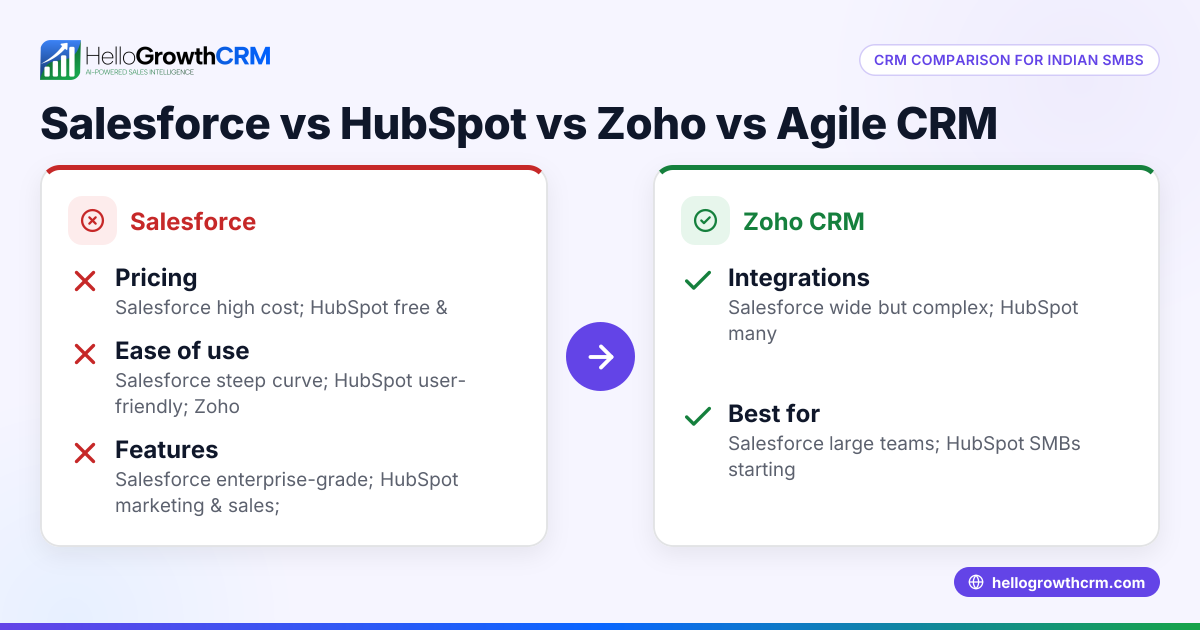
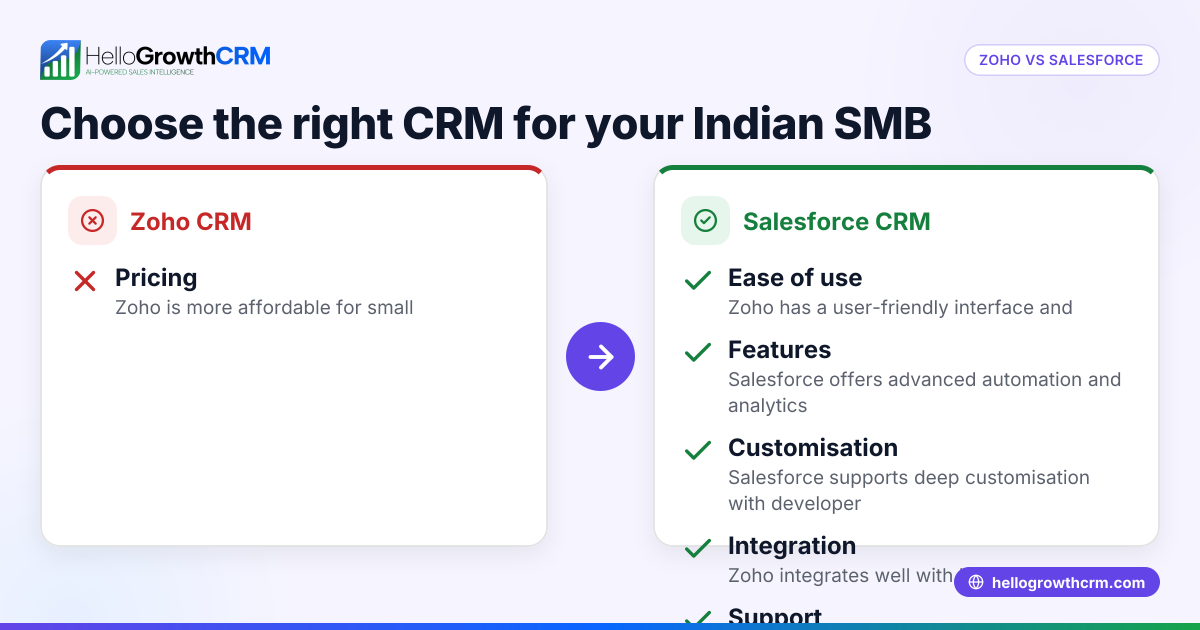
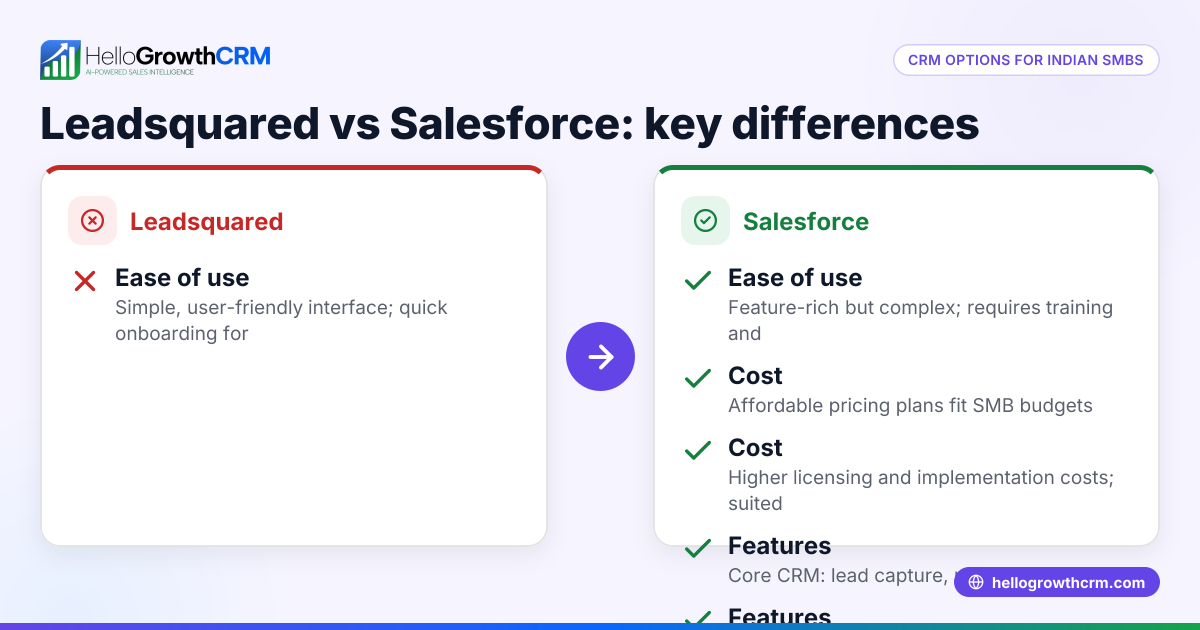
HubSpot and Salesforce are two leading CRM platforms that small and mid-sized businesses (SMBs) in India often compare when looking to improve sales management and customer follow-up. HubSpot is known for its ease of use and affordability, making it suitable for smaller teams and simpler sales processes. Salesforce provides a broad range of advanced features, deep customisation, and scalability, which can support larger teams and complex sales cycles but comes with a higher learning curve and cost.
Why this comes up / what goes wrong
Many Indian SMBs run sales processes manually on WhatsApp, Excel, or spreadsheets, leading to slow lead follow-up and lost opportunities. When deciding on a CRM, business owners search "HubSpot vs Salesforce" to find which platform can help their sales teams better organise leads, automate tasks, and scale operations. Choosing the wrong CRM can result in poor adoption, wasted budget, and continued inefficiencies.
Indian SMBs often struggle with limited budgets, small teams, and a need for quick onboarding. Meanwhile, some businesses anticipate rapid growth or require complex workflows. This makes the choice between HubSpot and Salesforce critical, as each CRM suits different needs and business sizes.
Step-by-step
| Criteria | HubSpot | Salesforce | Which fits best? |
|---|---|---|---|
| Ease of Use | Intuitive interface with minimal training | Complex interface, steep learning curve | HubSpot for teams new to CRM |
| Pricing Structure | Free tier available; paid plans scale modestly | Pricing can be high and complex | HubSpot for limited budgets |
| Customisation | Basic to moderate customisation options | Highly customisable workflows and modules | Salesforce for complex sales processes |
| Features | Core CRM, email tracking, basic automation | Advanced analytics, AI, extensive automation | Salesforce for large or data-driven teams |
| Integration | Good integration with common apps | Extensive integration options | Salesforce if many integrations needed |
| Support | Email and chat support, community forums | 24/7 phone support, dedicated success managers | Salesforce for high-touch support |
| Scalability | Suitable for small to mid-sized businesses | Designed for enterprise and rapid growth | Salesforce for fast-growing businesses |
Who should pick which?
- HubSpot fits Indian SMBs with small sales teams (5-50 users), straightforward sales processes, and tight budgets.
- Salesforce suits businesses expecting rapid growth, complex sales cycles, or requiring detailed custom workflows and integrations.
For Indian businesses, integration with tools like WhatsApp, Tally, and IndiaMART is important. You can explore integration options on the integrations (WhatsApp, Tally, IndiaMART) page.
Example (fictional figures)
An Indian SME in textile manufacturing has 10 salespeople and expects to handle 1,500 leads annually. They compare CRM costs for one year.
- HubSpot Starter plan costs ₹5,000 per user per month.
- Salesforce Essentials costs ₹7,000 per user per month.
Calculations:
HubSpot monthly cost: ₹5,000 × 10 users = ₹50,000
HubSpot annual cost: ₹50,000 × 12 months = ₹6,00,000
Salesforce monthly cost: ₹7,000 × 10 users = ₹70,000
Salesforce annual cost: ₹70,000 × 12 months = ₹8,40,000
Cost difference: ₹8,40,000 − ₹6,00,000 = ₹2,40,000
The SME saves ₹2,40,000 annually by choosing HubSpot, which they can invest in marketing or sales training. However, if they need advanced features or customisation, Salesforce might justify the higher cost.
Common mistakes
- Choosing based on brand reputation only: Don’t pick a CRM just because it’s popular. Assess your business size, sales process, and budget first to avoid mismatch.
- Ignoring user training: Salesforce can be complex; without proper training, teams may underuse it. Schedule training sessions to improve adoption and ensure your team uses the CRM effectively.
- Overlooking integration needs: Check if the CRM integrates with your existing tools like WhatsApp, Tally, or IndiaMART to avoid manual work and data duplication. Visit integrations (WhatsApp, Tally, IndiaMART) to learn more.
- Underestimating total costs: Factor in subscription fees, add-ons, training, and support costs before deciding. Salesforce may require additional investment beyond license fees.
- Skipping free trials: Use trial periods to test usability and fit with your team’s workflow. HubSpot offers a free tier which helps you start without upfront costs.
- Not planning for scalability: Choose a CRM that can grow with your business. Switching CRMs later can be costly and disruptive. See our compare CRMs page for guidance.
Frequently asked questions
Which is better for small sales teams, HubSpot or Salesforce? HubSpot is generally better for small sales teams due to its ease of use and lower cost. Salesforce suits teams needing advanced customisation and scalability.
Can HubSpot and Salesforce be integrated? Yes, third-party tools allow syncing data between HubSpot and Salesforce, but integration complexity and costs vary. Evaluate your business needs before integrating.
Is Salesforce too complex for Indian SMBs? Salesforce can be complex and may require dedicated admins or consultants, which might be costly for SMBs. HubSpot offers a simpler alternative with faster onboarding.
Do both CRMs support WhatsApp integration? Both platforms support WhatsApp integration through third-party apps or APIs. Setup and costs differ. See the integrations (WhatsApp, Tally, IndiaMART) page for details.
Which CRM offers better sales forecasting? Salesforce provides advanced forecasting and reporting tools suitable for larger or data-driven teams. HubSpot offers basic sales forecasting features.
How do I decide between HubSpot and Salesforce for my Indian SMB? Consider your team size, budget, sales process complexity, and need for customisation. Use free trials to test both platforms and consult resources like our compare CRMs page.
Key takeaways
- HubSpot is user-friendly and affordable, ideal for small Indian SMBs with straightforward sales needs.
- Salesforce offers extensive features, customisation, and scalability but is more complex and costly.
- Consider your business size, sales process complexity, budget, and integration needs before choosing.
- Use free trials to test CRM fit and plan training to improve adoption.
- Check integration options with platforms like WhatsApp and IndiaMART for smoother workflows.
- Plan for scalability to avoid costly CRM switches later.
Start improving your sales process with a CRM that fits your business by starting on the Free Forever plan (200 leads, no credit card).
Ready to put this into practice?
Set up your pipeline, WhatsApp follow-ups, and AI lead scoring in minutes — free, no credit card.
Try HelloGrowthCRM freeGet CRM tips in your inbox
Join thousands of sales professionals who get weekly insights on CRM strategy, AI automation, and pipeline optimization.

The HelloGrowthCRM team publishes guides on CRM strategy, AI sales tools, and revenue operations for small business sales teams.