HelloGrowthCRM software
Built for real small-business sales teams
HelloGrowthCRM helps reps qualify faster, follow up on time, and close more deals—with practical automation in one place.
- AI lead scoring and pipeline visibility
- Built-in dialer, WhatsApp, and email automation
- Sales forecasting and RevOps-ready reporting
Marketing automation platforms are software tools that automate repetitive marketing activities, such as sending sequences of emails or SMS messages, scoring leads, and routing prospects to sales reps. For small businesses, these platforms reduce manual work, speed up lead follow-up, and improve customer engagement.
Why this comes up / what goes wrong
Small-business owners often manage leads manually using spreadsheets, emails, and text messages. This manual approach leads to slow follow-up, lost leads, and inconsistent communication. Sales teams spend too much time on routine tasks instead of closing deals. Marketing automation platforms solve these problems by streamlining outreach and lead management, allowing teams to respond faster and more consistently.
Step-by-step
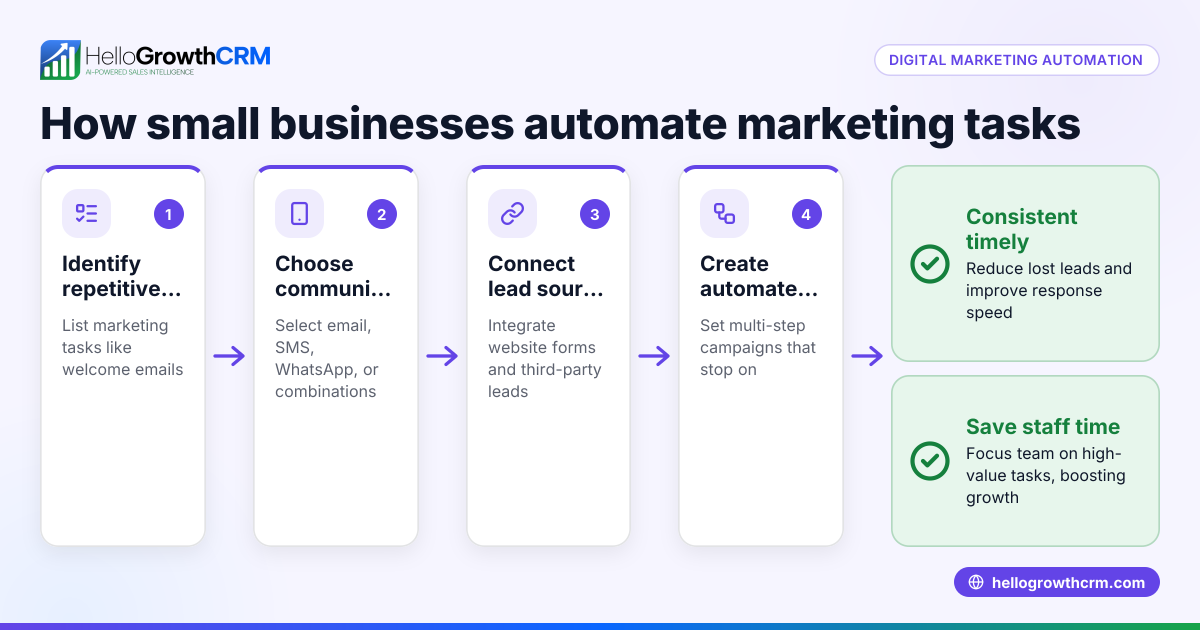
- Identify your marketing tasks to automate. List repetitive tasks such as welcome emails, follow-up sequences, lead assignment, and reminders. Prioritize those that take the most time or cause delays.
- Choose a platform that supports your communication channels. Confirm it can send emails, SMS, and WhatsApp messages, and integrates with your lead sources.
- Set up automated sequences or campaigns. Create multi-step workflows that send timed messages until a prospect replies, ensuring consistent follow-up without manual effort.
- Implement lead routing and validation rules. Automate assigning leads to sales reps based on territory, source, or round-robin to ensure timely contact and balanced workloads.
- Use AI agents if available. Automate drafting follow-up messages after calls to reduce manual work and speed up responses.
- Test your workflows thoroughly. Verify that messages send correctly, tasks are created as expected, and leads are routed properly.
- Monitor and optimize. Regularly review campaign performance metrics and adjust message content, timing, or routing rules to improve results.
For more details on automated workflows and AI agents, see AI CRM and WhatsApp and SMS CRM.
Example (fictional figures)
A B2B software reseller in Denver, Colorado, receives 300 leads monthly. They want to automate a five-step follow-up sequence over two weeks using email and SMS.
- Average lead value: $2,000
- Conversion rate before automation: 10% (30 sales)
- Conversion rate after automation: 15% (45 sales)
Calculations:
Sales increase = 45 sales - 30 sales = 15 sales
Additional revenue = 15 sales × $2,000 = $30,000
Manual follow-up took 20 hours weekly at $25/hour:
Weekly cost = 20 hours × $25 = $500
Automation reduces follow-up time by 75%, saving:
Time saved = 20 hours × 75% = 15 hours
Weekly savings = 15 hours × $25 = $375
Total benefit in one month (4 weeks) = $30,000 + ($375 × 4) = $30,000 + $1,500 = $31,500
This example shows how automating marketing sequences can increase revenue and reduce labor costs significantly.
Common mistakes
- Not defining clear goals. Prevent this by setting measurable objectives like increasing lead response rate or reducing follow-up time.
- Overloading prospects with messages. Prevent by spacing messages appropriately and stopping sequences immediately when a reply is received.
- Ignoring lead routing rules. Prevent by automating lead assignment to avoid delays and dropped leads.
- Failing to test workflows before launch. Prevent by running test sequences and verifying task creation and message delivery.
- Neglecting to monitor and adjust campaigns. Prevent by regularly reviewing campaign metrics and tweaking messages or timing.
- Relying solely on automation without personal touch. Prevent by combining automation with timely personal sales calls.
Learn more about automated workflows and lead routing at HelloGrowthCRM for the United States.
Doing this in HelloGrowthCRM
HelloGrowthCRM offers sequences and campaigns that automate multi-step follow-ups over two weeks, stopping immediately when a prospect replies. Its AI agents draft follow-up messages after calls, so reps only review and send. Workflows, lead routing, and validation rules automate lead assignment and task creation, such as assigning new inquiries round-robin and creating first-call tasks automatically. These features help small businesses streamline marketing and sales processes efficiently. See AI CRM for details.
Frequently asked questions
What channels do marketing automation platforms support? Most platforms support email, SMS, and increasingly WhatsApp messaging. This allows businesses to reach leads on the channels they prefer, increasing engagement.
How do I start with marketing automation if I have no experience? Begin by automating simple follow-up sequences and lead assignments. Use available templates and test each step carefully. Gradually add complexity as you become more comfortable.
Can automation replace personal sales calls? No, automation complements sales calls by handling routine outreach and follow-ups. This frees sales reps to focus on high-value conversations and closing deals.
What is lead routing and why is it important? Lead routing automatically assigns leads to the right sales rep based on rules like geography or round-robin. It ensures timely follow-up and balances workloads across the team.
How can AI agents help in marketing automation? AI agents can draft follow-up messages after calls and update CRM records automatically. This reduces manual work and speeds up response times, helping reps focus on selling.
How do I avoid overwhelming prospects with automation? Set your sequences to stop immediately when a prospect replies, and space out messages appropriately. Monitor engagement metrics and adjust frequency as needed.
Key takeaways
- Marketing automation platforms save time by automating repetitive marketing and sales tasks.
- Setting up sequences and lead routing improves follow-up speed and lead management.
- Testing workflows and monitoring results prevent common mistakes and improve effectiveness.
- AI agents can further reduce manual follow-up effort by drafting messages automatically.
- HelloGrowthCRM supports multi-step sequences, AI drafting, and automated lead routing to streamline sales processes.
- Combining automation with personal sales calls ensures the best results.
Start automating your marketing today to improve lead engagement and sales efficiency. You can Start on the Free Forever plan (200 leads, no credit card).
Ready to put this into practice?
Set up your pipeline, WhatsApp follow-ups, and AI lead scoring in minutes — free, no credit card.
Try HelloGrowthCRM freeGet CRM tips in your inbox
Join thousands of sales professionals who get weekly insights on CRM strategy, AI automation, and pipeline optimization.

The HelloGrowthCRM team publishes guides on CRM strategy, AI sales tools, and revenue operations for small business sales teams.