HelloGrowthCRM software
Built for real small-business sales teams
HelloGrowthCRM helps reps qualify faster, follow up on time, and close more deals—with practical automation in one place.
- AI lead scoring and pipeline visibility
- Built-in dialer, WhatsApp, and email automation
- Sales forecasting and RevOps-ready reporting
Marketing content automation uses software tools to automatically create, schedule, and send marketing messages to leads and customers across channels such as email, SMS, and WhatsApp. This automation saves time by reducing manual outreach, ensures consistent communication, and helps businesses follow up promptly with prospects. This article covers why small businesses seek marketing content automation, practical steps to implement it, a worked example with realistic figures, common mistakes to avoid, and how HelloGrowthCRM supports these processes.
Why this comes up / what goes wrong
Small business owners often handle marketing manually using email, text messages, and spreadsheets. This approach makes it easy to miss timely follow-ups, send inconsistent messages, or lose leads because of slow responses. Marketing content automation arises as a solution to these challenges by automating repetitive tasks, maintaining steady communication, and assigning follow-up responsibilities automatically.
Without automation, sales and marketing teams may waste hours on manual outreach, and leads can go cold due to delays or forgotten messages. Automation helps keep prospects engaged and sales moving forward without constant manual effort.
Step-by-step
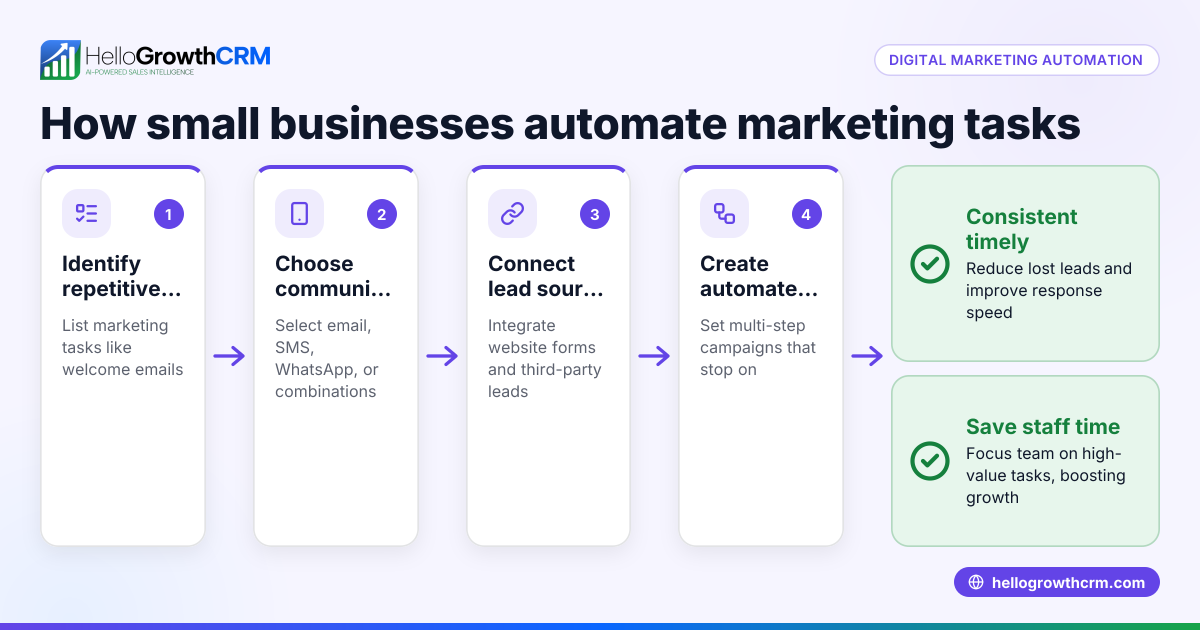
- Define your marketing goals and audience
- Clarify what you want to achieve with automation, such as nurturing leads or booking appointments.
- Segment your audience to tailor messages effectively.
- Choose communication channels
- Decide which channels to automate: email, SMS, WhatsApp, or others.
- Confirm your audience’s preferences and any compliance requirements.
- Create content and sequences
- Write clear, concise messages for each step in your automated sequence.
- Plan timing between messages, for example, a five-step follow-up over two weeks.
- Set up automation workflows
- Use a CRM or marketing tool to build workflows that trigger messages based on actions or timed delays.
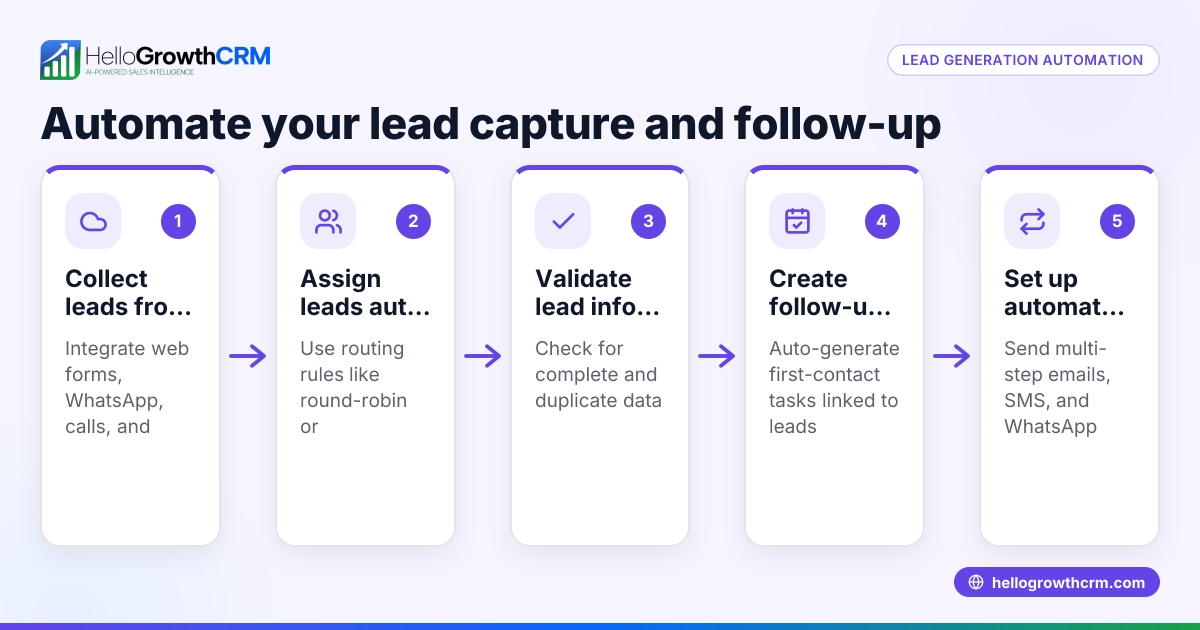
- Include lead routing and task creation to assign follow-up responsibilities automatically.
- Test your automation
- Test to ensure messages send correctly and stop when a prospect replies.
- Confirm leads are assigned properly and tasks are created.
- Monitor and optimize
- Track open rates, replies, and conversions.
- Adjust message content, timing, and sequence length based on performance.
Example (fictional figures)
A B2B software reseller in Denver, Colorado, starts automating lead follow-up on 06/01/2026.
- They set a five-step email and SMS follow-up spread over two weeks.
- Messages are spaced 3 days apart.
Starting with 100 new leads:
Day 1: Send message 1 to 100 leads. Day 4: Send message 2 to 90 leads (assuming 10 replies stop the sequence). Day 7: Send message 3 to 75 leads (assuming 15 replies). Day 10: Send message 4 to 55 leads (assuming 20 replies). Day 13: Send message 5 to 45 leads (assuming 10 replies).
If each converted lead brings $1,000 in sales and the business converts 5 leads from replies:
Total sales = 5 × $1,000 = $5,000.
This automation helps follow up efficiently and increases sales without manual outreach to every lead.
Common mistakes
- Sending too many messages too quickly
- Prevent by spacing messages appropriately and respecting customer preferences.
- Using generic content that doesn’t fit the audience
- Prevent by segmenting leads and personalizing messages.
- Not stopping sequences when a prospect replies
- Prevent by configuring automation to halt on reply to avoid annoying prospects.
- Neglecting to assign follow-up tasks to sales reps
- Prevent by automating lead routing and task creation to ensure timely calls.
- Failing to test automation workflows before launch
- Prevent by thoroughly testing all triggers and message flows.
- Ignoring performance data and not optimizing
- Prevent by regularly reviewing analytics to improve messaging and timing.
Doing this in HelloGrowthCRM
HelloGrowthCRM supports marketing content automation with sequences and campaigns that run a five-step follow-up over two weeks automatically and stop the moment a prospect replies. Its AI agents draft follow-up messages after calls so sales reps only review and send them, saving time. Automated workflows, lead routing, and validation rules assign new inquiries round-robin and create first-call tasks automatically, ensuring no lead is missed. Learn more about these features in the AI CRM and WhatsApp and SMS CRM sections. HelloGrowthCRM is tailored for small and mid-sized US businesses, as explained in HelloGrowthCRM for the United States.
Frequently asked questions
What is marketing content automation? Marketing content automation uses software to automatically send marketing messages based on triggers or schedules. It helps businesses maintain consistent communication with leads and customers without manual effort.
How can marketing content automation benefit small businesses? It saves time by automating repetitive tasks, improves lead follow-up speed, ensures consistent messaging, and supports better engagement with prospects.
Which channels are commonly automated? Email, SMS, and messaging apps like WhatsApp are commonly automated channels because they allow direct, personalized communication.
How do I know if my automated messages are effective? Track metrics like open rates, reply rates, and conversions. Use these insights to adjust message content, timing, and sequence length.
Can automation replace personal sales outreach? No, automation supports sales teams by handling routine follow-ups and lead nurturing, freeing reps to focus on personalized calls and closing deals.
Key takeaways
- Marketing content automation saves time by automating repetitive outreach tasks.
- Effective automation includes clear goals, tailored content, and proper timing.
- Automation workflows should stop when a prospect replies to avoid over-contacting.
- Assigning leads and tasks automatically ensures timely follow-up.
- Testing and monitoring performance are essential for success.
- HelloGrowthCRM offers sequences, AI agents, and workflows to streamline marketing automation for small businesses.
Start automating your marketing content today with HelloGrowthCRM. Start on the Free Forever plan (200 leads, no credit card) and see how automation can help your small business grow.
Ready to put this into practice?
Set up your pipeline, WhatsApp follow-ups, and AI lead scoring in minutes — free, no credit card.
Try HelloGrowthCRM freeGet CRM tips in your inbox
Join thousands of sales professionals who get weekly insights on CRM strategy, AI automation, and pipeline optimization.

The HelloGrowthCRM team publishes guides on CRM strategy, AI sales tools, and revenue operations for small business sales teams.