HelloGrowthCRM software
Built for real small-business sales teams
HelloGrowthCRM helps reps qualify faster, follow up on time, and close more deals—with practical automation in one place.
- AI lead scoring and pipeline visibility
- Built-in dialer, WhatsApp, and email automation
- Sales forecasting and RevOps-ready reporting
A sales enablement roadmap is a structured plan that guides your sales team through managing leads and closing deals effectively. It ensures that follow-ups happen on time, sales stages are clear, and responsibilities are assigned to prevent lost leads.
Why this comes up / what goes wrong
Many small and mid-sized business owners struggle with lost sales opportunities because their sales process is unstructured. Leads come in through various channels like text messages, emails, or spreadsheets, making it hard to track and follow up promptly. Without a roadmap, sales efforts are reactive and inconsistent, causing missed deals and unpredictable revenue.
Step-by-step
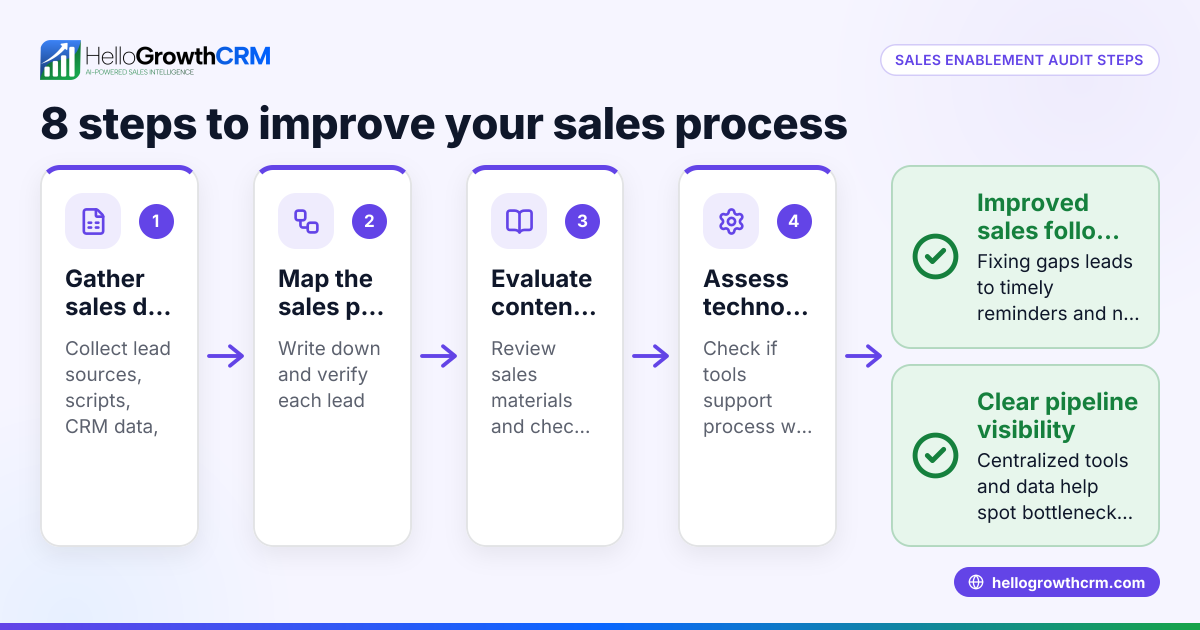
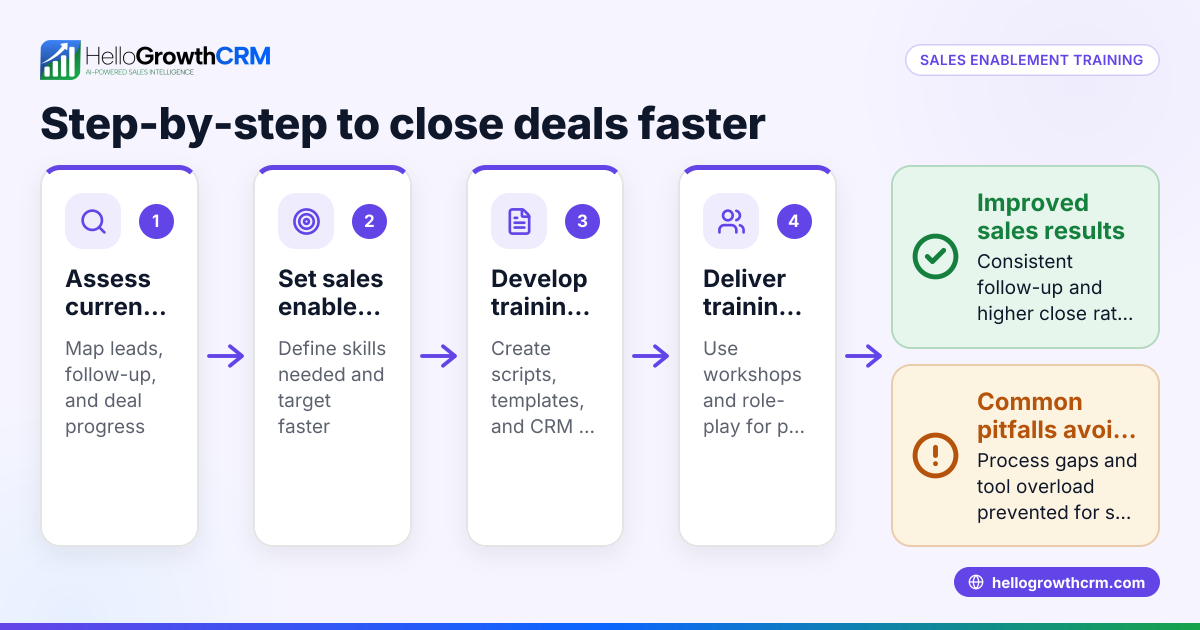
- Assess your current sales process: Identify where leads come from and how they are followed up. Check if any leads are forgotten or if communication is scattered across email, text, and spreadsheets.
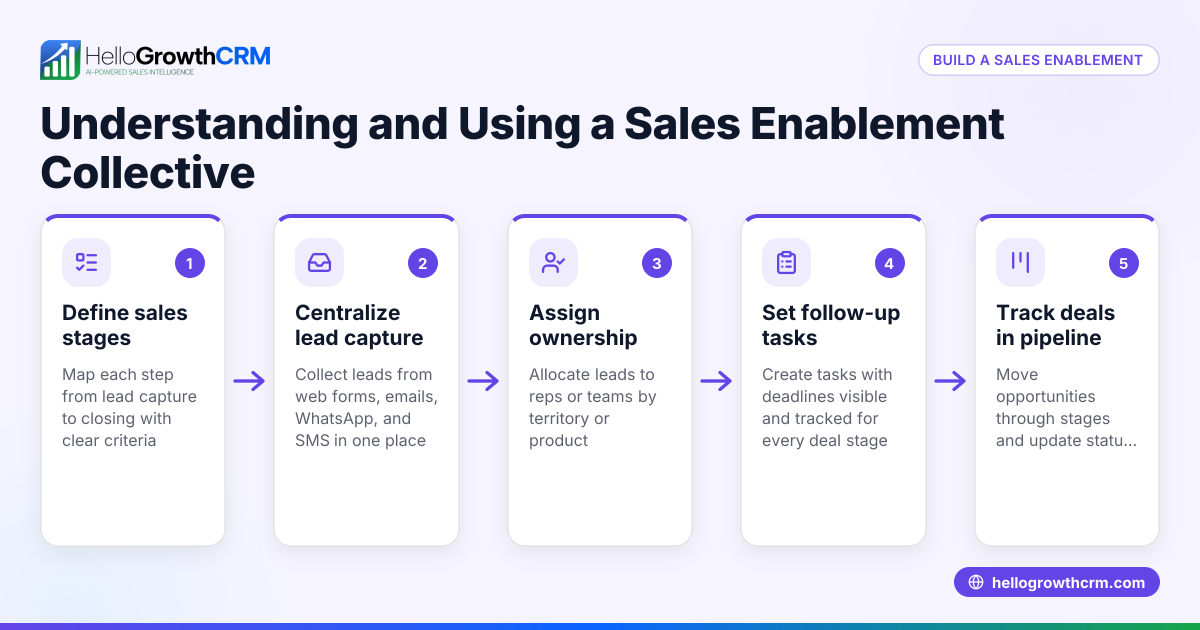
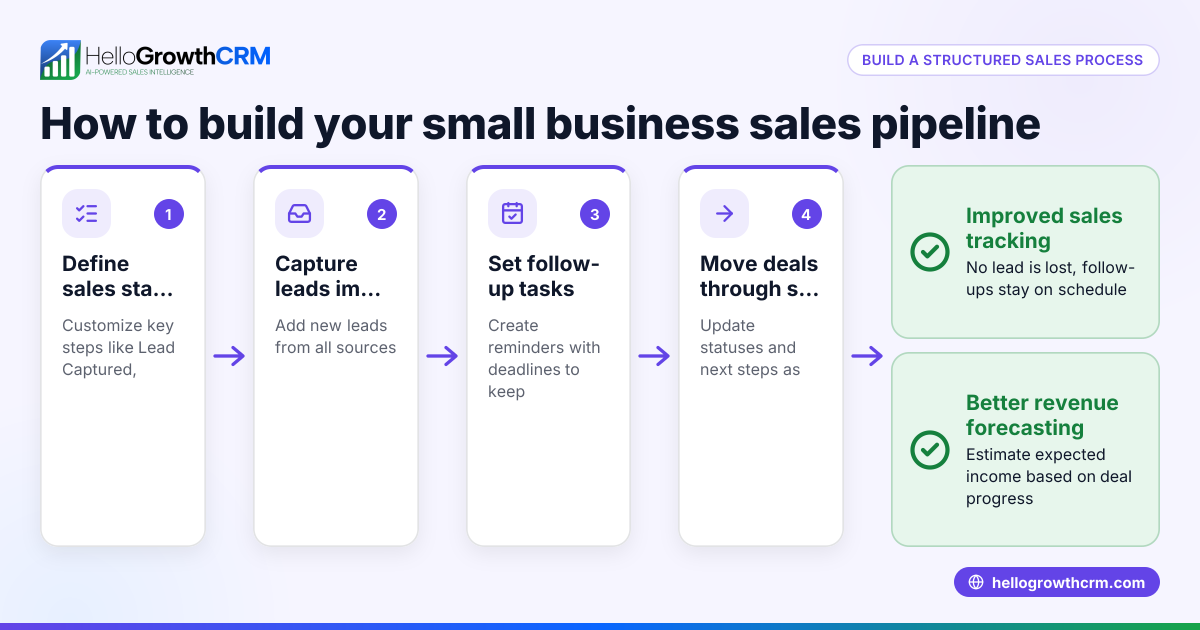
- Define clear sales stages: Map out your sales pipeline stages such as Lead Captured, Contacted, Quote Sent, and Closed. Make sure each stage has clear criteria and expected actions.
- Set measurable goals: For example, decide how quickly leads should be followed up or how many deals should close monthly. Choose goals that match your business capacity.
- Select tools that support your roadmap: Use a CRM that tracks deals through stages, sends reminders, and centralizes communication like WhatsApp and SMS. This keeps follow-ups timely and avoids lost leads.
- Assign roles and responsibilities: Specify who follows up leads, who sends quotes, and who closes deals. Clear ownership prevents leads from slipping through cracks.
- Provide training and sales content: Equip your sales team with scripts, product information, and templates to improve their effectiveness.
- Monitor and adjust regularly: Review your sales pipeline and follow-up performance weekly or monthly. Update stages, goals, or tools based on what you learn.
Check that your roadmap addresses slow follow-up, scattered communication, and unclear ownership.
Example (fictional figures)
Consider a B2B software reseller in Denver, Colorado, targeting $1,000,000 in annual sales.
- Step 1: They notice leads are lost because follow-ups happen inconsistently.
- Step 2: They define sales stages: Lead Captured → Contacted → Demo Scheduled → Quote Sent → Negotiation → Closed Won/Lost.
- Step 3: They set a goal to follow up with at least 250 leads monthly.
- Step 4: They implement a CRM to track deals and send reminders.
- Step 5: Sales rep A handles initial contact; sales rep B manages demos and quotes.
Calculation for monthly revenue:
Assuming 300 leads received monthly, 300 leads - 50 leads lost = 250 leads followed up
If the average deal size is $10,000 and 10% of followed-up leads close, 250 leads × 10% = 25 deals closed 25 deals × $10,000 = $250,000 monthly revenue
This example shows how a clear roadmap helps focus efforts and measure progress.
Common mistakes
- No clear sales stages: Leads get stuck or lost. Prevent by defining each stage with clear criteria.
- Ignoring follow-up timing: Leads cool off quickly. Use reminders to ensure timely contact.
- Scattered communication channels: Using email, text, and spreadsheets separately causes confusion. Centralize communication in one CRM system like HelloGrowthCRM’s WhatsApp and SMS CRM (/product/whatsapp-sms-crm).
- No accountability: Without assigned owners, leads fall through cracks. Assign roles explicitly.
- Neglecting pipeline hygiene: Old or dead deals clutter reports. Regularly clean and update your pipeline using tools with deals (pipeline) features (/product/ai-crm).
- Not tracking field sales activity: For businesses with field reps, missing visit logs leads to poor territory management. Use territory and field operations features (/product/territory-management) to track visits and routes.
Doing this in HelloGrowthCRM
HelloGrowthCRM supports your sales enablement roadmap by providing a deals pipeline that tracks open opportunities through stages, such as a quotation sent last week showing up at the 'quote sent' stage with a follow-up date, so it is not forgotten. For businesses with field sales, distributors' reps can log visits from their phones, allowing managers to see the day's beat. Additionally, founders without dedicated sales managers can use Managed RevOps support to have a specialist work the follow-up queue weekly, keeping sales efforts consistent. Learn more about HelloGrowthCRM for the United States (/usa).
Frequently asked questions
What is the difference between sales enablement and a sales enablement roadmap? Sales enablement is the collection of tools, content, and training that help sales teams sell effectively. A sales enablement roadmap is the strategic plan that outlines how and when these resources are deployed to improve sales outcomes.
How often should I update my sales enablement roadmap? Review your roadmap monthly or quarterly. Regular updates help you respond to changes in market conditions, sales team feedback, and business priorities.
Can a small business benefit from a sales enablement roadmap? Yes. Even small teams benefit from having a clear plan for managing leads, follow-ups, and sales activities. It helps avoid lost leads and improve closing rates.
What tools are essential for executing a sales enablement roadmap? A CRM with deal tracking, communication sequencing (email, WhatsApp, SMS), and task management is essential. HelloGrowthCRM offers these features along with a built-in CRM dialer (/product/crm-dialer).
How do I measure if my sales enablement roadmap is working? Track metrics like lead response time, number of deals closed, sales cycle length, and revenue growth. Improvements in these areas show your roadmap’s effectiveness.
Key takeaways
- A sales enablement roadmap is a clear plan to improve sales team efficiency and lead management.
- Defining clear sales stages and assigning responsibilities prevents leads from falling through cracks.
- Using a CRM that centralizes communication and tracks deals supports timely follow-up and pipeline visibility.
- Regular monitoring and pipeline hygiene keep your sales process healthy and productive.
- Small businesses benefit greatly from structured sales enablement, avoiding lost leads and boosting revenue.
Start building your sales enablement roadmap today and improve your sales outcomes. To get started with a CRM designed for small and mid-sized US businesses, try HelloGrowthCRM’s Free Forever plan with 200 leads and no credit card at /free-crm.
Ready to put this into practice?
Set up your pipeline, WhatsApp follow-ups, and AI lead scoring in minutes — free, no credit card.
Try HelloGrowthCRM freeGet CRM tips in your inbox
Join thousands of sales professionals who get weekly insights on CRM strategy, AI automation, and pipeline optimization.

The HelloGrowthCRM team publishes guides on CRM strategy, AI sales tools, and revenue operations for small business sales teams.