HelloGrowthCRM software
Built for real small-business sales teams
HelloGrowthCRM helps reps qualify faster, follow up on time, and close more deals—with practical automation in one place.
- AI lead scoring and pipeline visibility
- Built-in dialer, WhatsApp, and email automation
- Sales forecasting and RevOps-ready reporting
A sales rep scorecard template is a simple tool to measure and improve the performance of your sales team. It typically tracks key metrics such as total sales value, number of calls made, conversion rate, follow-up completion, and deals closed. Using this template regularly helps small and mid-sized Indian businesses spot gaps in sales activity, improve follow-up speed, and boost revenue.
Why this comes up / what goes wrong
Many Indian small-business owners and sales leaders manage sales on WhatsApp, Excel sheets, or scattered notes without a consistent system to evaluate sales reps. This leads to slow follow-ups, lost leads, and unclear accountability. Without a structured scorecard, it is difficult to identify which reps are performing well or where the team needs support. A ready-to-use sales rep scorecard template helps by providing a clear, standard way to capture and analyse sales activities and results.
Step-by-step
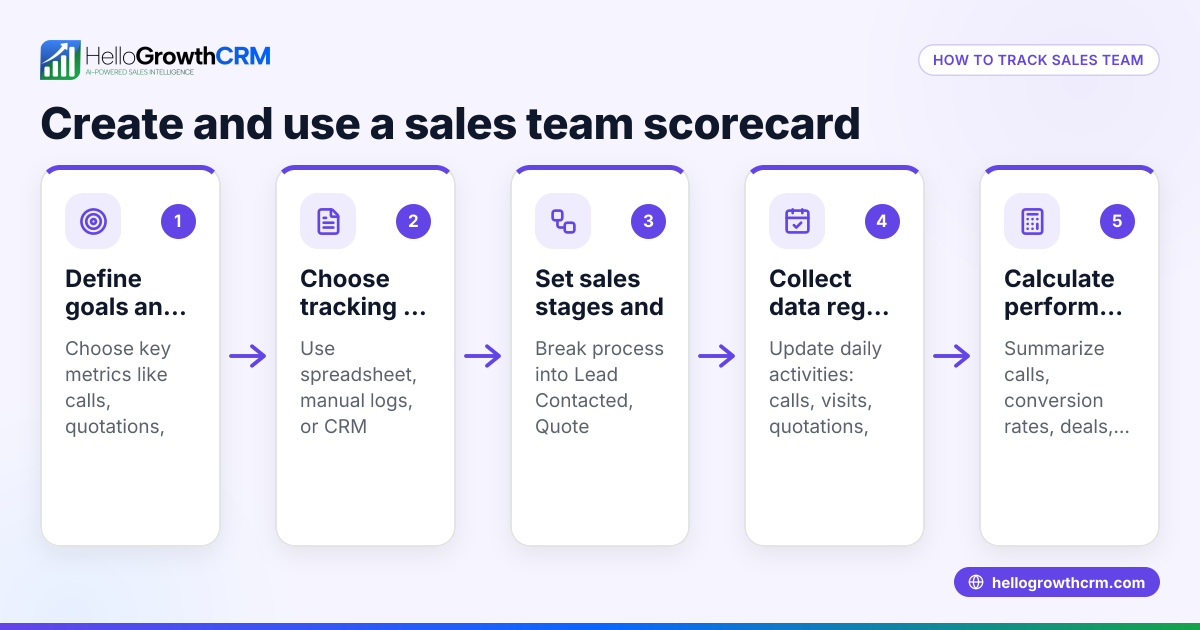
- Define key performance indicators (KPIs): Choose 3–5 metrics relevant to your business. Common KPIs include total sales value, number of client calls, follow-up completion rate, deals closed, and average deal size.
- Set the tracking period: Decide if you want to track performance weekly, monthly, or quarterly. Monthly tracking is common for Indian SMBs.
- Create the scorecard layout: Use a spreadsheet or download a free sales template from HelloGrowthCRM’s free sales tools and calculators. Your columns should include sales rep name, KPIs, targets, actual results, and comments.
- Collect data consistently: Instruct sales reps to log daily activities like calls made, meetings held, quotations sent, and follow-ups completed. Consistency is key to accurate tracking.
- Calculate scores and percentages: For example, conversion rate = (deals closed ÷ calls made) × 100. Calculate follow-up completion rate similarly.
- Review regularly: Hold weekly or monthly sales meetings to review scorecards, discuss strengths, and identify improvement areas.
- Adjust metrics and targets as needed: Update the scorecard KPIs to match changing business goals or sales strategies.
To get started quickly, you can use free sales templates from HelloGrowthCRM’s sales templates section without creating an account.
Example (fictional figures)
For the month of May 2024, here is a sales rep scorecard for "Rajesh Kumar," a sales rep at an electronics distributor:
- Calls made: 150
- Deals closed: 30
- Total sales value: ₹12,00,000
- Follow-ups completed: 45 out of 50 expected
Calculations:
Conversion rate = (30 ÷ 150) × 100 = 20%
Average deal size = ₹12,00,000 ÷ 30 = ₹40,000
Follow-up completion rate = (45 ÷ 50) × 100 = 90%
This scorecard shows Rajesh closes 1 in 5 calls and maintains a high follow-up rate, indicating good performance.
Common mistakes
- Tracking too many KPIs: Including too many metrics can overwhelm and confuse your team. Prevent this by focusing on 3–5 KPIs that directly impact revenue and sales activity.
- Inconsistent data entry: Missing or late updates reduce the scorecard’s usefulness. Prevent this by setting daily reminders and making data entry part of your sales routine.
- Ignoring qualitative feedback: Numbers alone don’t show customer satisfaction or sales challenges. Prevent this by adding a comments section for notes and observations.
- Not reviewing scorecards regularly: Without regular review meetings, insights are wasted. Prevent this by scheduling weekly or monthly sales reviews.
- Using complex formulas or tools: Overly complicated spreadsheets discourage use. Prevent this by keeping templates simple and user-friendly.
- Failing to link follow-ups to deals: Missing follow-ups causes lost leads. Prevent this by tracking follow-up completion rates and setting reminders.
Explore HelloGrowthCRM’s free sales tools and calculators for templates designed to avoid these common pitfalls.
Doing this in HelloGrowthCRM
HelloGrowthCRM offers free sales tools, templates, and calculators that include pipeline templates and follow-up cadence schedules available without an account. Its Deals (pipeline) feature tracks quotations sent and automatically sets follow-up dates, so no deal is forgotten. For businesses with field sales teams, territories and visit logging help managers monitor daily sales beats and commissions. Learn more about HelloGrowthCRM for India to streamline your sales tracking and improve team performance at HelloGrowthCRM for India.
Frequently asked questions
What metrics should a sales rep scorecard include? A scorecard should focus on key metrics like total sales value, number of calls made, conversion rate, follow-up completion rate, and deals closed. These provide a balanced view of activity and results.
Can I use a scorecard template without software? Yes, a simple spreadsheet or printable template works well. However, digital tools like HelloGrowthCRM automate data capture and reminders, reducing manual effort and errors.
How often should I update the sales rep scorecard? Sales reps should enter data daily, with managers reviewing scorecards weekly or monthly. Frequent updates keep the scorecard accurate and actionable.
Is there a free sales rep scorecard template available? Yes, HelloGrowthCRM offers free sales templates and calculators that can be downloaded without creating an account. These templates are tailored for Indian SMB sales teams.
How does follow-up tracking fit into a scorecard? Follow-up completion rate is a key metric showing discipline in contacting leads. It helps identify reps who may be losing leads due to slow or missed follow-ups.
Can a sales rep scorecard help improve team accountability? Yes, by tracking clear metrics and reviewing regularly, a scorecard makes performance transparent and encourages reps to meet targets consistently.
Key takeaways
- Use 3–5 key metrics such as sales value, calls made, conversion rate, and follow-up completion.
- Keep the scorecard simple and easy to update regularly.
- Review scorecards weekly or monthly with your sales team.
- Avoid tracking too many metrics or inconsistent data entry.
- Use free sales templates and calculators to get started quickly.
- Digital tools like HelloGrowthCRM can automate tracking and reminders.
Start using a sales rep scorecard template today to improve visibility into your sales team's performance and reduce lost leads.
Start on the Free Forever plan (200 leads, no credit card) at HelloGrowthCRM.
Ready to put this into practice?
Set up your pipeline, WhatsApp follow-ups, and AI lead scoring in minutes — free, no credit card.
Try HelloGrowthCRM freeGet CRM tips in your inbox
Join thousands of sales professionals who get weekly insights on CRM strategy, AI automation, and pipeline optimization.

The HelloGrowthCRM team publishes guides on CRM strategy, AI sales tools, and revenue operations for small business sales teams.