HelloGrowthCRM software
Built for real small-business sales teams
HelloGrowthCRM helps reps qualify faster, follow up on time, and close more deals—with practical automation in one place.
- AI lead scoring and pipeline visibility
- Built-in dialer, WhatsApp, and email automation
- Sales forecasting and RevOps-ready reporting
A sales and marketing scorecard for manufacturers is a tool that tracks key performance indicators (KPIs) to measure how well your sales and marketing efforts generate leads, convert prospects, and grow revenue. It helps identify strengths and weaknesses so you can improve your team's effectiveness. This article explains why manufacturers need a scorecard, step-by-step instructions to create one, a worked example with Indian figures, common pitfalls to avoid, and how HelloGrowthCRM supports this process.
Why this comes up / what goes wrong
Manufacturers, especially small and mid-sized businesses in India, often struggle to assess the impact of their sales and marketing activities clearly. They may run sales on WhatsApp or spreadsheets without a unified view of performance. Leads can be lost due to slow follow-up or unclear responsibilities. Without a scorecard, it’s hard to know which marketing campaigns bring quality leads or whether sales reps meet targets. This leads to wasted effort and missed revenue opportunities.
Step-by-step
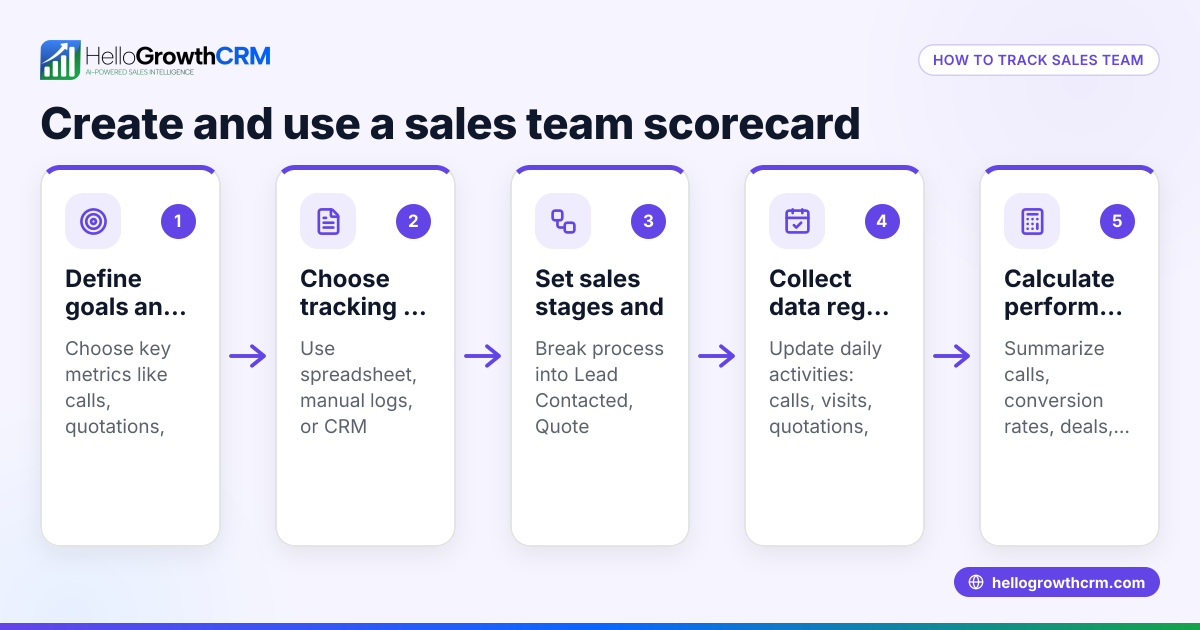
- Define your key metrics: Choose sales and marketing KPIs relevant to manufacturing, such as number of leads generated, lead conversion rate, sales pipeline value, average deal size, and customer acquisition cost. Check that these metrics align with your business goals.
- Set targets for each metric: For example, aim for 100 leads per month or a 20% conversion rate. Targets should be realistic and time-bound.
- Collect data regularly: Use tools or manual logs to track leads from sources like IndiaMART, JustDial, or your website. Record sales activities such as calls, meetings, and order closures.
- Calculate performance ratios: For example, conversion rate = (Number of deals closed ÷ Number of leads) × 100.
- Create a scorecard format: Use a spreadsheet or template to display metrics, targets, actuals, and variance. Colour-code results for quick visual feedback.
- Review and update weekly or monthly: Share the scorecard with your sales and marketing teams to identify bottlenecks and plan improvements.
- Assign accountability: Link metrics to specific sales reps or marketing campaigns for clearer ownership.
- Adjust targets and tactics based on results: Use the scorecard to test new approaches and track their impact.
Example (fictional figures)
A small manufacturer tracks monthly sales and marketing performance for April 2024:
- Leads generated: 120
- Leads target: 100
- Deals closed: 24
- Conversion rate target: 20%
- Average deal size: ₹1,00,000
Calculations:
Conversion rate = (24 ÷ 120) × 100 = 20%
Total sales value = 24 × ₹1,00,000 = ₹24,00,000
Lead generation variance = 120 - 100 = 20 (above target)
Conversion rate variance = 20% - 20% = 0 (on target)
This scorecard shows lead generation exceeded the target, conversion met the target, and sales value reached ₹24 lakh.
Common mistakes
- Tracking too many metrics: Focus on a few critical KPIs to avoid confusion. Prevent by prioritising metrics that directly impact revenue.
- Using inconsistent data sources: Leads from WhatsApp chats, calls, and forms must be entered reliably. Prevent by standardising data entry processes or using a CRM.
- Not setting clear targets: Without targets, it’s hard to judge performance. Prevent by setting measurable, time-bound goals.
- Ignoring follow-up speed: Slow response leads to lost leads. Prevent by defining follow-up SLAs and tracking them.
- Not reviewing scorecards regularly: A scorecard is only useful if acted upon. Prevent by scheduling weekly or monthly reviews.
- No accountability: Without assigning responsibility, issues remain unresolved. Prevent by linking metrics to teams or individuals.
Doing this in HelloGrowthCRM
HelloGrowthCRM helps manufacturers manage sales and marketing scorecards with features like Territories, field operations and commissions. Distributors’ field reps can log visits from their phones, and managers can see the day's activities and beat plans. For founders without a sales manager, the Managed RevOps service assigns a revenue specialist to keep the follow-up queue active weekly, ensuring no lead is missed. Additionally, HelloGrowthCRM offers free sales tools, templates and calculators, including pipeline templates and follow-up cadences, which can be downloaded without an account. Learn more about HelloGrowthCRM for India, WhatsApp and SMS CRM, and the built-in CRM dialer.
Frequently asked questions
What key metrics should manufacturers track in a sales and marketing scorecard? Manufacturers should track metrics like number of leads generated, lead conversion rate, sales pipeline value, average deal size, and customer acquisition cost. These KPIs help measure how marketing efforts translate into sales and revenue.
How often should a sales and marketing scorecard be updated? Ideally, update the scorecard weekly or monthly. Frequent updates help spot trends early and allow timely corrective actions. Monthly reviews are common for small businesses.
Can I use WhatsApp for sales tracking in a scorecard? Yes, many Indian SMBs use WhatsApp for sales communication. However, tracking lead sources and follow-ups manually can be error-prone. Using a CRM that integrates WhatsApp messaging can help automate data capture and improve accuracy.
How do I assign accountability using a scorecard? Link each metric or sales activity to a specific sales rep, team, or marketing campaign. This clarifies who is responsible for results and helps motivate better performance.
Are there templates available for sales and marketing scorecards? Yes, free templates and calculators are available online. HelloGrowthCRM offers downloadable pipeline and follow-up cadence templates without requiring an account, which can help you get started quickly.
Key takeaways
- A sales and marketing scorecard tracks key metrics like leads, conversion rates, and sales value.
- Set clear, realistic targets for each KPI and update data regularly.
- Use a simple, visual format to highlight performance gaps.
- Assign responsibility to sales reps or campaigns for each metric.
- Avoid tracking too many metrics or using inconsistent data.
- HelloGrowthCRM supports scorecard management with field operations logging, Managed RevOps, and free sales templates.
Start improving your sales and marketing performance by creating your scorecard today. To get started easily, start on the Free Forever plan (200 leads, no credit card).
Ready to put this into practice?
Set up your pipeline, WhatsApp follow-ups, and AI lead scoring in minutes — free, no credit card.
Try HelloGrowthCRM freeGet CRM tips in your inbox
Join thousands of sales professionals who get weekly insights on CRM strategy, AI automation, and pipeline optimization.

The HelloGrowthCRM team publishes guides on CRM strategy, AI sales tools, and revenue operations for small business sales teams.