Quick Answer
The top CRM companies serving Indian businesses in 2026 include Zoho CRM, Freshworks, LeadSquared, Salesforce, HubSpot, Kylas, TeleCRM, Kapture CX, Corefactors, SalesBabu, Vtiger and HelloGrowthCRM. Zoho and Freshworks lead on product breadth, LeadSquared on vertical depth, while WhatsApp-first SMB tools like HelloGrowthCRM start at ₹899 per user per month.
HelloGrowthCRM software
Built for real small-business sales teams
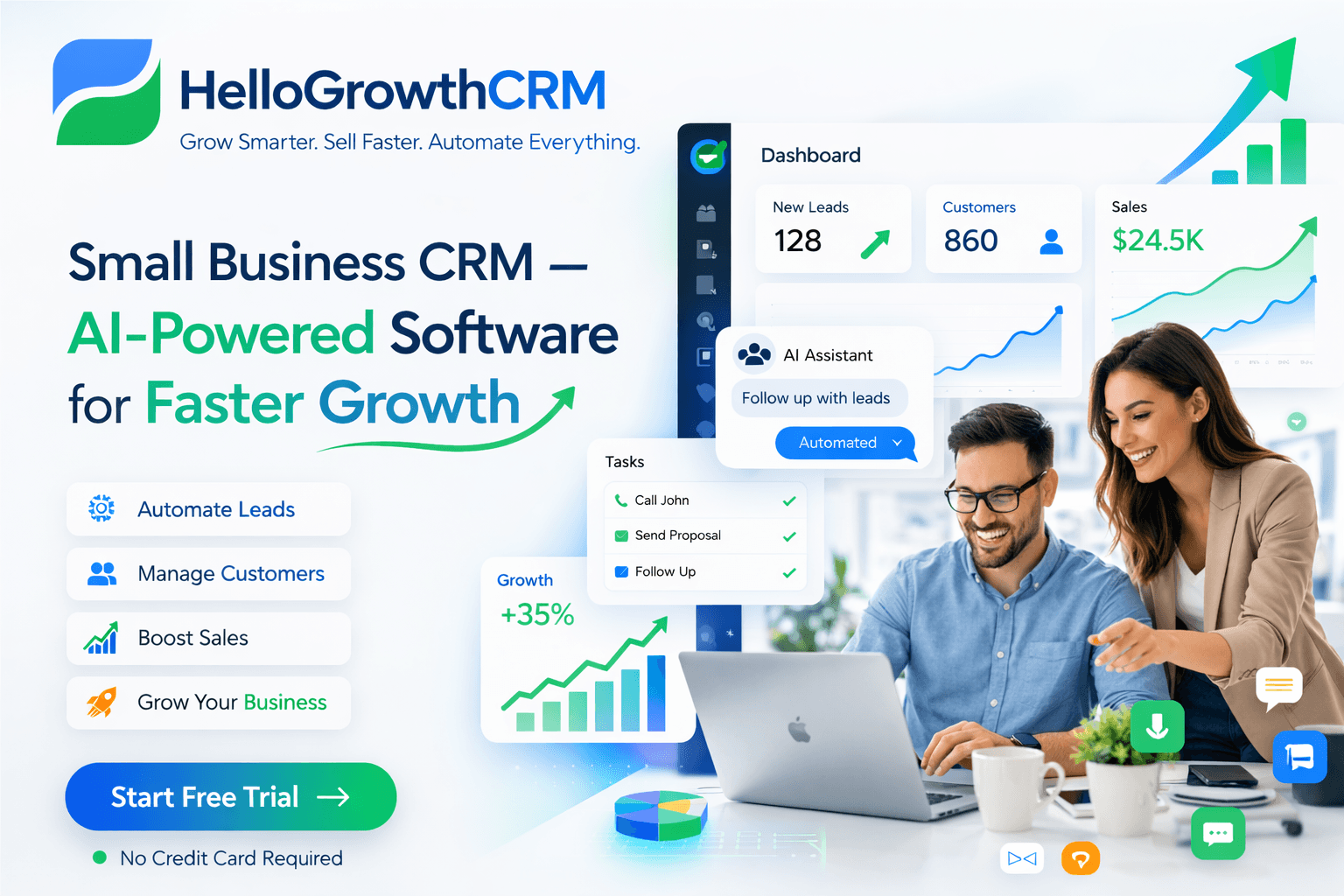
HelloGrowthCRM helps reps qualify faster, follow up on time, and close more deals—with practical automation in one place.
- AI lead scoring and pipeline visibility
- Built-in dialer, WhatsApp, and email automation
- Sales forecasting and RevOps-ready reporting
How we picked these 12 CRM companies — and what 'top' actually means here
India is now one of the largest and fastest-growing CRM markets in the world, and the shortlist problem has become genuinely hard. A founder searching for CRM software today faces global giants, Nasdaq-listed Indian SaaS companies, vertical specialists, and a long tail of affordable tools built specifically for Indian small businesses. All of them claim to be the right choice.
This list is an editorial selection, not a ranking by revenue or a pay-to-play directory. We looked at three things: market presence in India (a real customer base and rupee pricing, not just a global website that happens to load here), product breadth (how much of the lead-to-revenue journey the platform actually covers), and relevance to Indian SMBs (WhatsApp support, GST-aware billing, telecalling workflows, IndiaMART and JustDial lead capture, and pricing a five-person team can justify).
The order below is loosely grouped — the global-scale Indian SaaS companies first, then the international incumbents, then the India-focused SMB specialists — but it is not a 1-to-12 verdict. The best CRM for a 500-seat enterprise sales organisation and the best CRM for a three-person real-estate brokerage are different products, and pretending otherwise is how businesses end up paying for software nobody logs into.
One disclosure up front: this guide is published by HelloGrowthCRM, and we appear on the list. We have positioned ourselves where we honestly belong — as the WhatsApp-first option for Indian SMBs — rather than at the top. Where a competitor is the better fit for your situation, this article says so.
If you want a deeper head-to-head after reading, our best CRM in India guide compares the SMB options in more detail.
The Indian SaaS heavyweights: Zoho, Freshworks and LeadSquared
1. Zoho CRM — founded 1996, headquartered in Chennai. Zoho is the reference point for Indian SaaS: bootstrapped, profitable, and serving businesses in practically every country. Zoho CRM sits inside a suite of more than fifty applications covering email, accounting (Zoho Books), support (Zoho Desk), and marketing.
That breadth is the pitch — one vendor, one bill, everything loosely integrated. It fits businesses that want a full software stack from a single provider and have someone willing to spend time on configuration, because Zoho's flexibility comes with a real setup and admin burden.
Pricing is famously accessible, with a free edition for very small teams and paid plans that undercut the global incumbents. The common complaint is not price but sprawl: many SMBs end up using a fraction of what they pay for. See our detailed Zoho CRM comparison for where it wins and where simpler tools do.
2. Freshworks (Freshsales) — founded 2010, Chennai, listed on Nasdaq in 2021. Freshworks built its name on Freshdesk, the support product, and Freshsales is its CRM: clean interface, built-in phone and email, AI assistant (Freddy), and a design philosophy that deliberately avoids Salesforce-style complexity.
Freshsales fits mid-sized teams that want a modern, polished CRM without hiring an administrator. It is less India-specific than you might expect from a Chennai-founded company — the product is built for a global market, so WhatsApp-heavy Indian sales motions typically need add-ons or marketplace apps.
Pricing sits in the mid band: cheaper than Salesforce, costlier than the India-focused SMB tools.
3. LeadSquared — founded 2011, Bengaluru; reached unicorn status in 2022. LeadSquared is the strongest Indian answer to the question "what if the CRM was built around high-velocity lead follow-up?" Its sales execution platform is dominant in Indian edtech, lending, insurance and healthcare — industries where thousands of leads arrive daily and speed-to-call decides revenue.
Automation journeys, call-centre integrations, and field-force tracking are genuinely deep. The trade-off is that LeadSquared is an enterprise-leaning product: implementation projects, annual contracts, and pricing that makes sense at 25-plus seats far more than at five.
If you are an admissions team processing lakhs of enquiries a year, shortlist it. If you are a small services firm, it is more machine than you need.
The global incumbents with serious India operations: Salesforce and HubSpot
4. Salesforce India — founded 1999 in San Francisco; the world's largest CRM vendor by revenue, with a substantial India operation including a major development and delivery centre in Hyderabad. Salesforce is the default choice for Indian enterprises: banks, large manufacturers, IT services firms, and any company whose board asks "why aren't we on Salesforce?" The platform can model almost any sales process, and the partner ecosystem in India is enormous.
For SMBs the calculus is different. Even with entry-level editions, the total cost — licences, implementation partner, an admin to maintain it — routinely runs into several lakhs a year, and small teams frequently abandon it for something lighter. Choose Salesforce when process complexity and integration needs genuinely demand it, not for the brand.
5. HubSpot — founded 2006 in Cambridge, Massachusetts; the company that popularised inbound marketing. HubSpot's free CRM tier is one of the most generous in the industry and has given it a large Indian user base, supported by a fast-growing local partner network.
The product is superb for content-led, inbound-heavy businesses: marketing automation, landing pages, email sequences and reporting in one place with a famously friendly interface. The catch is well known — the free and Starter tiers are affordable, but the Professional tiers where the serious automation lives are priced in dollars for Western budgets, and costs climb steeply as contact lists grow.
Indian SMBs whose sales actually happen on WhatsApp and phone calls, rather than through email nurture funnels, often find they are paying for a marketing engine they do not use.
India-focused SMB specialists: Kylas, TeleCRM and Kapture CX
6. Kylas — a Pune-built CRM designed specifically for Indian SMBs, best known for its unusual pricing model: a flat organisation-level subscription with unlimited users, rather than per-seat pricing. For businesses with large but lightly-active teams — say, twenty field agents who each touch the CRM a few times a day — that model can be dramatically cheaper than per-user tools.
The product covers pipelines, lead capture from Indian portals, and basic automation, with onboarding support included. It fits growing teams that want everyone in the system without counting licences. Teams wanting deep marketing automation or advanced reporting will find it intentionally simple.
7. TeleCRM — an Indian startup built around a blunt observation: most Indian SMB selling happens on the phone and on WhatsApp, so the CRM should be a telecalling tool first. TeleCRM combines an autodialer, call recording, WhatsApp messaging and lead management in a mobile-first package aimed at telecalling teams — real estate, education counselling, loan sales.
If your sales floor is ten people with headsets working through lead lists, this focus is exactly right. It is not trying to be a full revenue platform, and businesses with longer, multi-stakeholder B2B cycles will outgrow its deal-management depth.
8. Kapture CX — founded in Bengaluru, Kapture began life as a CRM and has evolved into a customer experience and support automation platform serving large Indian consumer brands in retail, travel, consumer durables and BFSI. Its strength is post-sale: omnichannel ticketing, self-serve support, and field service management at enterprise scale.
It appears on this list because many Indian buyers searching for "CRM" actually need support software, and Kapture is one of India's strongest home-grown answers. For sales-pipeline management in an SMB, however, it is the wrong tool aimed at the right keyword.
The long-serving Indian vendors: Corefactors, SalesBabu and Vtiger
9. Corefactors — a Bengaluru company whose platform (historically known as Teleduce) positions itself as a RevOps tool: sales, marketing, support and success in one system, with telephony and campaign modules built in. Corefactors has quietly served Indian mid-market businesses for years, particularly those that want inbound call handling, SMS and email campaigns, and lead management under one login without assembling five tools.
It suits operations-minded teams consolidating their stack; the interface is functional rather than fashionable, and it has less brand presence than the venture-funded names above.
10. SalesBabu — one of India's longer-running cloud CRM vendors, serving small manufacturers, distributors and service businesses since the late 2000s. SalesBabu's endurance is the story: while dozens of Indian CRM startups have come and gone, it has kept a steady base of SMB customers with a practical product covering enquiry management, quotations, order processing and after-sales service.
It is a sensible shortlist entry for traditional SMEs — manufacturing units, dealer networks — that value stability and Indian-business workflows like quotation-to-order tracking over modern UI polish.
11. Vtiger — Bengaluru-based, with genuine open-source heritage: the original vtiger CRM, forked in 2004, became one of the most widely deployed open-source CRMs in the world. Today's Vtiger One is a commercial cloud product covering sales, support and marketing, while the open-source edition still exists for teams that want to self-host.
That dual identity is Vtiger's niche — businesses with technical capability who want control, customisation, or an escape route from subscription lock-in. Non-technical SMB buyers usually find the cloud incumbents easier to adopt.
The WhatsApp-first option: where HelloGrowthCRM fits
12. HelloGrowthCRM — the WhatsApp-first CRM for Indian small businesses, and the publisher of this guide, so read this entry knowing that. We built HelloGrowthCRM around how Indian SMBs actually sell in 2026: leads arrive from IndiaMART, JustDial, Facebook and the website; conversations happen on WhatsApp and phone calls; and deals die not from lost negotiations but from missed follow-ups.
The product combines a visual sales pipeline with native WhatsApp Business API messaging, a built-in Twilio-powered dialer, AI lead scoring, automated follow-up sequences across WhatsApp, SMS and email, GST-ready invoicing, and field-sales GPS check-ins.
Integrations cover the tools Indian SMBs already run on — IndiaMART, JustDial, Razorpay, Tally, Shopify and Zapier. Security is audited (SOC 2 Type II) and the platform is DPDPA-compliant, which matters more each year as Indian data-protection enforcement matures.
Pricing starts at ₹899 per user per month, and there is a genuinely usable free plan — not a 14-day trial — so a small team can run its pipeline at zero cost and pay only when the volume justifies it.
We will not claim to be number one; that claim is meaningless without saying number one for whom. If you are an enterprise, Salesforce or LeadSquared will serve you better. If you want fifty apps from one vendor, Zoho is the obvious pick. But if you are a 2-to-50-person Indian business whose selling lives on WhatsApp and the phone, and you want a CRM your team will actually open every morning, that is precisely the buyer we built for.
Our CRM software for India page covers the product in full.
What Indian SMBs actually pay: reading CRM pricing honestly
Sticker prices in this market are designed to be compared; total costs are not. Before shortlisting on the per-user number, understand the four places where CRM budgets quietly grow.
First, the plan-tier trap. Nearly every vendor's advertised entry price belongs to a plan missing the features that made you shortlist them — automation on the middle tier, advanced reporting on the top one. Read the plan comparison table for the specific features you named in your requirements, then price that plan.
With global vendors, the gap between the entry tier and the tier you actually need can be three to four times.
Second, channel costs. WhatsApp Business API conversations are billed by Meta per conversation regardless of which CRM you use, and calling minutes through built-in dialers carry telecom charges. These are usually pass-through costs, but vendors differ on markup and transparency — ask every shortlisted vendor to show the per-conversation and per-minute rates in writing.
Third, implementation and onboarding. SMB-focused Indian tools generally include onboarding free or near-free; enterprise platforms assume a paid implementation partner. If a vendor's proposal includes an implementation line item larger than the first year's licence cost, you are buying enterprise software — decide deliberately whether you are an enterprise.
Fourth, the annual-contract discount. Most vendors price monthly but discount annual commitments meaningfully. The honest way to use this: run the first one or two months on a monthly plan or free tier, confirm the team has actually adopted the tool, then switch to annual. Committing twelve months to software nobody has logged into yet is how CRM becomes shelfware with a renewal date.
As a reference point on rupee budgets: a five-person Indian sales team can run a capable WhatsApp-first CRM stack — HelloGrowthCRM at ₹899 per user per month, for instance — for roughly the monthly cost of a single portal listing or a few thousand rupees of ad spend.
At that price, the CRM pays for itself with one saved deal a quarter, which is why the adoption question matters far more than the price question for most SMBs.
How to choose between them: a practical five-question filter
Twelve credible vendors is still too many to trial. These five questions collapse the list fast.
First, where do your leads come from? If the answer includes IndiaMART, JustDial or WhatsApp click-to-chat ads, favour tools with native Indian lead-source capture — HelloGrowthCRM, Kylas, TeleCRM, LeadSquared. If leads come from content and email, HubSpot and Zoho pull ahead.
Second, where do your conversations happen? A team that sells on WhatsApp needs WhatsApp inside the CRM — templates, shared inbox, automated sequences — not a browser tab alongside it. A WhatsApp-integrated CRM removes the copy-paste layer where follow-ups die. Teams that sell by email and scheduled demos have more choices.
Third, how many people will use it, and how heavily? Per-user pricing punishes large casual teams (consider Kylas); flat low per-user pricing suits small intensive teams (HelloGrowthCRM, Zoho); enterprise seat counts justify enterprise platforms (Salesforce, LeadSquared).
Fourth, who will administer it? Salesforce and Zoho reward a dedicated admin. If nobody in your company will own configuration, pick a tool that works acceptably on defaults within the first week — this single question eliminates more mismatches than any feature comparison.
Fifth, what does the all-in cost look like at your size in year one — licences plus implementation plus the paid add-ons you will discover you need? Get that number in writing from every shortlisted vendor before committing. The gap between sticker price and real price is where CRM budgets go to die.
The bottom line for 2026
The Indian CRM market in 2026 is a buyer's market. Zoho and Freshworks prove Indian companies can build world-class horizontal SaaS; LeadSquared proves vertical depth wins enterprise deals; and a wave of SMB-focused tools — Kylas, TeleCRM, HelloGrowthCRM — proves that the 60-million-strong Indian MSME base is finally being built for directly, rather than sold hand-me-down enterprise software.
The practical advice is unglamorous: shortlist two or three tools from this list that match your lead sources, your conversation channels and your team size; run real leads through each for two weeks; and pick the one your slowest-to-adopt salesperson actually used. A CRM only earns its subscription when the whole team lives in it daily.
One final note on switching: moving CRMs mid-year feels daunting, but for an SMB with a few thousand contacts it is a spreadsheet export, an import, and a week of parallel running — far cheaper than another year on a tool the team avoids. Every vendor on this list imports CSV data; do not let sunk licence fees keep a bad fit in place.
If your team sells on WhatsApp and the phone, start your trial with HelloGrowthCRM — the free plan means the evaluation costs nothing, and setup takes an afternoon, not a quarter. Our pricing page has the full breakdown, and the best CRM in India comparison goes deeper on the head-to-head choices covered here.
Frequently Asked Questions
Ready to put this into practice?
Set up your pipeline, WhatsApp follow-ups, and AI lead scoring in minutes — free, no credit card.
Try HelloGrowthCRM freeGet CRM tips in your inbox
Join thousands of sales professionals who get weekly insights on CRM strategy, AI automation, and pipeline optimization.

The HelloGrowthCRM team publishes guides on CRM strategy, AI sales tools, and revenue operations for small business sales teams.