WhatsApp CRM India: The Complete Guide for SMBs (2026)

Co-Founder, HelloGrowthCRM · March 20, 2026 · 11 min read
Quick Answer
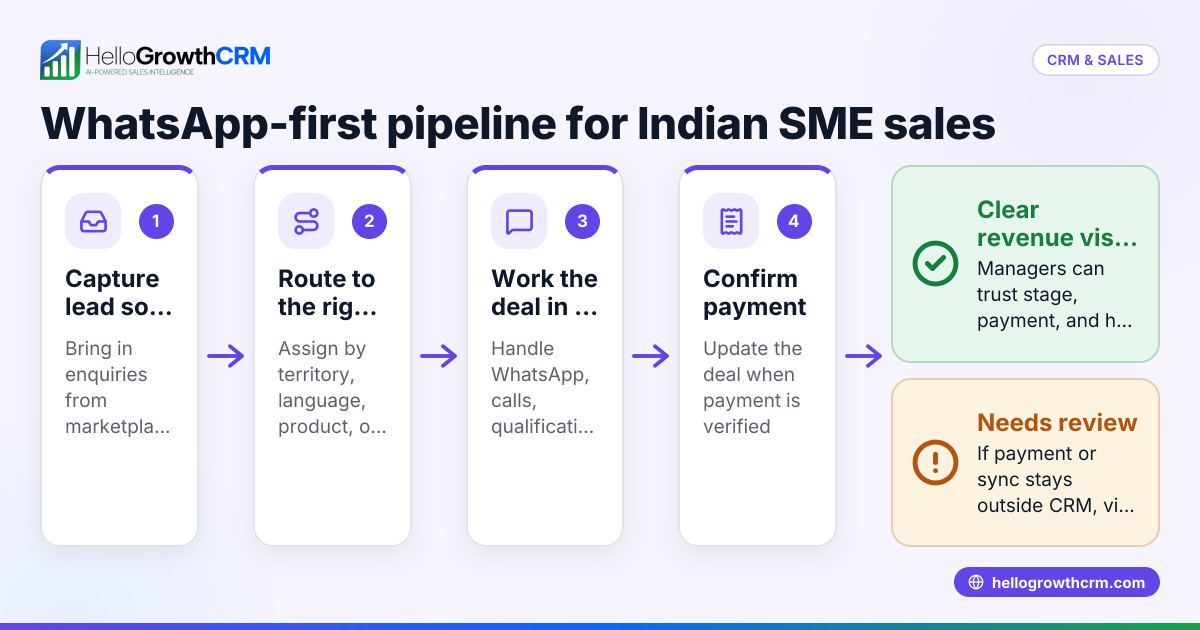
A WhatsApp CRM routes all lead conversations and deal updates through WhatsApp Business and logs every interaction automatically in a structured pipeline. For Indian SMBs, where over 500 million users make WhatsApp the primary sales channel, it eliminates the split between a CRM reps ignore and WhatsApp conversations where deals actually close.
HelloGrowthCRM software
Built for real small-business sales teams
HelloGrowthCRM helps reps qualify faster, follow up on time, and close more deals—with practical automation in one place.
- AI lead scoring and pipeline visibility
- Built-in dialer, WhatsApp, and email automation
- Sales forecasting and RevOps-ready reporting
What Is WhatsApp CRM and Why India Needs It Differently
A WhatsApp CRM is a sales and customer management system that routes all lead conversations, follow-up messages, and deal updates through WhatsApp Business — and logs every interaction automatically in a structured pipeline. In most Western markets, a CRM with email integration is sufficient. In India, it is not.
India has over 500 million active WhatsApp users. For most Indian SMBs — whether selling B2B industrial equipment, coaching programmes, or professional services — WhatsApp is not a messaging app. It is the primary channel through which sales actually happen.
Leads message first on WhatsApp. Buyers share specs and negotiate on WhatsApp. Payment confirmations, dispatch notifications, and after-sales queries all live on WhatsApp.
This creates a specific problem that generic CRM software sold from the US or Europe does not solve well. If your CRM does not integrate deeply with WhatsApp, your sales team maintains two separate systems: a CRM they update reluctantly, and WhatsApp where the real conversations happen.
The CRM data is always stale. Deals fall through because no one reads the CRM update — they read the WhatsApp chat.
A purpose-built WhatsApp CRM for Indian teams eliminates this split. Every message sent, every follow-up automated, and every buyer response received flows back into the pipeline. Your sales manager can see deal status in the CRM because the CRM reflects WhatsApp reality, not a parallel universe that reps forget to update.
The Indian B2B buying cycle also differs from Western SaaS models. Decision cycles are longer and more relationship-driven. A buyer might take 90-120 days to confirm a significant order — during which a salesperson who does not follow up on WhatsApp at the right cadence simply gets forgotten. WhatsApp CRM systems automate this persistence without making it feel spammy.
Why Email CRM Fails Indian SMBs
Most global CRM platforms — HubSpot, Salesforce, Zoho — were designed around email-first sales workflows. Email sequences, email open tracking, and email-based lead nurturing are their primary features. These work well in markets where business communication happens via email. India is not one of those markets.
Open rates for cold B2B emails in India hover around 8-14%, compared to industry norms of 20-25% in the US and UK. Why? Because Indian business buyers are overwhelmed with promotional emails they never asked for, and inbox filters have become aggressive.
Even if your email lands in the primary inbox, a busy procurement manager in Surat or Coimbatore is unlikely to respond — they respond on WhatsApp.
The failure mode looks like this: a sales rep logs a lead in the CRM, sends an introductory email, and waits. The email is ignored. The rep moves on to the next lead. The first lead — who would have responded in 10 minutes to a WhatsApp message — is now lost. Multiplied across 200 leads per month, this is a significant revenue leak.
Email automation also has a trust problem in Indian B2B contexts. Automated emails feel impersonal. A WhatsApp message from a named salesperson, even if templated, feels personal. Buyers reply. Relationships form. This is not a cultural bias to overcome — it is a commercial reality to build your sales infrastructure around.
A second failure mode: Indian SMBs often have field sales teams, channel partners, or resellers who are not office-based. These teams live on mobile and WhatsApp. Asking them to update a web-based CRM that requires a laptop login is a losing battle. A mobile-first WhatsApp CRM that captures conversations automatically is the only system they will actually use.
How WhatsApp CRM Works: The Technical Explanation
A WhatsApp CRM integrates with WhatsApp Business API (not the regular WhatsApp app) to route business messaging through a managed platform. Here is how the technical stack works for Indian SMBs.
WhatsApp Business API is Meta's official channel for businesses to send and receive messages at scale. Unlike the regular WhatsApp app (limited to one device, one account, no automation), the Business API allows: multiple agents to handle chats from a single number, automated message templates for follow-ups, webhook callbacks so every inbound message is logged in your CRM, and broadcast messaging to opted-in contacts.
The CRM sits on top of the API. When a lead submits a form on your website or calls your sales line, the CRM creates a new lead record. Simultaneously, it triggers a WhatsApp message to that lead — typically a greeting with a salesperson name and a question about their requirement.
The lead replies on WhatsApp. That reply is captured by the API webhook and logged in the CRM as an activity. The salesperson sees the full conversation history inside the CRM deal card.
Automation layers handle follow-up sequences: if a lead has not replied in 24 hours, the CRM automatically sends a follow-up message. If they have not replied in 48 hours, a second message goes out. If they have shown interest (replied but not advanced the deal), they get moved to a different sequence with different content — perhaps a case study or pricing information.
For Indian teams, the critical technical requirement is WABA (WhatsApp Business Account) verification. Your business needs to be verified by Meta to access the API at scale. This involves submitting business registration documents and a Facebook Business Manager account.
HelloGrowthCRM helps teams through this process and provides a managed API layer, so you do not need to build the integration yourself.
Choosing the Right WhatsApp CRM for Indian Teams
Not all CRM platforms that claim WhatsApp integration actually deliver it at the depth Indian sales teams need. Here is what to evaluate before committing.
Native vs. third-party integration: Some CRMs bolt on WhatsApp via a third-party connector (Zapier, Make, or a plugin). This creates fragile workflows where message failures silently drop records. A native WhatsApp integration — where the API is maintained directly by the CRM vendor — is significantly more reliable.
Ask specifically: is WhatsApp messaging built into your core platform, or is it a connector?
Two-way conversation logging: Can you see the full WhatsApp conversation thread inside the CRM deal card? Some platforms only log outbound messages, not inbound replies. This makes the CRM useless as a source of truth because you only see half the conversation.
Template library and approval management: WhatsApp Business API requires pre-approved message templates for outbound messages to new leads. Your CRM should have a template library where you can draft, submit for approval, and manage templates — without leaving the CRM.
Multi-agent handling: Can multiple salespeople handle conversations from the same WhatsApp Business number? This is essential for teams of more than two people. Look for features like agent assignment, conversation routing rules (by geography, product, or lead source), and visibility for managers into all active conversations.
INR pricing and Indian support: CRMs priced in USD with overseas-only support teams create ongoing friction. Look for vendors with INR pricing, GST invoicing, and India-based support who understand Indian compliance requirements including DPDPA.
HelloGrowthCRM is built for this exact use case — with native WhatsApp Business API integration, two-way conversation logging, template management, and pricing in INR. Plans start free with WhatsApp features included.
Setting Up Your First WhatsApp Automation
Getting your first WhatsApp automation live inside a CRM takes about two to three days — most of which is the Meta verification process, not the actual setup. Here is a practical implementation guide.
Step one: Get your WhatsApp Business Account (WABA) verified. You will need: a registered Indian business (GST registration or incorporation certificate), a Facebook Business Manager account, and a dedicated phone number that is not currently linked to any WhatsApp account.
The verification process takes 24-72 hours once documents are submitted. HelloGrowthCRM's onboarding team handles this submission on your behalf.
Step two: Create your first three message templates. Start with a lead acknowledgement template (sent immediately when a new lead comes in), a 24-hour follow-up template (sent if no reply), and a 48-hour follow-up template. Keep templates under 160 characters where possible — longer templates have lower open rates and occasionally fail approval.
Avoid promotional language in initial templates; Meta is strict about templates that feel like spam.
Step three: Set up your lead pipeline stages to match WhatsApp touchpoints. A typical Indian SMB pipeline: New Lead, WhatsApp Contacted, Replied, Requirement Shared, Quotation Sent, Negotiation, Won or Lost. Automate stage transitions: when a lead replies to your WhatsApp, they automatically move from WhatsApp Contacted to Replied. This removes manual work from reps.
Step four: Train your team on conversation handling. Automation handles initial contact and follow-ups. But when a lead shows genuine interest and replies, a human rep takes over the conversation. Make sure your team understands what to say, what not to say, and when to escalate to a call or site visit.
Step five: Set up your manager dashboard to track response rates, average first-reply times, and conversion by WhatsApp sequence. Run this for 30 days, then tune your templates based on response data.
Compliance and Data Protection for WhatsApp CRM in India
Two compliance frameworks govern WhatsApp CRM usage in India: Meta's WhatsApp Business Policy and India's Digital Personal Data Protection Act (DPDPA) 2023.
WhatsApp Business Policy requires that all outbound messages to new leads be sent via pre-approved templates. You cannot send free-form messages to contacts who have not previously messaged you. Contacts must have opted in to receive WhatsApp communications from your business — this opt-in must be explicit (a checked checkbox on a form, not a pre-ticked one), and you must be able to demonstrate it if Meta audits your account.
Bulk messaging to non-opted-in contacts can result in WABA suspension.
DPDPA 2023 imposes additional requirements for Indian businesses. Under the Act, personal data — which includes a phone number and associated conversation content — can only be collected and processed with explicit consent for a specific purpose. For WhatsApp CRM this means: your lead capture forms must include a clear consent statement explaining that their number will be used for sales communications via WhatsApp.
You must provide a way for contacts to withdraw consent. If a contact asks to be removed, they must be removed from your WhatsApp contact list and CRM within a reasonable time period.
Data storage is also relevant under DPDPA. WhatsApp conversation logs stored in your CRM must be treated as personal data. If your CRM is hosted outside India, check whether your vendor complies with cross-border data transfer rules that DPDPA introduces.
HelloGrowthCRM stores all data on Indian servers (Mumbai AWS region) and provides built-in consent capture on lead forms. DPDPA deletion requests can be processed via the admin panel, which removes data from the CRM and flags the corresponding WhatsApp contact for removal.
Common Mistakes Indian SMBs Make with WhatsApp Sales
After working with hundreds of Indian SMBs on WhatsApp CRM implementations, the same mistakes appear repeatedly. Knowing them in advance saves months of course-correcting.
Mistake one: using personal WhatsApp numbers for business sales. When a salesperson leaves, all their leads leave with them — because the conversations are on their personal number. The company has no record of what was discussed, no access to the pipeline, and no ability to transfer relationships.
Always operate from a WhatsApp Business number owned by the company, routed through the Business API.
Mistake two: sending too many follow-ups too fast. A common pattern is lead comes in on Monday, three WhatsApp messages go out by Wednesday afternoon, lead blocks the number. The correct cadence for cold leads is: immediate welcome message, 24-hour follow-up, 48-hour follow-up, then weekly for three weeks.
If no reply after that, move them to a monthly newsletter segment rather than continuing active follow-up.
Mistake three: using WhatsApp for everything — including conversations that should happen on email or phone. WhatsApp is for initial contact, follow-up, and quick queries. Complex proposals, contracts, and technical specifications should be shared as PDFs via WhatsApp but the detailed discussion should happen on a video call or email thread.
Trying to negotiate a large deal entirely over WhatsApp is a mistake.
Mistake four: no CRM integration at all. Teams that manage sales purely on WhatsApp — with leads in chat, follow-up dates in their head, and deal status remembered by the salesperson — scale to about three salespeople before everything collapses. The moment you add a fourth rep, you need a CRM that maps to your WhatsApp conversations.
Mistake five: not tracking which WhatsApp message template drives the most replies. Teams spend months using the same templates without testing variations. A simple A/B test — two different opening lines — can double your response rate. Your CRM should make this data visible.
Ready to put this into practice?
Set up your pipeline, WhatsApp follow-ups, and AI lead scoring in minutes — free, no credit card.
Try HelloGrowthCRM freeGet CRM tips in your inbox
Join thousands of sales professionals who get weekly insights on CRM strategy, AI automation, and pipeline optimization.
Rushabh Shah is co-founder of Soor LLC and leads product strategy at HelloGrowthCRM. He has worked with hundreds of small business sales teams to design CRM workflows that improve pipeline predictability and reduce operational overhead.