HelloGrowthCRM software
Built for real small-business sales teams
HelloGrowthCRM helps reps qualify faster, follow up on time, and close more deals—with practical automation in one place.
- AI lead scoring and pipeline visibility
- Built-in dialer, WhatsApp, and email automation
- Sales forecasting and RevOps-ready reporting
Tracking sales performance is crucial for small businesses to understand how well their sales efforts translate into revenue and growth. The five key performance indicators (KPIs) in sales that every small business owner should monitor are:
- Sales Growth: Measures the increase or decrease in sales revenue over a specific period.
- Conversion Rate: The percentage of leads or prospects that become paying customers.
- Average Deal Size: The average revenue generated per closed deal.
- Sales Cycle Length: The average time it takes to close a deal from first contact.
- Customer Acquisition Cost (CAC): The total cost spent to acquire a new customer.
Why this comes up / what goes wrong
Small business owners often struggle with inconsistent sales results or losing leads because they don’t track the right metrics. Without KPIs, it’s hard to know if sales efforts are effective or if the team is focusing on the right activities. For example, a business might have many leads but a low conversion rate, or long sales cycles that delay revenue. Tracking these five KPIs reveals bottlenecks and opportunities for improvement.
Step-by-step
- Measure Sales Growth
- Calculate total sales revenue over two periods (monthly, quarterly, or yearly).
- Check if sales revenue is increasing or decreasing.
- Calculate Conversion Rate
- Count the number of leads generated.
- Count how many of those leads became customers.
- Divide customers by leads and multiply by 100 for a percentage.
- Determine Average Deal Size
- Add the total revenue from all closed deals.
- Divide by the number of deals closed.
- Calculate Sales Cycle Length
- Track the number of days from first contact to deal close for each sale.
- Find the average number of days across all deals.
- Compute Customer Acquisition Cost (CAC)
- Add all sales and marketing expenses for a period.
- Divide by the number of new customers acquired in that period.
Check these KPIs regularly to spot trends and adjust sales strategies accordingly.
Example (fictional figures)
A B2B software reseller in Denver, Colorado, wants to evaluate sales performance for Q1 2026 (01/01/2026 to 03/31/2026).
- Total sales revenue Q1: $1,200,000
- Total sales revenue Q4 2025: $1,000,000
- Leads generated Q1: 400
- Customers acquired Q1: 80
- Total revenue from closed deals Q1: $1,200,000
- Number of deals closed Q1: 80
- Days from first contact to close for deals: 45, 60, 30, 50, 55 (five deals sample)
- Total sales and marketing expenses Q1: $240,000
Calculations:
- Sales Growth = ($1,200,000 - $1,000,000) / $1,000,000 × 100 = 20%
- Conversion Rate = (80 / 400) × 100 = 20%
- Average Deal Size = $1,200,000 / 80 = $15,000
- Sales Cycle Length = (45 + 60 + 30 + 50 + 55) / 5 = 48 days
- Customer Acquisition Cost = $240,000 / 80 = $3,000
This example shows 20% sales growth, a 20% conversion rate, an average deal size of $15,000, a sales cycle length of 48 days, and a CAC of $3,000.
Common mistakes
- Not tracking KPIs consistently
- Prevent by setting a regular schedule (weekly or monthly) to review sales KPIs.
- Ignoring the sales cycle length
- Prevent by measuring how long deals take to close; long cycles may indicate process inefficiencies.
- Focusing only on revenue, not costs
- Prevent by including Customer Acquisition Cost to understand profitability.
- Using inaccurate or incomplete data
- Prevent by centralizing sales data in one system to avoid errors.
- Neglecting follow-up on deals in progress
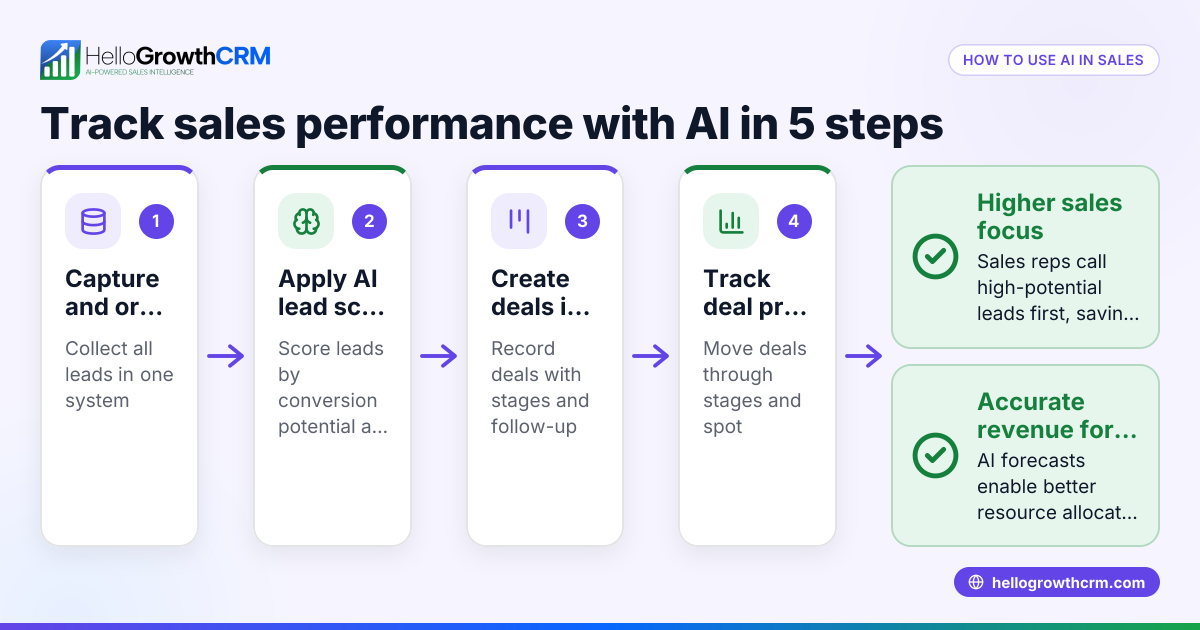
- Prevent by managing deals in a pipeline and setting follow-up reminders.
Doing this in HelloGrowthCRM
HelloGrowthCRM helps track these KPIs effectively. The Deals (pipeline) feature lets you see every open opportunity, such as a quotation sent last week appearing at the 'quote sent' stage with a follow-up date, so no deal is forgotten. The built-in dialer allows sales reps to call leads directly from the CRM and log call outcomes, keeping all activity tied to contacts and deals. For teams with field reps, territories and field operations tools let reps log visits from their phones, while managers can monitor daily activity and commissions. Learn more about HelloGrowthCRM for the United States, the WhatsApp and SMS CRM, and the built-in CRM dialer.
Frequently asked questions
What is the most important sales KPI? Sales Growth is often considered the most important KPI because it directly measures revenue increase. However, all five KPIs together provide a complete picture of sales performance.
How often should I track these KPIs? Ideally, track sales KPIs monthly or quarterly to spot trends and make timely adjustments.
Can I track KPIs without a CRM? Yes, but it’s more time-consuming and error-prone. A CRM like HelloGrowthCRM centralizes data and automates tracking.
How does conversion rate differ from sales growth? Conversion rate measures the efficiency of turning leads into customers, while sales growth measures overall revenue increase.
What if my Customer Acquisition Cost is too high? Review sales and marketing expenses and focus on improving lead quality and conversion rates to lower CAC.
Key takeaways
- Track Sales Growth, Conversion Rate, Average Deal Size, Sales Cycle Length, and Customer Acquisition Cost.
- Calculate each KPI regularly to monitor sales health.
- Avoid common mistakes like inconsistent tracking and ignoring costs.
- Use HelloGrowthCRM’s Deals pipeline, dialer, and field operations tools to manage sales efficiently.
- Regular KPI tracking helps identify bottlenecks and improve sales strategies.
Start tracking your sales KPIs today to make informed decisions and grow your business revenue. To get started, Start on the Free Forever plan (200 leads, no credit card).
Ready to put this into practice?
Set up your pipeline, WhatsApp follow-ups, and AI lead scoring in minutes — free, no credit card.
Try HelloGrowthCRM freeGet CRM tips in your inbox
Join thousands of sales professionals who get weekly insights on CRM strategy, AI automation, and pipeline optimization.

The HelloGrowthCRM team publishes guides on CRM strategy, AI sales tools, and revenue operations for small business sales teams.