

Skip to content
CRM for Staffing in Singapore

Keep the Client Side Moving: A CRM for Staffing in Singapore, From First Meeting to Contract Renewal

Client pipeline, agreed fee and mark-up per account, contract renewal dates and quarterly review prep in one system. From USD 100/user/year, billed annually, free plan available.

Last updated:

Free Forever • No Credit Card Required

Live preview

Staffing CRM

A sample Staffing workspace. The names and figures are illustrative.

Open pipeline

42

+12% this month

Follow-ups due

9

5 automated

Response SLA

18m

-34% faster

Automation coverage

76%

Terms on the account

1

Staffing Account

New enquiry, owner assigned

S$32K

Review-ready reporting

1

Staffing Opportunity

Fee percentage, mark-up and replacement period recorded per client and per role band

S$15K

Extension reminders

1

Staffing Renewal

Pass-type context captured on every requirement

S$9.4K

Account continuity

1

Staffing Follow-up

Contract and framework renewal dates with reminders months ahead

S$44K

Quick answer

CRM for Staffing in Singapore: what problem does HelloGrowthCRM solve first?

Terms are agreed verbally in a meeting and the signed version differs from what the consultant remembers three months later. Fee percentage, mark-up and replacement period are fields on the client account with the agreement attached, so the terms in force are the same for the consultant, the manager and finance.
  • Terms on the account
  • Review-ready reporting
  • Extension reminders
  • Account continuity

See pricingBook a demo

HelloGrowthCRM

Capture. Follow up. Close.

From Enquiry to Customer in One CRMEvery lead captured, followed up and tracked — so nothing goes cold.The path a lead takes inside HelloGrowthCRM, from first enquiry to a repeat customer.
  1. Step 1

    Capture

    Web forms, WhatsApp, calls and ads land in one inbox

  2. Step 2

    Qualify

    AI lead scoring flags who is ready to talk

  3. Step 3

    Assign

    Routed to the right rep automatically

  4. Step 4

    Follow up

    Reminders, sequences and WhatsApp nudges

  5. Step 5

    Track the deal

    Stages, value and next step in the pipeline

  6. Step 6

    Win & retain

    Renewals and repeat business stay on the radar

Every call, message and email is logged on the contact — the history travels with the lead.

One contact record, one pipeline, one clear next step.

01

How staffing services are bought in Singapore

A small market with long memories

Singapore is compact enough that a reputation is a real asset and a mishandled search is remembered across an industry. Most agencies grow through referral, repeat hiring managers who change employer, and long nurture of accounts already served by two or three incumbent suppliers. The opening is usually an event rather than a pitch: a resignation, a new team, an approved headcount, a supplier who missed a deadline.

Procurement, terms and pass realities

Once interest exists, the process becomes formal quickly. Terms are negotiated, vendor onboarding runs through procurement, a purchase order appears, and only then do roles start being released. Every requirement also carries a practical question about work pass eligibility, since a role that assumes a fresh pass application has a different timeline and a different candidate pool from one that does not. Agencies here are licensed and should confirm their own obligations on advertising and personnel registration before changing how they operate.
02

The CRM workflow a Singapore agency needs

Model the client pipeline on procurement rather than optimism: introduction, capability meeting, terms agreed, vendor onboarding, purchase order, first role released. Record fee percentage, mark-up and replacement period on the account so the agreement in force is visible to everyone. Add renewal and review dates with reminders, because supplier reviews are calendared here and preparation is the differentiator.

For contract staffing, the account also needs an active headcount view with end dates and extension status. The revenue that leaks in this market is rarely a lost search; it is a contractor whose extension was discussed too late, and a quarterly review that arrived without a prepared story about fill rate and submission speed.

03

What to check before buying staffing CRM software in Singapore

Four checks worth making. Can the client side operate independently of candidate workflow so it sits alongside your existing database? Are contract end dates and renewals first-class fields with reminders? Does reporting produce a client-facing review without manual assembly? And is pricing published, so a five-person agency can budget without a sales process? HelloGrowthCRM is USD 100/user/year, billed annually with a free plan available.

04

Candidate database, spreadsheet, or HelloGrowthCRM

CapabilitySpreadsheet and emailCandidate databaseHelloGrowthCRM
Client pipeline through procurement stagesFragilePartialYes
Fee and mark-up recorded per clientManualPartialYes
Contract end and extension remindersNoPartialYes
Quarterly review reportingManual rebuildPartialYes
WhatsApp thread on the accountPersonal phonesNoYes
Consent recorded on the contactNoPartialYes
Candidate submissions and interviewsNoYesKeep yours
Published per-user pricingFree but leakyVariesYes

The two systems are complements. Keep candidate history where your recruiters already work, and run clients, terms, renewals and reviews in a CRM built for the commercial side.

Challenges we solve

Common CRM problems in this industry — and how HelloGrowthCRM solves each one

Every team in this space loses revenue to the same recurring gaps. Each card below states one problem and the specific HelloGrowthCRM capability that closes it.

  • Problem: Terms are agreed verbally in a meeting and the signed version differs from what the consultant remembers three months later.

    How HelloGrowthCRM solves it: Fee percentage, mark-up and replacement period are fields on the client account with the agreement attached, so the terms in force are the same for the consultant, the manager and finance.

    HelloGrowthCRM capability: Terms on the account

  • Problem: An annual supplier review arrives and the team spends four days rebuilding numbers from email and spreadsheets.

    How HelloGrowthCRM solves it: Roles released, fill rate, submission speed and open positions are live on the account, so review preparation is a review of the data rather than a reconstruction of it.

    HelloGrowthCRM capability: Review-ready reporting

  • Problem: A contractor extension is missed and a good billing month becomes an awkward call about a role that already lapsed.

    How HelloGrowthCRM solves it: Contract end dates carry reminders, so the extension conversation happens while the contractor is still on site and the client still has budget in the current cycle.

    HelloGrowthCRM capability: Extension reminders

  • Problem: A senior consultant resigns and the client relationships, terms and history leave with them.

    How HelloGrowthCRM solves it: Accounts, threads, terms and activity live in the CRM with role-based access and controlled exports, so a handover takes an afternoon and the firm keeps what it built.

    HelloGrowthCRM capability: Account continuity

What you get

Why teams choose HelloGrowthCRM

AI-powered CRM with the features you need to close more deals.

  • A client pipeline that mirrors how Singapore corporates buy: introduction, capability meeting, terms negotiation, procurement and vendor onboarding, purchase order raised, first role released, with each step owned and dated
  • Fee percentage, mark-up and replacement period recorded per client and per role band, so a contract signed with a regional office is not renegotiated from memory when the hiring manager changes
  • Pass-type context captured on every requirement, because the practical shape of a role changes entirely depending on whether the client expects a local hire, a pass holder already in Singapore, or a candidate needing a fresh application
  • Contract and framework renewal dates with reminders months ahead, since annual supplier reviews in this market are scheduled events and the agency that walks in prepared usually keeps the account
  • Quarterly business review packs assembled from live data, showing roles released, fill rate, time to submit and open positions, so the review is a discussion about performance rather than a week of manual reporting
  • Contractor extension tracking for firms running IT and project contract staffing, with end dates, extension conversations and rate changes held on the account rather than in a project manager inbox
  • Email sequences for the slow half of Singapore business development, where a target account already has three suppliers and the opening is a resignation or a headcount approval six months away
  • A built-in dialer with logged outcomes, plus consent-aware calling practice, so your team keeps a clean record of who agreed to be contacted and when the conversation actually happened
  • WhatsApp threads on the account for hiring managers who prefer messaging over email, with the history staying visible to the firm rather than only to the consultant who owns the phone
  • AI lead scoring that reads enquiry detail, seniority and response speed to rank which prospective clients deserve a consultant hour today, and drafts the follow-up using account context
  • Multi-currency deal values for agencies placing into regional headquarters, so a role billed in Singapore dollars and a regional contract billed elsewhere both report correctly in one pipeline view
  • Role-based access, audit trails and export controls, so a client list built over a decade is not carried out of the door on a personal spreadsheet when a senior consultant moves firm
  • A recruitment module, switched on per account, for the candidate side: bulk CV import that reads each CV into the candidate record, a match score against each job, automatic shortlisting above your threshold with the recruiter making the final call, an AI first-round phone screen once your AI Knowledge Base is set up, and a candidate blacklist that blocks calls and messages to anyone flagged
Watch it work

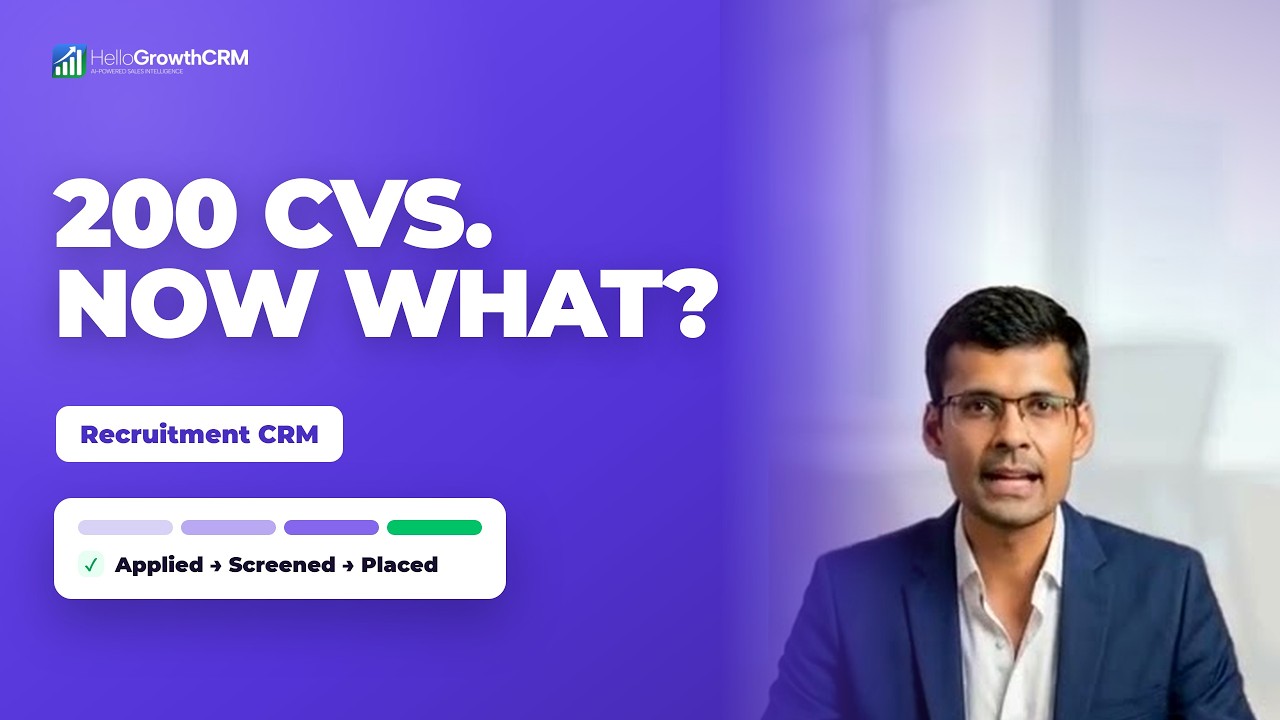
CRM for Recruitment: A Pipeline, Not an ATS

CRM for Recruitment: A Pipeline, Not an ATS
A short walkthrough of HelloGrowthCRM for recruitment, staffing and HR.

Key takeaways from this video

  • How recruitment maps onto a sales CRM: client briefs as accounts, mandates as deals, candidates as leads, hiring steps as stages.
  • A dashboard that opens on what is ageing — open roles, stalling candidates and an owner on every item.
  • Candidate records with skills, availability and notice period, plus duplicate detection before resubmitting.
  • Your own hiring stages on one board, from sourced to placed.
  • Booking pages synced to your calendar instead of email back-and-forth.

Watch the full video on its own page

HelloGrowthCRM by the numbers

$12
per user/month list price — USD 100/user/year, billed annually on annual billing, ₹899/user/mo in India
$0
free forever starter plan — no credit card required
14-day
trial included on paid plans
500+
teams worldwide run their pipeline on HelloGrowthCRM

Frequently Asked Questions

Common questions about using HelloGrowthCRM in your industry.

Prioritisation and writing. Enquiries are scored on seniority, volume and responsiveness so consultants work the account most likely to release a role. Follow-up drafts are generated from what is already on the account, which shortens the second and third chase to a hiring manager who is polite but busy. Long threads are summarised into an account status a manager can read in a minute before a client call. Nothing goes out without a consultant reviewing it, which matters when your reputation in a small market is the product.

Yes. Consultants carry the client list, contacts, terms and next actions on their phone, and log meeting outcomes immediately after a client visit in the CBD rather than at the end of the day. Calls placed from the app are logged against the contact automatically. Managers see pipeline activity as it happens, so the Monday meeting starts from what is on the board rather than what people can recall about last week.

Because they solve different problems. A candidate database manages CVs, submissions and interview history. It has nothing useful to say about a prospective client who has met you twice and gone quiet, an agreement waiting on procurement, a contractor whose end date is in three weeks, or a supplier review scheduled for next month. Most agencies run both, keeping the candidate system where it is and adding a client-side CRM in front of it rather than attempting a single system that does neither job well.

A small agency is usually live within a week. Client accounts and contacts import from a spreadsheet or from your existing system, and pipeline stages are configured to match your sales process rather than a generic template. The important set-up decisions are which fields are mandatory at each stage and how contract renewal dates are recorded, since those two choices determine whether the pipeline stays trustworthy after the first busy month.

Two-way email and calendar sync, native WhatsApp on a business number, a built-in dialer with call logging, and web forms that create leads directly. There is an API and support for automation platforms for anything specific, which is how agencies connect a timesheet or invoicing tool so contractor billing status is visible to consultants without giving everyone access to the finance system.

Yes, and they should sit on separate boards. Permanent recruitment is a fee-per-placement business measured on submission speed and offer conversion. Contract staffing is a margin business measured on active headcount, extension rate and timesheet accuracy. The client account is shared, so you can see total revenue by client across both lines, but stages, reminders and reporting differ. Agencies that run one blended pipeline usually end up with accurate permanent numbers and guesswork on contract renewals.

Access is role based, exports can be limited, and every change is logged. Singapore regulates personal data and also restricts unsolicited marketing calls and messages to local numbers through a registry, so confirm your own obligations before running a calling or messaging campaign, and record consent on the contact record so anyone picking up the account can see the basis on which you may contact that person. Retention rules can be configured to match your own policy.

More CRM guides to explore

Browse related HelloGrowthCRM guides and see how different teams run their pipelines.

Ready to grow?

Join small businesses that close more deals with HelloGrowthCRM.

Free Forever • No Credit Card Required

Take the next step

Free Forever • No Credit Card Required

Prefer email? Write to sales@hellogrowthcrm.com