Overview
Make (formerly Integromat) is the automation platform you graduate to when workflows stop being straight lines — its visual scenario builder handles branching, iteration, aggregation, and error paths that simpler tools express awkwardly or not at all. Connected to HelloGrowthCRM's webhooks and REST API, Make becomes the orchestration layer for genuinely complex flows: multi-system lead routing, enrich-validate-then-create pipelines, and scheduled data hygiene jobs.
Where Zapier optimises for "connect two apps in a minute" and Integrately for one-click recipes, Make optimises for control: you see the whole scenario as a diagram, inspect every execution bundle, and pay by operations rather than per-task tiers — typically cheaper at volume. Teams with an ops-minded person on staff tend to standardise on it.
What data is involved
- CRM webhook events (lead created, stage changed, deal won) triggering Make scenarios in real time.
- Leads, deals, tasks, and notes created or updated via the REST API from any scenario.
- Multi-step flows: enrich from one service, validate, then write to the CRM conditionally.
- Iteration over CRM record batches for scheduled hygiene and reporting jobs.
- Error-handling routes so failed steps retry or alert instead of dropping data.
- Full field mapping including custom fields in both directions.
Step-by-step setup
Setup at a glance (3-5 bullets)
- In Make.com, create a scenario with HelloGrowthCRM as a module or use an HTTP webhook to receive CRM events.
- Configure triggers (e.g. new lead, deal updated) and actions in other apps.
- Test with a small dataset, then enable scheduling.
Sign in or sign up at HelloGrowthCRM. Open the login page, enter your credentials (or use Google), or choose Sign up if you need a new account. You must be signed in before you can open Settings and connect this integration.
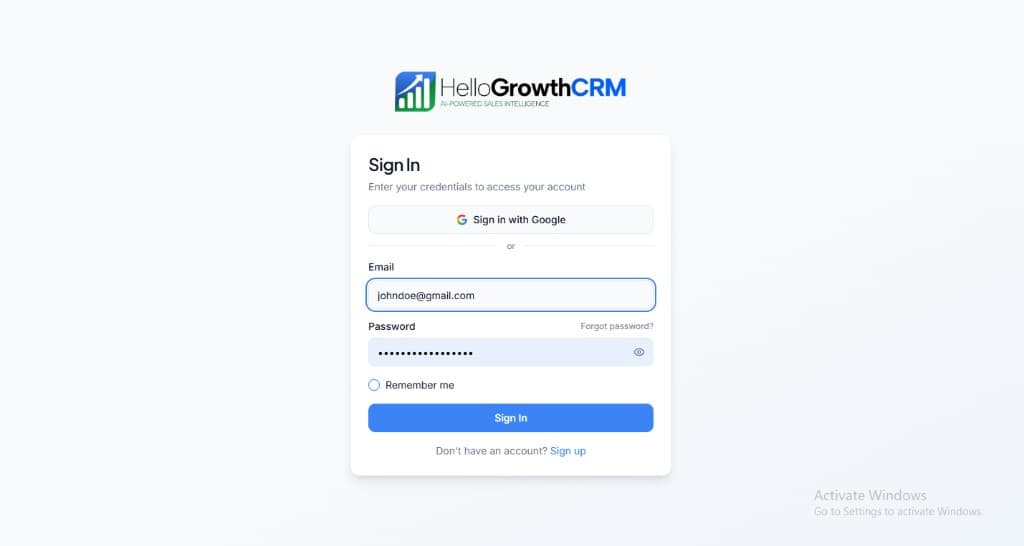
Open login page(opens in a new tab)app.hellogrowthcrm.com/login
Open Settings. In the left sidebar, under Admin, click Settings (you will land on the Settings area; the URL is app.hellogrowthcrm.com/settings).
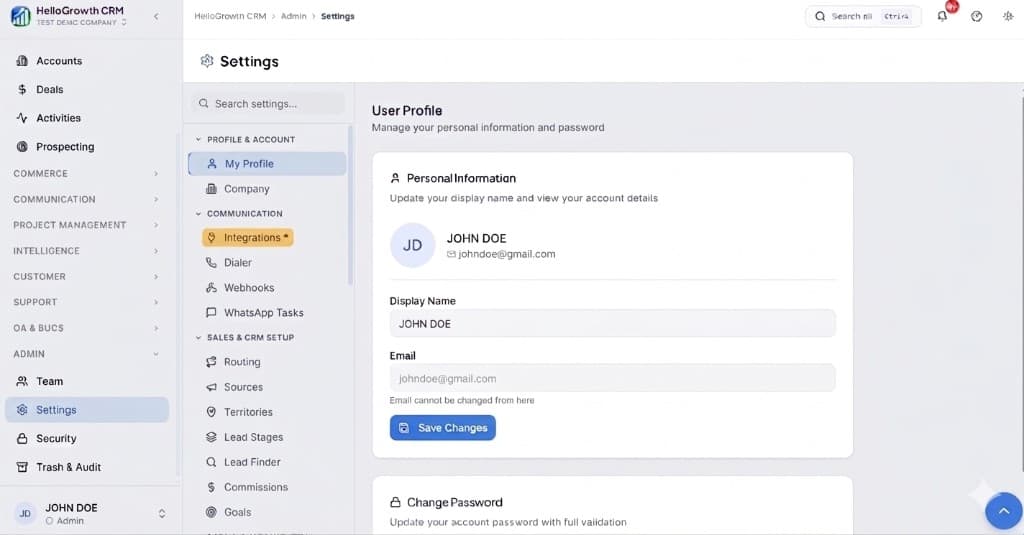
Open Settings(opens in a new tab)app.hellogrowthcrm.com/settings
Go to Integrations. On the Settings screen, use the middle settings menu. Under COMMUNICATION, click Integrations (star icon). Then find and configure this connector—the connector-specific steps below pick up from here.
Open Settings (Integrations)(opens in a new tab)app.hellogrowthcrm.com/settings
- In Make.com, create a scenario with HelloGrowthCRM as a module or use an HTTP webhook to receive CRM events.
- Configure triggers (e.g. new lead, deal updated) and actions in other apps.
- Test with a small dataset, then enable scheduling.
Best practices
- Use webhooks as triggers rather than polling — instant, and it conserves Make operations.
- Build error routes on any scenario touching leads; a silent midnight failure that drops a day of leads is the classic middleware injury.
- Aggregate before writing when processing batches — one update per record beats one scenario run per field.
- Name scenarios by job ('IndiaMART → CRM lead router') and keep one job per scenario; sprawling mega-scenarios are unmaintainable.
- Watch operations consumption the first month and add filters early — unfiltered triggers on busy events burn quota fast.
Best for & common use cases
Teams that need multi-step logic, iterators, and error handling beyond simple Zaps.
- Sync CRM deals to project tools or accounting when a stage changes.
- Route form submissions through transforms before CRM create.
Expected outcomes
- Faster lead handoff between tools and CRM owners
- Cleaner activity history for follow-up and reporting
- Lower manual copy-paste errors in the pipeline
Troubleshooting
- Scenario not triggering: the webhook was recreated in the CRM and the URL changed — update the trigger module's address.
- Records half-updated: a mid-scenario error with no error route — add error handling and replay the failed bundles from history.
- Operations exhausted early: a trigger firing on every record change instead of the relevant ones — add a filter right after the trigger.
FAQ
Governance
Treat API keys and webhooks as production secrets. Align field mapping with your privacy policy and regional regulations (GDPR, marketing consent, telemarketing rules). Your admin controls which roles can install or edit integrations.
Related integrations in this category
One-click automation recipes connecting HelloGrowthCRM webhooks and REST API to popular SaaS tools with minimal setup.
Pushes CRM reports or record lists to Google Sheets on a schedule, or ingests rows as leads via a mapped sheet and webhook.
Guided migration from HubSpot: contacts, companies, deals, owners, and pipelines are mapped into HelloGrowthCRM with deduplication and stage mapping.
Connects the CRM to thousands of apps via outbound webhooks and triggers.
Bidirectional contact and deal sync with HubSpot so both systems stay aligned during coexistence or phased migration.
Enterprise CRM sync for accounts, contacts, opportunities, and activities with field-level mapping.
Contact and deal sync with Pipedrive pipelines, stages, and owners.
Multi-CRM bidirectional sync for popular SMB platforms including Zoho CRM, Freshsales, Copper, and Insightly.