Overview
Every business has one spreadsheet that refuses to die — the partner-lead tracker, the event-registration sheet, the report a director insists on viewing in Sheets. The Google Sheets sync makes peace with that reality: rows added to a connected sheet become CRM leads automatically, and CRM data exports to live sheets that stay current, so the spreadsheet-dependent parts of the business connect to the pipeline instead of competing with it.
Both directions have a job. Inbound, Sheets is the universal adapter — anything that can write a row (event tools, partner submissions, legacy processes) can feed the pipeline. Outbound, live report sheets give stakeholders their familiar format without anyone exporting CSVs every Monday. What the sync deliberately isn't: a way to run your pipeline in Sheets — editing CRM truth in a spreadsheet is the disease, not the cure.
What data is involved
- New rows in connected sheets creating CRM leads with column-to-field mapping.
- Deduplication on email or phone so re-imported rows update rather than duplicate.
- CRM views exportable as live Google Sheets that refresh on schedule.
- Source tagging per sheet for attribution of spreadsheet-fed leads.
- Multiple sheets connectable, each with its own mapping and direction.
- Sync logs showing per-row results for reconciliation.
Step-by-step setup
Setup at a glance (3-5 bullets)
- Settings → Integrations → Google Sheets → Connect Google account.
- Choose a spreadsheet and tab or create a template from the CRM export wizard.
- Define sync direction (CRM → Sheet or Sheet → CRM) and column mapping.
Sign in or sign up at HelloGrowthCRM. Open the login page, enter your credentials (or use Google), or choose Sign up if you need a new account. You must be signed in before you can open Settings and connect this integration.
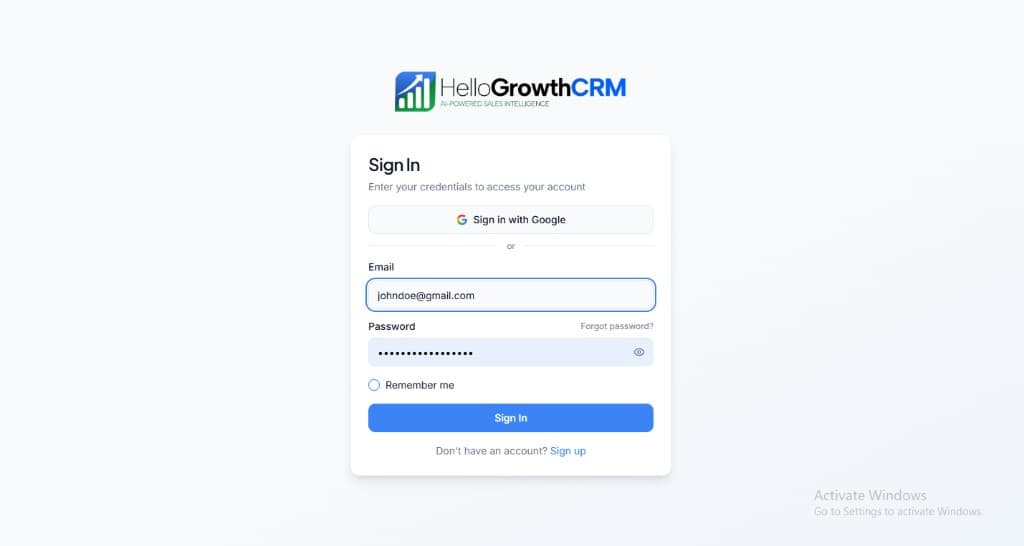
Open login page(opens in a new tab)app.hellogrowthcrm.com/login
Open Settings. In the left sidebar, under Admin, click Settings (you will land on the Settings area; the URL is app.hellogrowthcrm.com/settings).
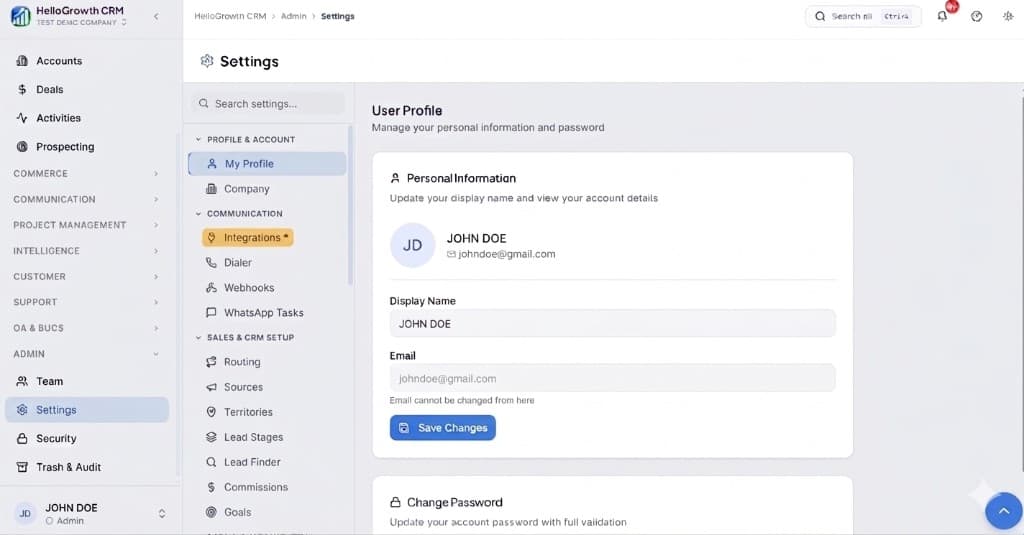
Open Settings(opens in a new tab)app.hellogrowthcrm.com/settings
Go to Integrations. On the Settings screen, use the middle settings menu. Under COMMUNICATION, click Integrations (star icon). Then find and configure this connector—the connector-specific steps below pick up from here.
Open Settings (Integrations)(opens in a new tab)app.hellogrowthcrm.com/settings
- Settings → Integrations → Google Sheets → Connect Google account.
- Choose a spreadsheet and tab or create a template from the CRM export wizard.
- Define sync direction (CRM → Sheet or Sheet → CRM) and column mapping.
Best practices
- Treat inbound sheets as append-only inboxes — new rows in, leads out; editing old rows to 'update' the CRM invites conflicts.
- Lock the header row and column order; remapping after a well-meaning colleague reorganises columns is the classic failure.
- Dedupe on email or phone from day one, especially for event lists where repeat registrants are normal.
- Give every connected sheet a source tag so spreadsheet-fed leads report honestly against forms and portals.
- Use outbound live sheets for stakeholders who want Sheets — and keep edit rights off; a report that's editable becomes a fork.
Best for & common use cases
Finance and RevOps teams that live in spreadsheets for ad‑hoc analysis and stakeholder sharing.
- Weekly pipeline snapshot to a shared workbook.
- Import event attendee lists from a Sheet into CRM leads.
Expected outcomes
- Faster lead handoff between tools and CRM owners
- Cleaner activity history for follow-up and reporting
- Lower manual copy-paste errors in the pipeline
Troubleshooting
- Rows not importing: the header row changed and broke the mapping — restore the original headers or re-map.
- Duplicates appearing: the sheet's email column has formatting artifacts (spaces, mixed case) — clean with TRIM/LOWER; matching normalises but garbage defeats it.
- Export sheet stopped refreshing: the Google OAuth grant was revoked — reconnect the Google account from the integration settings.
FAQ
Governance
Treat API keys and webhooks as production secrets. Align field mapping with your privacy policy and regional regulations (GDPR, marketing consent, telemarketing rules). Your admin controls which roles can install or edit integrations.
Related integrations in this category
Guided migration from HubSpot: contacts, companies, deals, owners, and pipelines are mapped into HelloGrowthCRM with deduplication and stage mapping.
Connects the CRM to thousands of apps via outbound webhooks and triggers.
Make.com (formerly Integromat) lets you build visual scenarios that connect HelloGrowthCRM to thousands of apps using modules, webhooks, and routers—with branching and error handling beyond simple one-step automations.
One-click automation recipes connecting HelloGrowthCRM webhooks and REST API to popular SaaS tools with minimal setup.
Bidirectional contact and deal sync with HubSpot so both systems stay aligned during coexistence or phased migration.
Enterprise CRM sync for accounts, contacts, opportunities, and activities with field-level mapping.
Contact and deal sync with Pipedrive pipelines, stages, and owners.
Multi-CRM bidirectional sync for popular SMB platforms including Zoho CRM, Freshsales, Copper, and Insightly.