Overview
Pipedrive popularised the visual pipeline, and teams leaving it usually aren't leaving the pipeline idea — they're leaving per-seat costs that climb with every add-on, or they've outgrown its contact-centric model. The Pipedrive sync keeps contacts, deals, stages, and owners aligned between Pipedrive and HelloGrowthCRM, which turns migration from a weekend cliff-edge into a phased move: run both, shift team by team, cut over when the new system has proven itself.
The sync maps Pipedrive's model cleanly — pipelines to pipelines, stages to stages, owners to users — so a deal moved in either system shows the same state in both during coexistence. Activity history and notes come across in the migration pass, meaning the first call a rep makes from the new CRM starts from the same context as the last call they made from the old one.
What data is involved
- Contacts and organisations synced with deduplication on email and name.
- Deals synced with pipeline, stage, value, and expected close date mapped.
- Owners mapped to CRM users so attribution and reporting carry over.
- Notes and activity history imported onto the matching records.
- Stage changes reflected across both systems during coexistence.
- Custom fields mapped to CRM custom fields where they carry sales meaning.
Step-by-step setup
Setup at a glance (3-5 bullets)
- Settings → Integrations → Pipedrive.
- Paste API token and select pipelines to mirror.
- Map stages and dedupe keys (email, organization).
Sign in or sign up at HelloGrowthCRM. Open the login page, enter your credentials (or use Google), or choose Sign up if you need a new account. You must be signed in before you can open Settings and connect this integration.
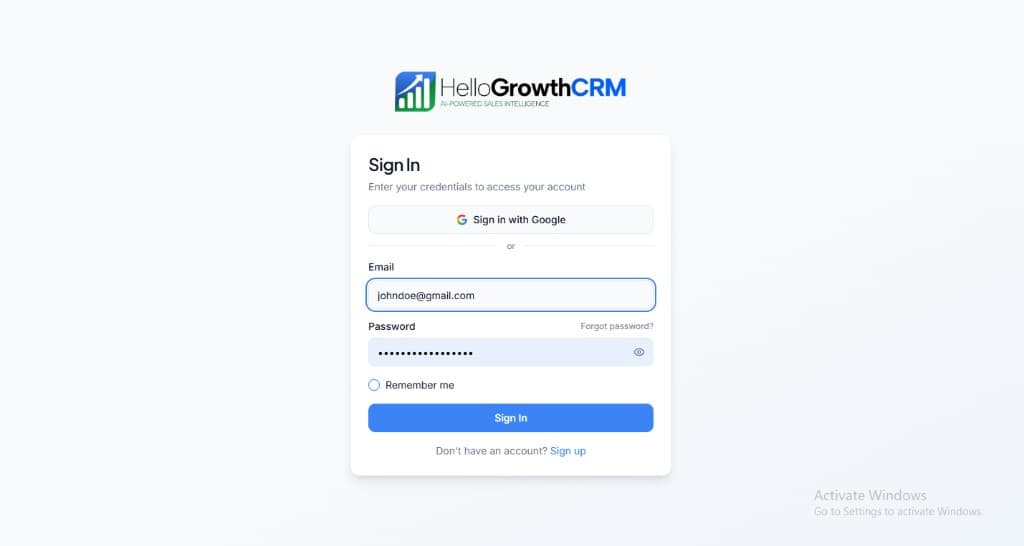
Open login page(opens in a new tab)app.hellogrowthcrm.com/login
Open Settings. In the left sidebar, under Admin, click Settings (you will land on the Settings area; the URL is app.hellogrowthcrm.com/settings).
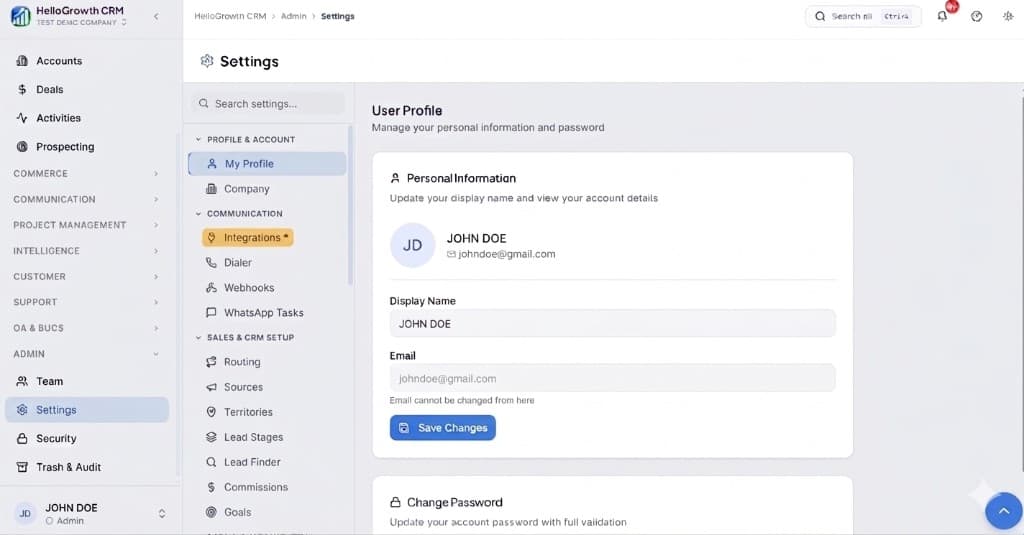
Open Settings(opens in a new tab)app.hellogrowthcrm.com/settings
Go to Integrations. On the Settings screen, use the middle settings menu. Under COMMUNICATION, click Integrations (star icon). Then find and configure this connector—the connector-specific steps below pick up from here.
Open Settings (Integrations)(opens in a new tab)app.hellogrowthcrm.com/settings
- Settings → Integrations → Pipedrive.
- Paste API token and select pipelines to mirror.
- Map stages and dedupe keys (email, organization).
Best practices
- Standardise stage names before syncing — migration is the cheapest moment you will ever get to clean up pipeline definitions.
- Run one team on HelloGrowthCRM first while sync keeps both sides current; their experience de-risks the full cutover.
- Map every Pipedrive user to a CRM user up front, including departed reps' records, so historical attribution doesn't collapse into 'unassigned'.
- Freeze Pipedrive automations that create or edit deals during the final cutover window to avoid racing the sync.
- Set an explicit end date for coexistence — indefinite two-CRM operation is a tax, not a strategy.
Best for & common use cases
Teams migrating off Pipedrive or running a subset of reps in HelloGrowthCRM.
- Side-by-side comparison during evaluation without double entry.
Expected outcomes
- Faster lead handoff between tools and CRM owners
- Cleaner activity history for follow-up and reporting
- Lower manual copy-paste errors in the pipeline
Troubleshooting
- Duplicate contacts after first sync: pre-existing duplicates in Pipedrive replicated across — dedupe the source or tighten match rules, then re-run.
- Deals in the wrong stage: two Pipedrive pipelines shared stage names and mapped to one CRM pipeline — split the mapping per pipeline.
- Sync conflicts on a field: both systems edited it between sync intervals — designate a single owning system per field during coexistence.
FAQ
Governance
Treat API keys and webhooks as production secrets. Align field mapping with your privacy policy and regional regulations (GDPR, marketing consent, telemarketing rules). Your admin controls which roles can install or edit integrations.
Related integrations in this category

Multi-CRM bidirectional sync for popular SMB platforms including Zoho CRM, Freshsales, Copper, and Insightly.

Bidirectional contact and deal sync with HubSpot so both systems stay aligned during coexistence or phased migration.
Enterprise CRM sync for accounts, contacts, opportunities, and activities with field-level mapping.

Creates Jira issues from CRM tasks for engineering and bug tracking.

Creates Linear issues from CRM tasks via the GraphQL API.

Creates support tickets from CRM records.
Creates Freshdesk tickets from CRM records.

Pushes CRM data to Notion databases with custom field mapping.