Overview
This is the guided, one-time path off HubSpot: contacts, companies, deals, owners, and pipelines mapped into HelloGrowthCRM with deduplication and stage mapping handled in a wizard rather than in spreadsheets. It suits teams that want a clean cutover — export, map, validate, go live — without running two systems in parallel. (If you want phased coexistence instead, the HubSpot Sync integration covers the bidirectional case.)
The migration is opinionated where it helps: duplicates are caught on email during import rather than replicated, HubSpot's lifecycle stages map onto your CRM pipeline explicitly, and a validation pass compares record counts before anything is final. Most teams schedule the real import for a quiet evening and start the next morning in the new CRM with history intact.
What data is involved
- Contacts and companies imported with email-based deduplication.
- Deals imported with pipeline, stage, amount, and close date mapped via the wizard.
- Owners mapped to CRM users, including a house-account option for departed reps.
- Notes, logged emails, and activities attached to their matching records.
- HubSpot properties mapped to CRM fields or tags, or deliberately dropped.
- Validation report comparing source and imported record counts before finalising.
Step-by-step setup
Setup at a glance (3-5 bullets)
- Settings → Integrations → HubSpot Migration → Connect HubSpot OAuth.
- Select objects and date range to export.
- Map HubSpot pipelines to CRM stages and owners to users.
- Run a dry run, review errors, then execute full migration.
Sign in or sign up at HelloGrowthCRM. Open the login page, enter your credentials (or use Google), or choose Sign up if you need a new account. You must be signed in before you can open Settings and connect this integration.
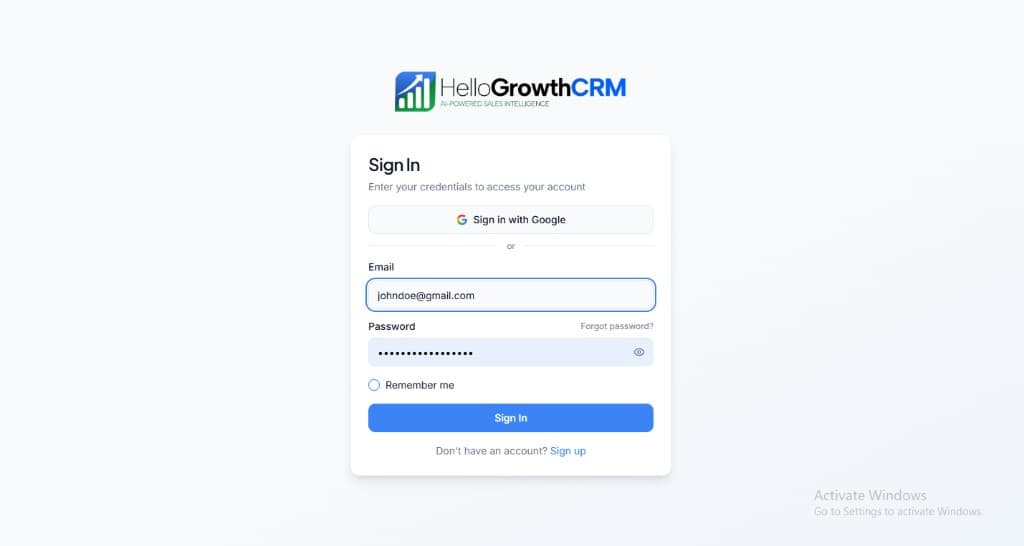
Open login page(opens in a new tab)app.hellogrowthcrm.com/login
Open Settings. In the left sidebar, under Admin, click Settings (you will land on the Settings area; the URL is app.hellogrowthcrm.com/settings).
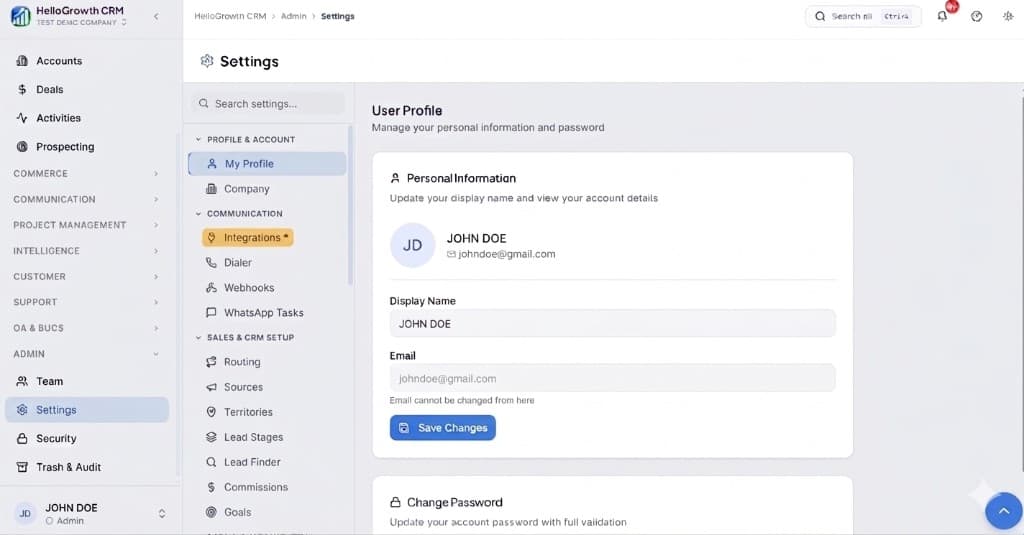
Open Settings(opens in a new tab)app.hellogrowthcrm.com/settings
Go to Integrations. On the Settings screen, use the middle settings menu. Under COMMUNICATION, click Integrations (star icon). Then find and configure this connector—the connector-specific steps below pick up from here.
Open Settings (Integrations)(opens in a new tab)app.hellogrowthcrm.com/settings
- Settings → Integrations → HubSpot Migration → Connect HubSpot OAuth.
- Select objects and date range to export.
- Map HubSpot pipelines to CRM stages and owners to users.
- Run a dry run, review errors, then execute full migration.
Best practices
- Export everything, import deliberately — bring open pipeline at full fidelity and let stale 2021 leads arrive as archived contacts, not active clutter.
- Decide lifecycle-to-pipeline mapping on paper first; it is the one mapping that changes how reports read forever after.
- Run the trial import into a sandbox pipeline, eyeball 20 familiar records, then run the real one.
- Do the final export at a frozen moment (evening or weekend) so nothing changes in HubSpot between export and go-live.
- Downgrade or close the HubSpot subscription only after the validation report matches — not before.
Best for & common use cases
Teams switching from HubSpot Sales Hub to HelloGrowthCRM without losing history.
- Consolidate HubSpot CRM and marketing contacts into one CRM.
- Pilot migration for a single pipeline before cutover.
Expected outcomes
- Faster lead handoff between tools and CRM owners
- Cleaner activity history for follow-up and reporting
- Lower manual copy-paste errors in the pipeline
Troubleshooting
- Counts mismatch in validation: HubSpot's marketing-contact filters excluded records from your mental total — compare against the full contacts database count.
- Deals arrived stageless: a HubSpot pipeline wasn't given a mapping — every source pipeline needs an explicit target.
- Owner shows as unassigned: the HubSpot user wasn't mapped — add the user or map them to a house account and re-run the affected batch.
FAQ
Governance
Treat API keys and webhooks as production secrets. Align field mapping with your privacy policy and regional regulations (GDPR, marketing consent, telemarketing rules). Your admin controls which roles can install or edit integrations.
Related integrations in this category
Connects the CRM to thousands of apps via outbound webhooks and triggers.
Make.com (formerly Integromat) lets you build visual scenarios that connect HelloGrowthCRM to thousands of apps using modules, webhooks, and routers—with branching and error handling beyond simple one-step automations.
One-click automation recipes connecting HelloGrowthCRM webhooks and REST API to popular SaaS tools with minimal setup.
Pushes CRM reports or record lists to Google Sheets on a schedule, or ingests rows as leads via a mapped sheet and webhook.
Bidirectional contact and deal sync with HubSpot so both systems stay aligned during coexistence or phased migration.
Enterprise CRM sync for accounts, contacts, opportunities, and activities with field-level mapping.
Contact and deal sync with Pipedrive pipelines, stages, and owners.
Multi-CRM bidirectional sync for popular SMB platforms including Zoho CRM, Freshsales, Copper, and Insightly.