Overview
Plenty of growing businesses run on Microsoft 365 — Outlook mailboxes, Teams, and the Office suite — while their CRM guidance assumes Gmail. The Outlook integration gives Microsoft-first teams the same completeness: email with leads and customers logs to the CRM timeline automatically via Microsoft Graph, sent items included, so deal records stay complete without BCC discipline or copy-paste.
The integration authenticates per-user with Microsoft OAuth, respects your tenant's security policies, and matches messages to contacts and companies the same way as the Gmail connector. For firms in accounting, legal, insurance, and other Microsoft-standard industries, this is usually the single highest-leverage integration to switch on first — it converts the CRM from a data-entry chore into a record that writes itself.
What data is involved
- Outlook mail with known contacts logged to the CRM timeline via Microsoft Graph.
- Sent items captured automatically — no BCC address required.
- Threads grouped per contact and deal, with attachments referenced.
- New senders surfaced as potential leads for one-click capture.
- Contact details kept consistent between Microsoft 365 and the CRM.
- Per-user OAuth connection compatible with tenant conditional-access policies.
Step-by-step setup
Setup at a glance (3-5 bullets)
- Go to Settings → Integrations → Outlook / Microsoft 365 (Email).
- Sign in with Microsoft; complete admin consent in Entra ID if your IT policy requires it.
- Select the mailbox or shared mailbox and confirm sync folders (e.g. Sent, Inbox).
- Run a test send or receive and confirm the activity attaches to the correct lead or contact.
Sign in or sign up at HelloGrowthCRM. Open the login page, enter your credentials (or use Google), or choose Sign up if you need a new account. You must be signed in before you can open Settings and connect this integration.
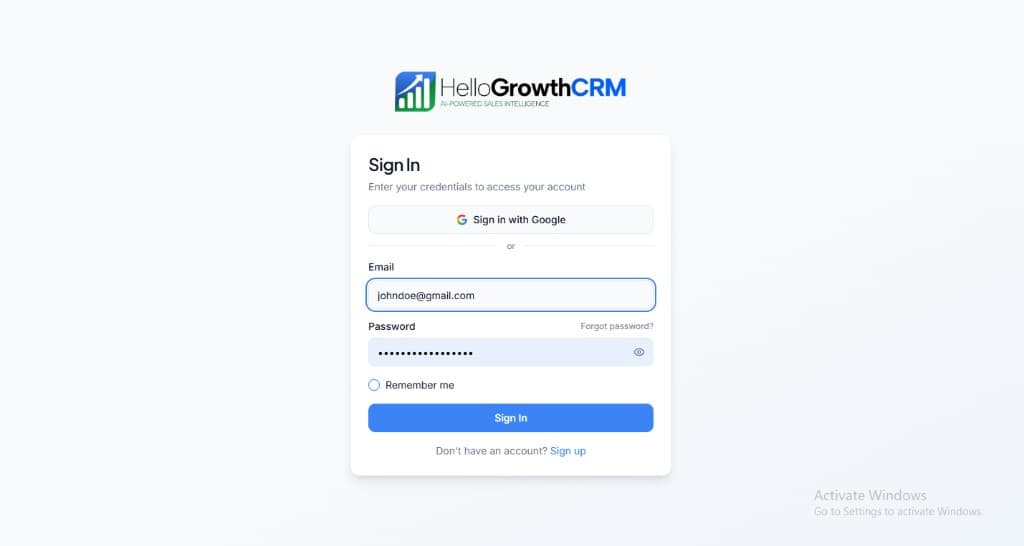
Open login page(opens in a new tab)app.hellogrowthcrm.com/login
Open Settings. In the left sidebar, under Admin, click Settings (you will land on the Settings area; the URL is app.hellogrowthcrm.com/settings).
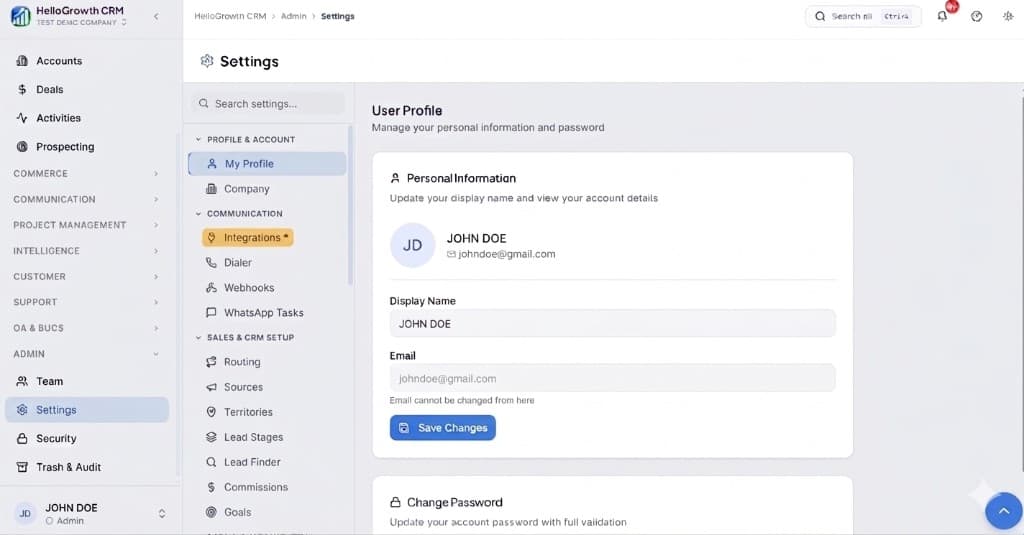
Open Settings(opens in a new tab)app.hellogrowthcrm.com/settings
Go to Integrations. On the Settings screen, use the middle settings menu. Under COMMUNICATION, click Integrations (star icon). Then find and configure this connector—the connector-specific steps below pick up from here.
Open Settings (Integrations)(opens in a new tab)app.hellogrowthcrm.com/settings
- Go to Settings → Integrations → Outlook / Microsoft 365 (Email).
- Sign in with Microsoft; complete admin consent in Entra ID if your IT policy requires it.
- Select the mailbox or shared mailbox and confirm sync folders (e.g. Sent, Inbox).
- Run a test send or receive and confirm the activity attaches to the correct lead or contact.
Best practices
- Connect every client-facing mailbox — partial coverage produces misleading timelines that erode trust in the CRM.
- Use domain matching so any correspondent at a client organisation logs against the right company record.
- Filter out internal domains and personal threads from logging; signal beats volume.
- Send deal-related follow-ups from the CRM record to get logging, templates, and sequences in one step.
- Coordinate with your Microsoft 365 admin on consent: granting tenant-wide admin consent once avoids per-user permission prompts.
Best for & common use cases
Organizations on Microsoft 365 that want one place to see pipeline, tasks, and customer email.
- Enterprise sellers moving between Outlook and CRM without copy-paste.
- Compliance-friendly retention of customer email alongside deal updates.
Expected outcomes
- Faster lead handoff between tools and CRM owners
- Cleaner activity history for follow-up and reporting
- Lower manual copy-paste errors in the pipeline
Troubleshooting
- Connection blocked at sign-in: tenant requires admin consent for new apps — have the admin approve the integration once from the Microsoft admin portal.
- Mail stopped logging after a password reset: the OAuth token was invalidated — reconnect the mailbox.
- Internal mail appearing on records: your own domain isn't excluded in the logging filters — add it to the exclusion list.
FAQ
Governance
Treat API keys and webhooks as production secrets. Align field mapping with your privacy policy and regional regulations (GDPR, marketing consent, telemarketing rules). Your admin controls which roles can install or edit integrations.
Related integrations in this category
Social messaging integration: route Meta inbox conversations into CRM threads with contact linkage.
Bot integration for messaging and notifications from CRM events to Telegram chats or channels.
Third-party live chat integration: sync visitors and transcripts into CRM leads and activities.
Embeddable on-site chat with AI auto-responses and human handoff to CRM owners.
Rich CRM notifications in Slack channels (new leads, deal updates, task reminders).
CRM notifications with rich embeds via webhook to your server channels.
Adaptive Card notifications in Teams channels for CRM events and deep links to records.
Template messages with delivery tracking; send and receive WhatsApp conversations with leads (sent, delivered, read).