HelloGrowthCRM software
Built for real small-business sales teams
HelloGrowthCRM helps reps qualify faster, follow up on time, and close more deals—with practical automation in one place.
- AI lead scoring and pipeline visibility
- Built-in dialer, WhatsApp, and email automation
- Sales forecasting and RevOps-ready reporting
Accurate sales forecasts predict your future sales revenue based on reliable data and realistic assumptions. They help you plan inventory, manage cash flow, and allocate resources effectively. This article explains why accurate sales forecasting matters, provides step-by-step instructions, a worked example, common pitfalls, and how HelloGrowthCRM can support your process.
Why this comes up / what goes wrong
Small and mid-sized business owners often face challenges with sales forecasting because their sales data is scattered across text messages, emails, and spreadsheets. This disorganization leads to missed deals and inaccurate projections. Without a clear, updated sales pipeline and consistent follow-up, forecasts become unreliable. For many, the lack of a dedicated sales manager means pipeline hygiene and follow-up suffer, causing forecasts to miss actual sales potential or overestimate revenue. This can result in poor inventory management, cash flow issues, and missed growth opportunities.
Step-by-step
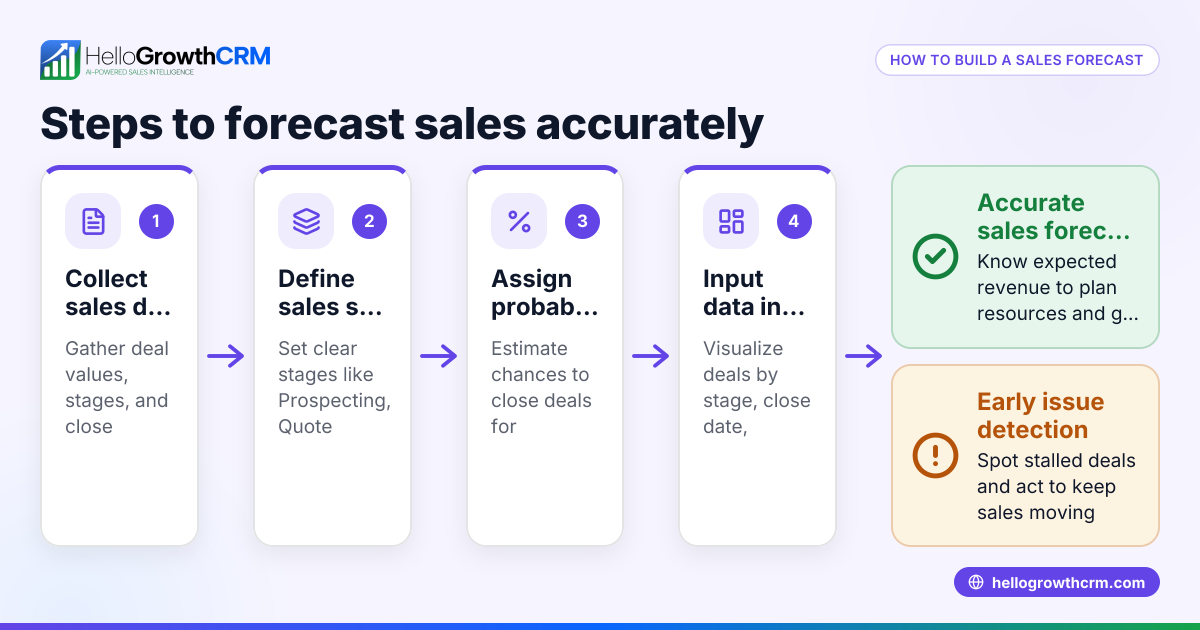
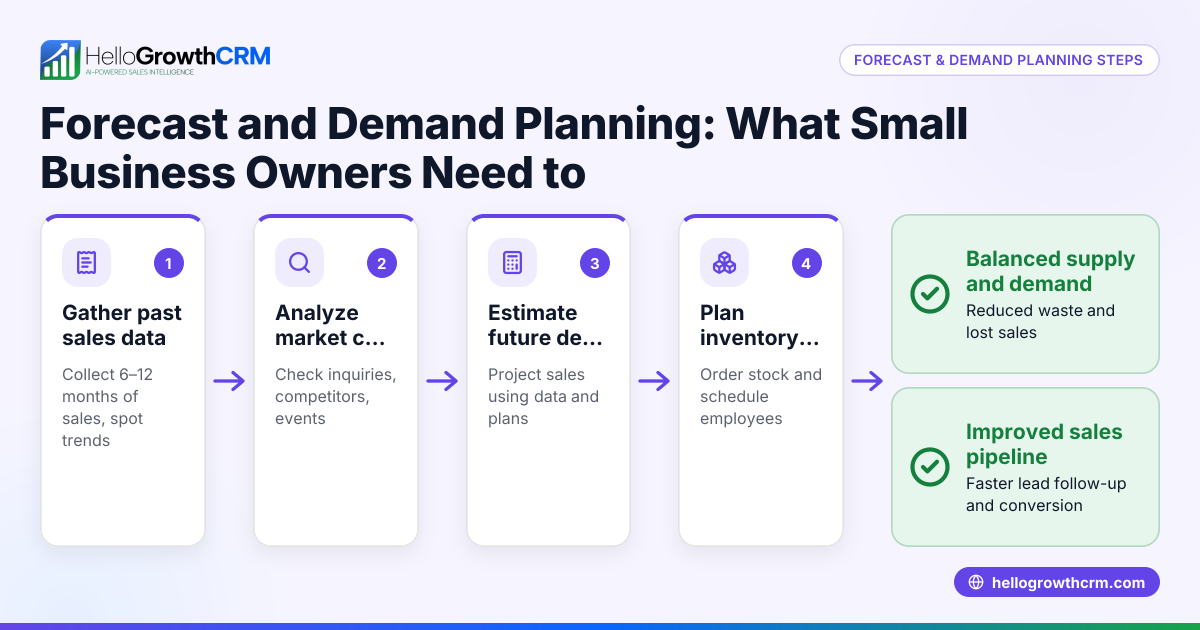
- Gather historical sales data: Collect your past sales figures for at least the last 6 to 12 months. Check for seasonal trends or recurring patterns that may affect sales. This historical context provides a baseline for your forecast.
- Review your current sales pipeline: List all open deals with their stages, expected close dates, and values. Confirm each opportunity is actively managed and updated, so your forecast reflects real potential sales.
- Assign probabilities to deals: Estimate the likelihood of closing each deal based on its current stage and your historical win rates for similar deals. Use objective data rather than guesswork to assign these probabilities.
- Calculate expected revenue: Multiply each deal’s value by its probability of closing, then sum these amounts to get your forecasted sales for the period. This weighted approach balances optimism with realism.
- Adjust for external factors: Consider market trends, economic conditions, upcoming marketing campaigns, or competitor actions that could influence sales. Adjust your forecast to reflect these influences.
- Update forecasts regularly: Review and revise your forecast weekly or monthly to reflect pipeline changes, new deals, or shifting probabilities. Frequent updates keep your forecast aligned with reality.
- Use tools to track and automate: Employ a CRM to centralize deal tracking, automate follow-ups, and generate sales reports, reducing errors and saving time. This improves accuracy and efficiency.
Example (fictional figures)
A B2B software reseller in Denver, Colorado, wants to forecast sales for Q3 2026.
- Deal A: $120,000, at 'proposal sent' stage, 60% chance, expected close 08/15/2026
- Deal B: $80,000, at 'negotiation' stage, 75% chance, expected close 09/10/2026
- Deal C: $50,000, at 'qualification' stage, 30% chance, expected close 09/25/2026
Calculations:
$120,000 × 60% = $72,000 $80,000 × 75% = $60,000 $50,000 × 30% = $15,000
Total forecasted sales = $72,000 + $60,000 + $15,000 = $147,000
This forecast helps the reseller plan inventory and staffing for Q3.
Common mistakes
- Ignoring pipeline updates: Prevent this by scheduling regular pipeline reviews and follow-ups to keep data current. Outdated pipelines lead to inaccurate forecasts.
- Overestimating deal probabilities: Base your probabilities on historical win rates, not wishful thinking. This keeps forecasts realistic.
- Mixing closed deals with forecasts: Separate actual sales from projected deals to avoid inflating forecasts. Closed deals belong in actual revenue, not forecasts.
- Failing to adjust for market changes: Monitor external factors like economic shifts or competitor moves and revise forecasts accordingly. Ignoring these can skew your numbers.
- Using multiple disconnected tools: Consolidate sales data in one CRM to avoid errors and data loss. Fragmented data reduces forecast reliability.
- Neglecting follow-up tasks: Ensure follow-up dates are set for deals to prevent opportunities from slipping through. Missed follow-ups mean lost sales and inaccurate forecasts.
Doing this in HelloGrowthCRM
HelloGrowthCRM supports accurate sales forecasts with its Deals (pipeline) feature. A quotation sent last week appears as a deal at the 'quote sent' stage with a follow-up date, so it is not forgotten. This helps keep your pipeline current and your forecasts reliable. For businesses with field sales teams, territories and visit logging ensure managers see daily activity. If you lack a sales manager, Managed RevOps provides weekly follow-up execution and pipeline hygiene support. Learn more about the AI CRM and sales forecasting features.
Frequently asked questions
What is the best way to assign probabilities to sales deals? Assign probabilities based on the deal stage and your historical conversion rates for similar stages. For example, if 60% of deals at 'proposal sent' close, use 60% probability for those deals.
How often should I update my sales forecast? Update your forecast at least monthly, and preferably weekly if your sales cycle is short or your pipeline changes frequently. Regular updates keep forecasts accurate and actionable.
Can a CRM improve my sales forecasting accuracy? Yes, a CRM centralizes your sales data, tracks deal progress, automates follow-ups, and generates pipeline reports, all of which improve forecast accuracy. HelloGrowthCRM offers these capabilities tailored for small and mid-sized US businesses.
How do external factors affect sales forecasts? Market trends, competitor actions, seasonal demand, and economic conditions can increase or decrease expected sales. Adjust your forecast to reflect these factors.
What if I don’t have a dedicated sales manager? HelloGrowthCRM’s Managed RevOps service can help by providing weekly follow-up and pipeline management support, ensuring your forecast stays up to date even without a sales manager.
How can I avoid overestimating sales forecasts? Use objective data like historical win rates and assign probabilities carefully. Regularly review and adjust your forecasts based on actual outcomes and market changes.
Key takeaways
- Accurate sales forecasts rely on current, reliable sales pipeline data.
- Assign realistic probabilities based on historical conversion rates.
- Regularly update forecasts to reflect new deals and market changes.
- Avoid common mistakes like ignoring pipeline hygiene or mixing actual sales with forecasts.
- Use tools like HelloGrowthCRM’s Deals pipeline and Managed RevOps to keep forecasts accurate.
- Consistent follow-up and pipeline review are essential for reliable forecasts.
Start improving your sales forecasts today. Start on the Free Forever plan (200 leads, no credit card) to track deals and follow-ups efficiently.
Ready to put this into practice?
Set up your pipeline, WhatsApp follow-ups, and AI lead scoring in minutes — free, no credit card.
Try HelloGrowthCRM freeGet CRM tips in your inbox
Join thousands of sales professionals who get weekly insights on CRM strategy, AI automation, and pipeline optimization.

The HelloGrowthCRM team publishes guides on CRM strategy, AI sales tools, and revenue operations for small business sales teams.