HelloGrowthCRM software
Built for real small-business sales teams
HelloGrowthCRM helps reps qualify faster, follow up on time, and close more deals—with practical automation in one place.
- AI lead scoring and pipeline visibility
- Built-in dialer, WhatsApp, and email automation
- Sales forecasting and RevOps-ready reporting
In Canada, the right agentic AI CRM for a home services business is one that can act on your data without breaking your tax records, consent evidence, scheduling logic or bilingual customer communication.
That matters more in home services than in many desk-based industries. An HVAC contractor in Calgary, an electrical firm working across the GTA and a plumbing company serving Ottawa and Gatineau all deal with field quotes, reschedules, deposits, urgent messages and payments arriving through more than one channel. A generic CRM may promise automation, but if it cannot distinguish a service reminder from a marketing message, record where a job was supplied, or keep March appointments from shifting after a daylight-saving change, it creates admin work instead of removing it.
Agentic AI raises the bar further. If the system is allowed to draft follow-ups, update records and trigger workflow steps on its own, the underlying rules have to reflect Canadian operating reality. The selection question is not whether the AI sounds smart. It is whether the CRM can support the evidence, controls and local process details your office will need when the jobs pile up.
Province of supply matters more than the headline price
For a Canadian home services company, a CRM record cannot stop at customer name, job value and close date. It needs the province of supply on each transaction because GST, HST, PST and, in Quebec, QST do not all apply the same way. The Canada Revenue Agency publishes GST and HST guidance, and Revenu Québec publishes QST guidance. If your team works in more than one province, the province attached to the job is part of the commercial record, not a nice-to-have note.
This becomes important when an AI agent is creating quotes, moving deals to won, or prompting invoice creation. If it acts on a deal that only contains a postal code and a total amount, your office may still need a person to reconstruct where the supply took place. That reconstruction is slow, error-prone and avoidable.
Deposits add another Canadian wrinkle. CRA guidance distinguishes between the timing of tax obligations and the treatment of deposits and forfeited amounts; those are not identical rules. So if you take a booking deposit for a furnace install in Alberta, then later apply it, refund it or retain part of it after a cancellation, the CRM should preserve the sequence of events and the original terms. The useful test when evaluating a system is simple: can it show what was promised, what was paid, when the service was delivered and which province the transaction belongs to, all without searching five tools?
If you want practical calculators and templates for cleaning up the commercial side of this process, the library of free sales tools is a reasonable starting point.
CASL turns everyday follow-up into a record-keeping problem
Canadian home services firms live on reminders, quote chases and seasonal promotions, which is exactly why CASL needs to be built into CRM selection. Canada’s Anti-Spam Legislation is enforced by the CRTC and covers commercial electronic messages. The legal question is not only what you sent, but whether you had the right consent, whether the sender was identified and whether the unsubscribe mechanism worked.
The awkward part is that everyday service communication can drift into marketing. A boiler maintenance reminder may be operational. Add a line offering a duct-cleaning special and you may have moved into CASL territory. That means your CRM should keep transactional templates separate from promotional ones, and your team should be able to see which consent basis supports each message type.
Implied consent does not last forever, so a bare checkbox saying “email okay” is weak evidence. A stronger CRM setup stores the date, source and type of consent, along with the specific channel. That way, if an AI agent is sending a follow-up sequence, it can be constrained by the contact’s consent record rather than by guesswork. For home services businesses that rely on SMS and WhatsApp for appointment coordination, this is not a legal footnote; it is the rule that decides whether automation is usable.
When you assess platforms, ask these questions:
- Can the CRM store consent source, consent type and the date captured for each contact?
- Can service reminders and promotional campaigns be kept in separate workflows?
- Can unsubscribe status stop future automated outreach across email, SMS and similar channels?
- Can staff see the full interaction history before sending a manual message?
Interac e-Transfer changes how receipts should reach the CRM
Many Canadian home services companies are paid by Interac e-Transfer, not only by card. That sounds mundane until you try to reconcile quotes, invoices and deposits in a CRM built around card processor events. Interac payments land in the bank, often with a message line that may or may not match the customer record. If your office receives C$350 for a callout, C$2,400 for a water heater and a separate deposit by e-Transfer on the same day, a card-only logic will under-record what was actually collected.
That has operational consequences before it has accounting consequences. Dispatch may hold a booking because the CRM still shows “awaiting payment.” Office staff may chase a customer who has already paid. An AI agent that updates deal stages based only on card events can make those errors scale.
In Canada, the payment mix often includes Interac e-Transfer, pre-authorised debit, credit card, cheque and wire transfer. A suitable CRM therefore needs a clear method to record payments received against the commercial document and to preserve references that let staff match the bank activity to the customer. If you use several systems, this is where integration options matter: not because more connections are inherently better, but because your chosen tools need to pass enough context for reconciliation and follow-up.
Quebec is not just another sales territory
If you serve Quebec, customer communication has to be treated differently from day one. French is not optional in practice for customer-facing confirmations, reminders and quote communication, and Quebec’s language rules affect how your business presents itself. On the privacy side, Law 25 adds obligations around consent, transparency and the reporting of confidentiality incidents. The relevant regulator is the Commission d'accès à l'information.
For CRM selection, this means the issue is not simply whether the interface can display French. The real question is whether the system can support bilingual customer journeys without your team keeping shadow templates in inboxes and word processor files. A Montreal-area home services office that sends an English booking page, an English reminder and an English payment request to a French-speaking customer will create friction even before any legal issue is considered.
Privacy also changes the standard for what an AI agent should do automatically. Under PIPEDA, overseen by the Office of the Privacy Commissioner of Canada, and under Law 25 in Quebec, you need to know what personal information is being used, why it is being used and how incidents are handled. In practical CRM terms, that points you toward role clarity, auditable record updates and restrained automation rather than a model that lets the AI contact customers or enrich records with no visible trail. The safer shortlist is the one that helps your staff see what happened inside the record.
If you need to review a vendor’s formal compliance posture, start with its security information rather than relying on sales language.
Canadian calendars break automations in quiet ways
Canada has six time zones, one of them offset by half an hour, and daylight saving is not handled uniformly. Saskatchewan is the classic trap. For a home services company, that means a booking made in October for work in March can drift by an hour if the CRM stores or renders time badly. This is not cosmetic. A missed arrival window can trigger refund arguments, crew idle time and poor reviews.
Statutory holidays add another scheduling issue. They differ by province, and some are observed only in certain provinces. If your dispatch team covers both Ontario and Quebec, or Alberta and British Columbia, reminder sequences and technician routing need to reflect local working days. An AI agent that automatically proposes the “next business day” without provincial calendar awareness can create promises your field team will later have to unwind.
The practical test is to build a few ugly scenarios during evaluation: a recurring maintenance reminder that crosses a daylight-saving change, an appointment in Newfoundland and Labrador, a customer moving from Ottawa to Gatineau, and a reschedule around a province-specific holiday. If the outputs look obvious and stable, good. If your team has to remember caveats, the automation is not mature enough for real dispatch volume.
Lead sources in Canada need different handling before AI scores them
Home services leads in Canada rarely arrive from one clean pipeline. They come from Google Business Profile, Kijiji, Facebook, LinkedIn, HomeStars, Yellow Pages and referrals, often with very different intent signals. A referral from a property manager may deserve immediate priority even if the form is sparse. A marketplace lead with no address and no job details may need qualification before it enters the same queue.
This is where agentic AI can help, but only if the CRM keeps source, geography and service type structured from the start. If all inquiries are dumped into one inbox, AI lead scoring becomes little more than educated sorting. If the system captures source and routes by territory or trade, the automation becomes operationally useful.
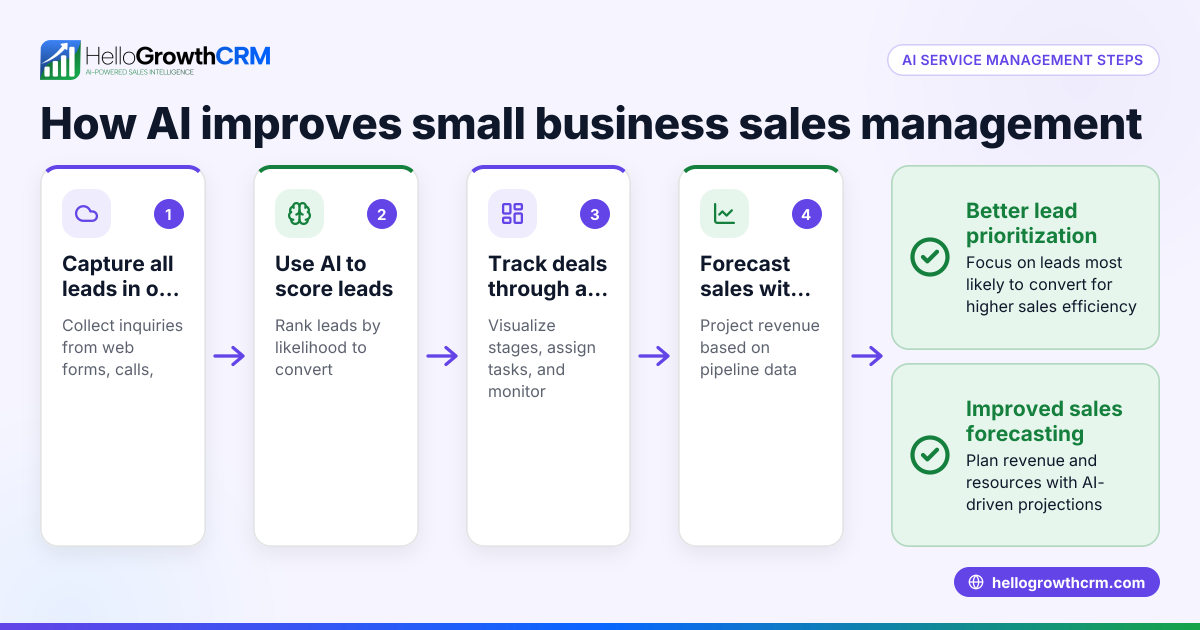
HelloGrowthCRM is relevant here because it combines lead capture and AI lead scoring with a pipeline layer, workflow rules and AI agents that can draft follow-ups, update records and execute workflow steps inside the CRM. For a Canadian home services company, the value is not abstract intelligence; it is the ability to qualify inbound demand, route it to the right person and keep the interaction history tied to the record so office staff can see what happened before the next call or message.
Agentic automation should reduce office work, not bury it in hidden actions
There is a difference between useful autonomy and background activity that no one can audit. In home services, the good version is narrow and concrete: when a new inquiry arrives, the CRM creates a record, applies qualification rules, assigns a territory, drafts a first reply, sets a follow-up task and moves the opportunity when the customer books. The bad version is an AI layer that edits records and sends messages in ways your staff cannot trace.
That distinction matters in Canada because customer communication, privacy handling and payment follow-up all generate evidence questions later. If a customer disputes whether they approved an estimate, or asks why they received a promotion after opting out, your office needs a clear timeline. The CRM should preserve notes, tasks, messages and stage movements on the same record. This is where tools such as task boards and activity history matter more than flashy summaries: they give dispatch, sales and admin one operating view of the job.
The same goes for calling. Many Canadian service businesses still close work by phone. A built-in dialer is useful if it logs call outcomes back to the record and keeps the call history visible to the team member handling the next touch. If it merely places calls without improving the record, it does little for office discipline.
A short Canadian decision test with realistic invented numbers
The arithmetic below is illustrative; the figures are made up to show the shape of the decision.
Imagine a small HVAC contractor serving Calgary and nearby communities. In a typical month, the office handles about C$42,000 in quoted work, collects C$6,000 in booking deposits and receives around C$9,500 through Interac e-Transfer for completed jobs. Staff estimate they spend C$1,800 worth of office time chasing unanswered quotes, reconciling payments and fixing bookings that were entered without enough detail.
Now compare two CRM setups. In the first, leads from Google Business Profile and referrals enter a shared inbox with no structured source field, deposit payments are noted manually, and the AI tool drafts replies but does not update the record. In the second, inquiries enter the pipeline with source and service type captured, deposit requests are tied to the deal, an AI agent drafts follow-ups and updates the record after staff approval, and tasks are triggered when a quote sits untouched.
If the second setup cuts even part of that C$1,800 in office effort and helps the team recover one C$3,200 install that would otherwise have gone cold, it can justify itself quickly. But that arithmetic leaves out several things: implementation time, staff training, the cost of cleaning existing data, and the risk of automating weak templates or weak consent records. Those omissions matter. A CRM is not cheaper because the subscription is low; it is cheaper when the office can actually operate from it.
If you are testing options, it is sensible to start with a controlled rollout on a free CRM plan or a narrow team process before you let automation touch the full job lifecycle.
Choose the system that fits Canadian field reality: province-sensitive records, consent evidence, bilingual communication where needed, stable scheduling across time zones and payment capture that reflects how customers in Canada actually pay. That is the kind of CRM an AI agent can improve rather than complicate.
Ready to put this into practice?
Set up your pipeline, WhatsApp follow-ups, and AI lead scoring in minutes — free, no credit card.
Try HelloGrowthCRM freeGet CRM tips in your inbox
Join thousands of sales professionals who get weekly insights on CRM strategy, AI automation, and pipeline optimization.

The HelloGrowthCRM team publishes guides on CRM strategy, AI sales tools, and revenue operations for small business sales teams.