HelloGrowthCRM software
Built for real small-business sales teams
HelloGrowthCRM helps reps qualify faster, follow up on time, and close more deals—with practical automation in one place.
- AI lead scoring and pipeline visibility
- Built-in dialer, WhatsApp, and email automation
- Sales forecasting and RevOps-ready reporting
Agriculture lead generation means finding and capturing potential customers interested in your agricultural products or services, such as seeds, fertilisers, or grain trading. To generate leads, use multiple channels like online marketplaces, WhatsApp, and local contacts, then organise and follow up quickly to convert them. This article covers why agriculture lead generation is challenging, step-by-step methods to improve it, common pitfalls, a practical example, and how HelloGrowthCRM can help streamline your sales process.
Why this comes up / what goes wrong
Agriculture business owners and accountants often face difficulties in lead generation because their sales processes are informal and spread across WhatsApp, phone calls, and notebooks. For example, a seed and fertiliser dealer in Guntur might get inquiries from multiple sources but lose track of follow-ups, causing missed sales. Similarly, a commission agent at a grain mandi in Ludhiana may struggle to prioritise leads or assign them to sales staff efficiently. The lack of a system to capture, score, and route leads results in slow responses and lost opportunities.
Step-by-step
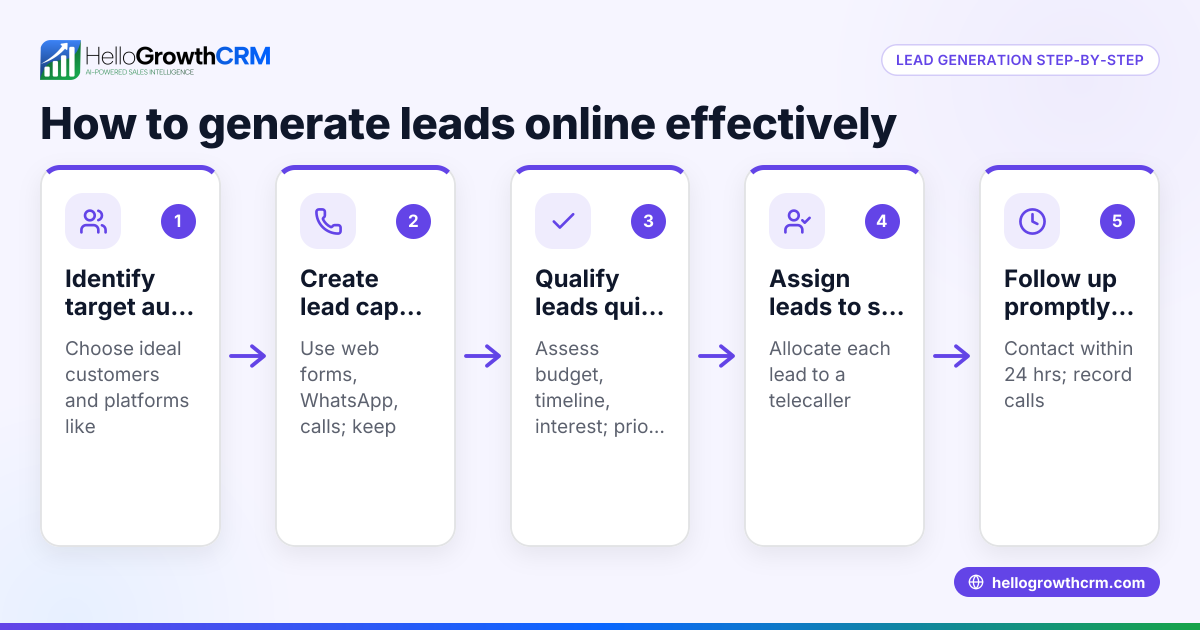
- Identify your lead sources: List where your potential customers come from — online marketplaces like IndiaMART, JustDial, WhatsApp groups, local fairs, or referrals. Check which sources bring the most inquiries.
- Capture leads systematically: Use a tool or method to record every inquiry immediately, whether from a phone call, WhatsApp message, or web form. Avoid notebooks or unorganised spreadsheets.
- Assign leads to owners: Decide who in your team handles each lead. Assign leads based on territory, product expertise, or workload to ensure quick follow-up.
- Set a next step for every lead: Define what action to take next, such as a call, product demo, or site visit. Schedule this follow-up promptly.
- Score leads by likelihood to convert: Prioritise leads that show higher interest or match your ideal customer profile so your telecalling team calls them first.
- Follow up with sequences: Use WhatsApp, SMS, or email sequences to nurture leads who are not ready to buy immediately.
- Track pipeline stages and outcomes: Monitor leads as they move from enquiry to negotiation and closure. Analyse data regularly to improve your lead generation and sales process.
- Review and improve lead sources and process: Periodically check which channels bring quality leads and refine your approach accordingly.
Example (fictional figures)
A commission agent at a grain mandi in Ludhiana receives 50 enquiries in March 2024. He wants to prioritise calls to leads likely to convert into sales of wheat and rice.
- Total enquiries: 50
- Estimated conversion rate without prioritisation: 20% (10 sales)
- Average sale value per customer: ₹1,20,000
Using AI lead scoring, he identifies 15 leads with high buying intent.
- Calls made to high-score leads: 15
- Conversion rate for high-score leads: 40% (6 sales)
- Calls made to remaining leads: 35
- Conversion rate for remaining leads: 11.4% (4 sales)
Calculations:
- Sales from high-score leads = 6 × ₹1,20,000 = ₹7,20,000
- Sales from remaining leads = 4 × ₹1,20,000 = ₹4,80,000
- Total sales = ₹7,20,000 + ₹4,80,000 = ₹12,00,000
By prioritising calls using lead scoring, he increases sales value from ₹12,00,000 with better focus and efficient use of time.
Common mistakes
- Relying on informal tracking: Using notebooks or WhatsApp chats without a system leads to lost or forgotten leads. Prevent this by capturing every lead in a central place.
- Ignoring lead prioritisation: Calling leads randomly wastes time. Use lead scoring to focus on high-potential enquiries first.
- Delayed follow-up: Leads lose interest if not contacted quickly. Set tasks and reminders for immediate follow-up.
- No clear ownership: Leads without an assigned owner often fall through the cracks. Assign leads clearly to team members.
- Not reviewing lead sources: Continuing with poor-quality lead sources wastes effort and costs. Regularly analyse and adjust your lead generation channels.
- Failing to nurture cold leads: Some leads need multiple contacts before buying. Use automated sequences to stay in touch without manual effort.
Doing this in HelloGrowthCRM
HelloGrowthCRM helps agriculture businesses by capturing every enquiry from forms, calls, or WhatsApp messages as leads with a designated owner and next step, avoiding lost leads in notebooks. Its AI lead scoring helps telecallers focus on leads most likely to convert first. Automated workflows and lead routing assign new IndiaMART enquiries round-robin and create first-call tasks automatically, ensuring no lead is missed or delayed. Learn more about AI lead scoring and how HelloGrowthCRM supports agricultural trading and agri businesses in India on the HelloGrowthCRM for India page.
Frequently asked questions
How can I generate more leads for my agriculture business? Use multiple channels such as online marketplaces like IndiaMART, WhatsApp groups, local fairs, and referrals. Capture every enquiry systematically and follow up quickly. Also, review which sources bring quality leads and focus your efforts there.
What is AI lead scoring and how does it help agriculture sales? AI lead scoring ranks leads based on their likelihood to convert, so sales teams call the most promising leads first. This saves time and improves conversion rates by focusing efforts where they matter most.
How do I assign leads to my sales team effectively? Assign leads based on territory, product knowledge, or workload to ensure quick and efficient follow-up. Automated lead routing tools can help distribute leads fairly and create follow-up tasks automatically.
Why is quick follow-up important in agriculture lead generation? Leads in agriculture often have urgent needs tied to seasons and crop cycles. Delayed responses can mean lost sales as customers move to competitors. Setting reminders and tasks ensures timely contact.
Can WhatsApp be used for agriculture lead generation? Yes, WhatsApp is widely used in Indian agriculture for enquiries and communication. Organising WhatsApp leads into a CRM system prevents them from getting lost and enables follow-up sequences.
Key takeaways
- Capture every agriculture enquiry from all sources systematically.
- Assign leads clearly to team members with defined next steps.
- Use AI lead scoring to prioritise calls and improve conversion.
- Follow up quickly and use sequences to nurture leads.
- Regularly review lead sources and sales data to optimise efforts.
- Automate lead routing and task creation to avoid missed opportunities.
Start managing your agriculture leads efficiently with HelloGrowthCRM. Start on the Free Forever plan (200 leads, no credit card).
Ready to put this into practice?
Set up your pipeline, WhatsApp follow-ups, and AI lead scoring in minutes — free, no credit card.
Try HelloGrowthCRM freeGet CRM tips in your inbox
Join thousands of sales professionals who get weekly insights on CRM strategy, AI automation, and pipeline optimization.

The HelloGrowthCRM team publishes guides on CRM strategy, AI sales tools, and revenue operations for small business sales teams.