HelloGrowthCRM software
Built for real small-business sales teams
HelloGrowthCRM helps reps qualify faster, follow up on time, and close more deals—with practical automation in one place.
- AI lead scoring and pipeline visibility
- Built-in dialer, WhatsApp, and email automation
- Sales forecasting and RevOps-ready reporting
In Singapore, the right AI CRM is the one that matches PDPA consent rules, GST timing, PayNow-heavy payment habits and the way local customers actually enquire and book.
That matters because many CRM buying guides stay at the level of features: pipeline, automation, reports, maybe AI scoring. A Singapore business needs a narrower test. If an enquiry form collects the wrong personal data, if staff cannot tell marketing WhatsApp from transactional WhatsApp, or if a PayNow payment sits outside the customer record until someone notices, the software is not helping the business run cleanly.
So instead of asking which AI CRM has the longest feature list, ask whether it can support the operating reality of Singapore: English-first but sometimes multilingual customer communication, a single local time zone with some ASEAN spillover, moving public holiday dates, strong use of WhatsApp, and payments that often arrive outside card rails. If you serve a regulated sector such as a dental or aesthetic practice, the fit test gets tighter again because Ministry of Health rules and professional guidance affect how you can communicate and advertise.
This guide focuses on those local constraints so you can choose a system that works in day-to-day use, not just in a demo.
PDPA and Do Not Call rules should shape your data fields from day one
For a Singapore business, AI in a CRM starts with data quality, and data quality starts with lawful collection. The governing law is the Personal Data Protection Act, with the Personal Data Protection Commission as regulator. If your CRM captures enquiries from web forms, landing pages, WhatsApp or imported lists, you need fields that distinguish consent, message purpose and source of the number or email address. Without that structure, AI-generated follow-ups can easily become non-compliant follow-ups.
Singapore’s Do Not Call provisions are especially relevant for teams that sell by SMS or phone. The duty to check the relevant Do Not Call Registry before sending specified messages to Singapore numbers sits with the sender, not the software vendor. That means your internal process matters more than any vendor promise. Your CRM should let staff record whether a contact gave clear and unambiguous consent, whether a message is transactional rather than promotional, and who verified the basis for contact.
One local trap is the casual collection of NRIC numbers on enquiry or booking forms. PDPC guidance restricts collection of NRIC numbers, so asking for one by default for a consultation, site visit or callback creates risk without much operational benefit. If your current forms collect it “just in case,” that is a sign the CRM project should start with field design, not automation.
For businesses in regulated health services, add another layer. A dental practice in Novena or an aesthetic clinic in Orchard may have legitimate reasons to communicate with patients, but those communications still sit inside both PDPA and sector-specific rules from the Ministry of Health and relevant professional boards. An AI CRM can draft follow-ups; it cannot decide whether the message content is permissible.
PayNow, FAST and bank transfers can break your revenue picture if the CRM only sees cards
Singapore businesses often get paid through PayNow, FAST, GIRO, NETS, credit card and ordinary bank transfer. That mix is practical for customers, but it causes a CRM problem: non-card payments do not automatically appear in a card processor dashboard. If your team relies on one payment feed, the pipeline can show an invoice as unpaid even after the customer has transferred the money.
This is more than an admin annoyance. It affects sales forecasting, chasing logic and the handoff from sales to operations. An air-conditioning service firm in Jurong might send a quote, receive a PayNow deposit, and schedule a crew. If the deposit is not tied back to the deal record promptly, the scheduler may hold the slot for too long or chase a customer who has already paid.
Singapore tax treatment makes this linkage more important. GST is administered by IRAS, and for taxable supplies a payment received can trigger the tax point at the earlier of invoice or payment, so a deposit counts when it arrives. Do not rely on memory for the current rules, scope or edge cases; check IRAS guidance on GST and, where needed, get advice on your facts. The practical CRM takeaway is simple: payment received date, payment method and invoice linkage should be first-class fields, not a note buried in free text.
If you compare systems, test whether staff can reconcile PayNow and bank transfer receipts against the right customer and deal without awkward workarounds. If the payment journey in your demo assumes everyone pays by card, you are testing the wrong thing for Singapore.
GST timing affects deposit workflows, not just finance settings
Many CRM buyers treat tax as something for the accounting team later. In Singapore, that is a mistake when the sales process includes deposits, staged billing or advance booking. GST registration and reporting are matters for IRAS, with the current registration rules and filing requirements published by IRAS. The exact current numbers belong there, not in a blog article, and any business near the registration line should confirm its position carefully.
The operational issue is timing. A tuition centre in Tampines may collect a reservation fee before term starts. A clinic may take a booking deposit before a procedure. A B2B logistics broker near Changi may invoice part of a project upfront. In each case, the CRM should record when money was received, what it related to, and whether the commercial document issued to the customer reflects the same reality.
The arithmetic below is illustrative; the figures are made up to show the shape of the decision. Suppose a service business sends a quote for S$12,500, takes a booking deposit of S$2,500 by PayNow on Monday, then issues the formal invoice for the balance later in the week. If the team only updates the invoice after finance catches up, sales may think the whole S$12,500 is still open, operations may delay preparation, and finance may have to reconstruct when the deposit landed and what supply it related to. A cleaner setup records the S$2,500 against the deal as soon as the money arrives, links it to the commercial document, and leaves a visible remaining balance of S$10,000. This leaves out partial exemptions, bad debt treatment, credit notes and industry-specific complications, which is why the tax treatment itself should be checked against IRAS materials and professional advice.
When you review an AI CRM, look beyond whether it can produce a quote or invoice. The real question is whether deposits, part-payments and payment dates remain visible to sales, operations and finance in one record.
Singapore lead sources are predictable enough to model properly
Lead capture in Singapore is not random. For many small and mid-sized businesses, enquiries come in recurring local patterns: Google Business Profile for high-intent local search, WhatsApp for quick contact, Instagram and Facebook for consumer-facing discovery, LinkedIn for B2B outreach, Carousell for certain price-sensitive or home-service categories, GeBIZ for public sector opportunities, plus referrals that still carry a lot of weight.
If your CRM source field only says “web,” its AI will learn very little. Source design should reflect how Singapore buyers actually arrive. A dental practice may want to separate Google Business Profile from Instagram because intent differs. A service contractor may need Carousell split from referrals because the follow-up speed and close approach are different. A logistics broker pursuing government-related work should not bury GeBIZ under a generic source label because tender timelines and documentation differ from ordinary inbound sales.
Singapore also has clear geographic patterns. CBD prospects often prefer tighter scheduling around office hours, while heartland customers may book after work or during weekends. For field teams, location is not just an address; it affects route planning, travel buffers and who should own the lead.
A good AI CRM can only score or route leads based on the fields you give it. That is why AI lead scoring matters less than source hygiene at setup. If you feed the model “website” and “phone call,” you get broad guesses. If you feed it “Google Business Profile call,” “WhatsApp from IG ad,” “Carousell message,” “GeBIZ tender” and “referral from existing customer,” you get something a sales manager can actually use.
Booking logic in Singapore depends on moving holidays and sharp time-slot demand
Singapore has one time zone, which simplifies domestic scheduling, but local calendar behaviour is more complex than many off-the-shelf booking flows assume. Public holidays span several communities, and some are tied to lunar or Islamic calendars, so dates move from year to year. A booking page that is technically functional can still be operationally clumsy if it ignores those shifts.
Time-slot demand is also uneven. Lunch-hour consultations and post-work appointments often carry demand that mid-morning does not. That matters for clinics, tuition centres and B2B demo teams serving office workers. If your CRM scheduler spreads capacity evenly without reflecting actual preference, the AI layer may optimise around the wrong baseline.
Regional business adds one more wrinkle. A company based in Singapore may still sell to clients in Malaysia, Indonesia, Thailand or the Philippines. The home team sits in one time zone, but customer calendars do not. So the CRM should store both local operating windows and customer time context for outbound sequences and bookings.
This is one place where automation should stay modest. Use booking tools to reduce back-and-forth, but keep local exclusions and buffer rules explicit. For businesses that depend on quick appointment conversion, meeting scheduling and booking is only useful when it reflects Singapore’s real peaks, closures and travel assumptions.
English is the working language, but customer-facing messages often should not be monolingual
Most Singapore businesses run internally in English, yet customer-facing communication often works better when it reflects the audience segment. Mandarin or Malay copy can matter depending on neighbourhood, age profile and service type. For a heartland tuition centre, parent communication may land better in a different language from the one used in staff notes and pipeline stages. For home services, concise multilingual confirmations can reduce no-shows and callback friction.
This has implications for AI-generated outreach. If the CRM drafts follow-ups, templates and sequences need language rules attached to the record. Otherwise the system defaults to whatever the team used last, which may be efficient for staff but not clear for customers. Language preference therefore belongs in the contact record alongside channel preference.
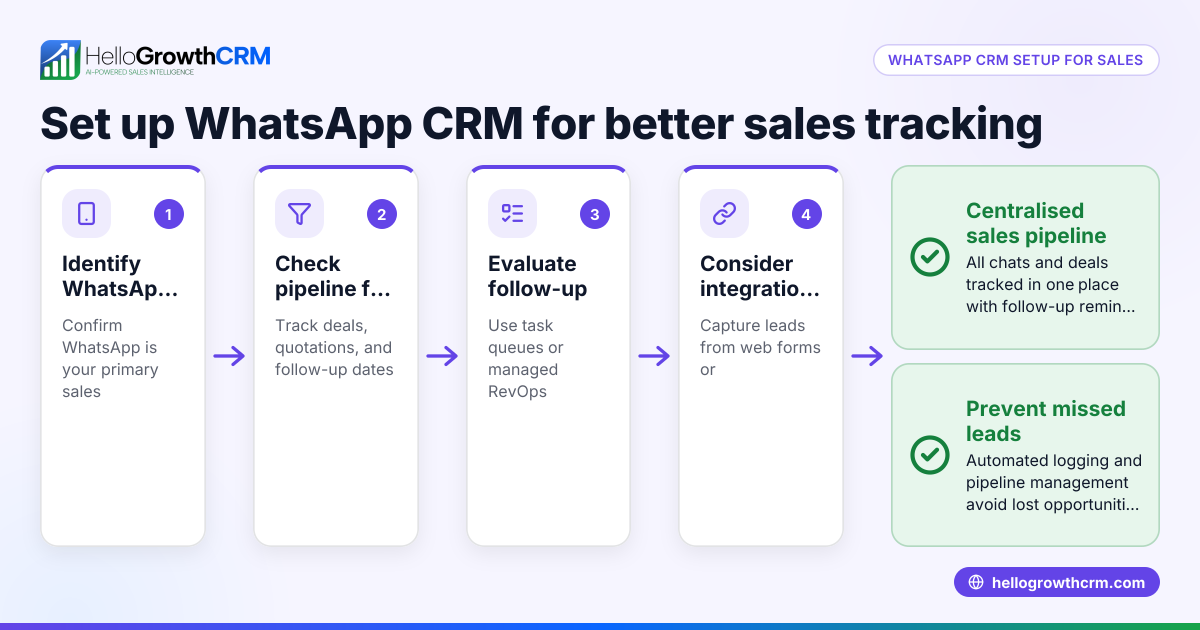
WhatsApp is especially important in Singapore because many customers treat it as the fastest legitimate business channel. That does not erase the distinction between service messages and marketing messages under PDPA. It means your team needs message templates and approval logic that reflect both the channel and the legal basis for contact. If your sales process relies on messaging, WhatsApp and SMS workflows are relevant only if your team has already decided who can send what, to whom, and on what basis.
Corppass, SingPass and ACRA data change what “good company records” look like
In Singapore, business administration has its own identity layer. Corppass and SingPass are how businesses and individuals authenticate with government services, and company records are commonly checked against ACRA information. Even if your CRM does not connect directly to those systems, your staff will often validate customer or vendor details against official records during onboarding, procurement or credit review.
That affects B2B CRM design. A contact is not enough; you often need a clean account record with legal entity name, UEN where appropriate, billing contact, operating contact and any procurement constraints. For companies selling into larger local organisations or public sector opportunities, the commercial process is slower and document-driven. The CRM should separate the person who replied on LinkedIn from the entity that will actually sign and pay.
This is also where AI agents and workflows need boundaries. Auto-created company records are useful only if they do not multiply near-duplicates that later confuse finance and account management. If you are evaluating an AI CRM, test the boring parts: duplicate prevention, validation rules, and whether tasks and notes stay attached to the right account and deal across handoffs.
Ask vendors about operational fit, not abstract AI claims
A demo goes better when you pressure-test the system against Singapore-specific work. One tight checklist is enough:
- Can we store consent basis, message purpose and Do Not Call checks in the contact record?
- Can staff reconcile PayNow, FAST and bank transfer receipts to the right deal without relying on a card dashboard?
- Can booking rules reflect local public holidays, lunch-hour demand and post-work demand?
- Can source capture distinguish Google Business Profile, WhatsApp, Carousell, GeBIZ, referrals and paid social?
- Can account records hold the company details our team checks against ACRA or procurement paperwork?
- Can multilingual templates, tasks and follow-up histories stay in one place for the whole team?
If a vendor answers these with vague references to automation or “smart” workflows, keep pushing. In Singapore, the boring operational edges decide whether AI helps or creates rework.
Where HelloGrowthCRM can help a Singapore team
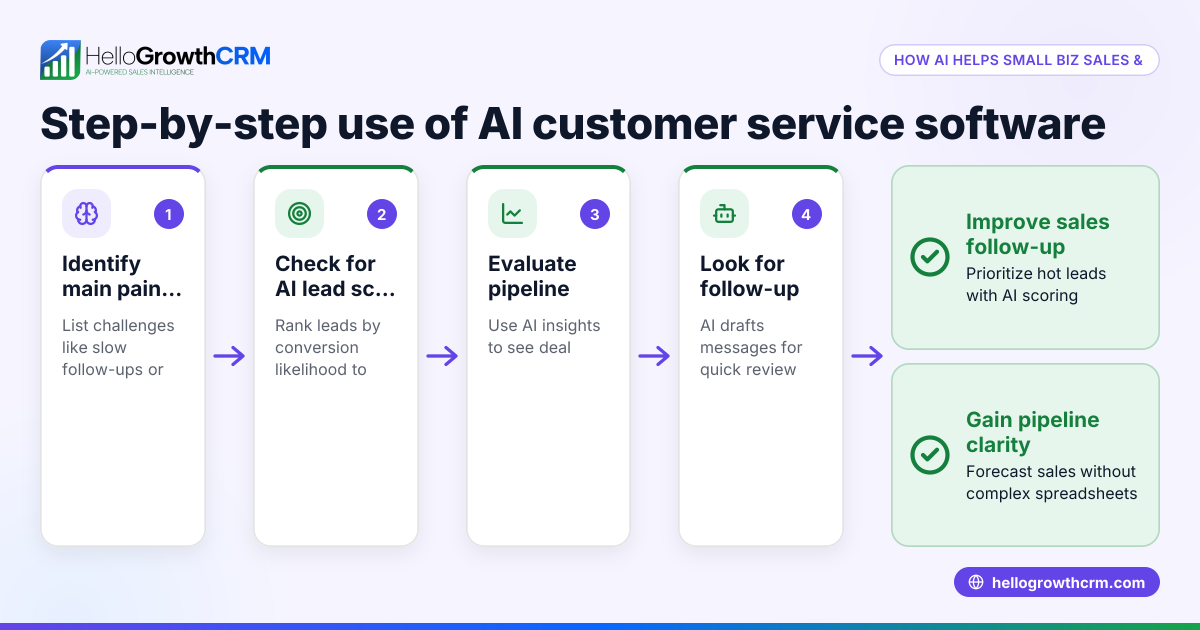
For a Singapore business, the useful parts of HelloGrowthCRM are the ones that support disciplined process rather than magic claims. Its lead capture and AI lead scoring can help teams organise enquiries from local channels into a workable pipeline. Its pipeline layer tracks open opportunities from first contact through close. Activities, calls, meetings and notes stay tied to the customer record through task boards and activity logging, which matters when handoffs happen between sales, ops and finance. If your process depends on quick booking, messaging or follow-up, the scheduling, WhatsApp, SMS and sequence features are the areas to test against your own Singapore workflow. For buyers concerned about handling customer data, the company also publishes its security posture at its security page.
The best AI CRM for Singapore is not the one with the boldest automation language; it is the one you can configure around PDPA, local payment behaviour, GST timing and the channels your customers already use.
Ready to put this into practice?
Set up your pipeline, WhatsApp follow-ups, and AI lead scoring in minutes — free, no credit card.
Try HelloGrowthCRM freeGet CRM tips in your inbox
Join thousands of sales professionals who get weekly insights on CRM strategy, AI automation, and pipeline optimization.

The HelloGrowthCRM team publishes guides on CRM strategy, AI sales tools, and revenue operations for small business sales teams.